
Share your experience of AI tools
Tell us whether you use AI tools, what for, and how much you trust them. Your answers are combined with other people's and reported only as totals.
Start the artificial intelligence in daily life surveyAbout 5 minutes. No account needed. You can stop at any time.
What this topic covers
Artificial intelligence (AI) is a broad term for computer systems that do tasks people usually associate with human thinking, such as recognizing speech, translating language, spotting patterns or writing text. AI has been part of daily life for years in less visible ways: spam filters, map directions, photo sorting, fraud alerts on bank cards and recommendations on streaming services.
This topic focuses on the tools people choose to use directly:
- Chatbots and AI assistants that answer questions and hold a conversation in plain language.
- Writing and editing tools that draft emails, essays or reports, or fix grammar.
- Image and audio tools that create or edit pictures, voices or music from a text description.
- AI features built into everyday apps, such as search summaries, email suggestions, meeting notes and photo editing.
It also covers what people think about AI more broadly: trust, fairness, jobs and rules.
How the tools work, in plain terms
Most current chatbots are built on large language models. These are trained on very large amounts of text so that they can predict which words are likely to come next. The result can read as fluent and confident. It does not mean the tool checks facts the way a person consulting a reliable source would.
That is why these tools can produce answers that sound right but are wrong, sometimes called hallucinations. They can invent a reference, mix up dates, or give an outdated answer. Many tools now search the web or cite sources, which helps, but the sources still need checking.
AI tools also differ in what they remember. Some keep a history of past conversations and use it to shape later answers, while others start fresh each time. Some companies use the conversations people have with their tools to improve future versions, and many let users turn this off in the settings.
How people use AI tools
Uses reported by people tend to fall into a few groups:
- Information: asking a question instead of searching, or getting a summary of a long document.
- Writing help: drafting a message, rewording a letter, or checking grammar.
- Learning: explaining a hard idea in simpler terms, or practising a language.
- Work tasks: drafting reports, summarizing meetings, writing code or analysing a spreadsheet.
- Planning: meal plans, travel itineraries, workout schedules or budgets.
- Creative play: stories, images and jokes.
Example
A newcomer to Canada uses a chatbot to explain a letter from a government office written in formal English. The tool gives a clear summary. Because the letter mentions a deadline, they also call the office to confirm the date before acting on it.
Example
A small business owner uses an AI writing tool to draft replies to customer emails. It saves time on routine questions, but they stop using it for complaints after it produced a reply that promised a refund their policy does not offer.
Trust: what people rely on AI for
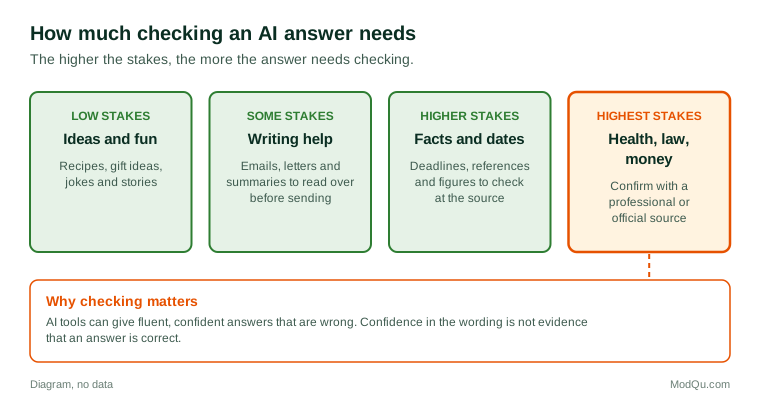
People do not trust AI tools equally for every task. Many are comfortable using them for low-stakes tasks, such as a recipe idea or a birthday message, and much less comfortable for health, legal or money decisions. Trust also depends on experience: people who have caught a tool making a mistake often become more careful.
Ways people check AI answers include:
- asking the same question in a different way;
- looking for the original source;
- comparing with a trusted website, book or professional;
- asking someone who knows the subject.
Example
A parent asks a chatbot whether a child's rash needs a doctor. The answer lists several possible causes and suggests seeing a health professional. The parent calls their provincial health line, where a nurse gives advice based on the child's symptoms.
AI at school and work
Schools, colleges and universities have had to decide how students may use AI. Some ban it for assignments, some allow it with disclosure, and many have different rules by course. Students and teachers often disagree about where help ends and cheating begins.
At work, some employers provide approved AI tools and others ban public tools because of concerns about confidential information. Employees sometimes use AI tools without telling their employer. People also hold different views about how AI will affect jobs: some expect it to remove routine tasks and make work easier, others worry about job losses or lower pay in their field.
Concerns people raise
Common concerns about AI in daily life include:
- Accuracy: confident answers that are wrong.
- Privacy: what happens to the questions and documents people type in.
- Bias: tools that treat some groups unfairly because of the data they were trained on.
- Fake content: realistic images, audio or video of real people, used to mislead or to defraud.
- Scams: voice cloning used in calls that pretend to be a family member in trouble.
- Effects on learning: whether relying on AI weakens skills such as writing and problem-solving.
- Copyright: whether the work of writers and artists was used fairly to train the tools.
Example
An older adult gets a call from someone who sounds like their grandson, saying he needs money urgently. The voice is convincing. They hang up and call their grandson's own number, and he answers from home. The call was a scam that may have used a cloned voice.
Rules and what people disagree about
Governments are working out how to regulate AI. The European Union has passed a broad AI law, and Canada and the United States have debated and issued rules, guidance and voluntary codes. Questions under debate include who is responsible when an AI system causes harm, whether AI-generated content should be labelled, and how personal data used by AI should be protected.
People also disagree about how fast AI should develop, whether it will do more good than harm, and whether they want it built into the apps they already use. These are the kinds of attitudes that change quickly, which is why surveys that repeat the same questions over time are useful.
Key terms
- Artificial intelligenceComputer systems that do tasks usually linked with human thinking.
- ChatbotA program that holds a conversation in plain language.
- Large language modelAn AI system trained on large amounts of text to produce language.
- PromptThe question or instruction a person types into an AI tool.
- HallucinationAn AI answer that sounds right but is false or invented.
- DeepfakeRealistic fake video, image or audio of a real person.
- Voice cloningUsing AI to copy a person's voice from a recording.
- Training dataThe information an AI system learned from.
Full glossary: artificial intelligence terms on EditingTests.com.
Artificial intelligence in daily life vocabulary test
How well do you know the language of this topic? Try 8 quick questions. Your score is shown straight away and is not saved.
What the artificial intelligence in daily life survey asks
This survey is part of ModQu's Technology at Home survey. The artificial intelligence in daily life part takes about five minutes and covers:
- Whether you have used an AI chatbot or assistant in the last month, and how often.
- What you used it for: information, writing, learning, work, planning or fun.
- How much you trust answers from AI tools for different kinds of tasks.
- How you check AI answers, if you do.
- Your concerns about AI, including privacy, accuracy, scams and jobs.
- How you expect AI to affect your work and daily life.
After that you can choose to continue with other short parts of the Technology at Home survey, such as smartphones and mobile apps or internet and mobile plans, or stop.
Ready to take part?
Your answers help show what people really think and do. Results are only ever reported as totals; no one can see your individual answers.
Start the surveyQuestions about this survey
Who can take part?
Adults.
Do I have to give my name?
No. You may be asked for your age group, region and similar details so results can be broken down, but not your name. ModQu never asks for passwords, card numbers or account numbers.
How are the results used?
Answers are combined into totals and percentages and published in ModQu reports. Individual answers are never shown.
Is the vocabulary test part of the survey?
No. It is optional and separate, and your score is not stored.
Do I need to have used AI tools to take part?
No. People who have never used them are asked about their views and reasons too.