
Inquiry · Ethics and limits
Inquiry and Misinformation: Building Resistance Through Questions
The best defence against misinformation is the habit of asking good questions. This article reviews research on how questioning builds resistance to false claims, from psychological inoculation and lateral reading to accuracy prompts and explanation, and offers a practical set of questions for testing any claim.
Most efforts against misinformation try to correct false claims after they have spread. Corrections help, but they are slow, they rarely reach everyone who saw the original claim, and false beliefs often persist after correction. A complementary approach is to strengthen people's ability to evaluate claims for themselves before they believe or share them. At the heart of this approach is inquiry: the habit of asking questions of a claim rather than simply accepting or rejecting it. Research over the past six decades shows that such habits can be taught, and that even small prompts to ask questions make a measurable difference.
Why correction is not enough
Ullrich Ecker and colleagues (2022) reviewed research on why people believe misinformation and why it resists correction. Belief is driven by familiarity, the apparent fluency of a claim, the credibility of its source and its fit with existing beliefs and identities. Once established, false beliefs continue to influence reasoning even after people accept a correction. Nathan Walter and Sheila Murphy (2018) analysed many experiments on correcting misinformation and found that corrections do reduce belief in false claims on average, but often only partly, and less effectively for claims that are tied to people's political views or that have been held for a long time.
Corrections can also have side effects. Pennycook et al. (2020) found that attaching warning labels to some false headlines led people to rate unlabelled false headlines as more accurate, apparently assuming that anything without a warning had been checked. The researchers called this the implied truth effect. Correction systems that cannot check everything may give false confidence in what they miss.
Inoculation: questioning in advance
In the 1960s, the social psychologist William McGuire proposed that people could be made resistant to persuasion in the same way that vaccines make them resistant to disease: by exposure to a weakened form of the attack together with a refutation. McGuire and Papageorgis (1961) found that people who had read arguments against a widely held belief, together with refutations of those arguments, resisted later attacks on the belief more effectively than people who had read only supportive arguments. McGuire (1964) developed this into inoculation theory.
Recent research has applied inoculation to misinformation. In one study, van der Linden et al. (2017) found that warning people that politically motivated groups were using misleading tactics to cast doubt on the scientific consensus on climate change, and explaining one such tactic, protected much of the effect of the scientific consensus message from a later misinformation attack. Cook et al. (2017) found that explaining a misleading argumentative technique, such as presenting a small number of dissenting experts as if they represented a genuine scientific debate, reduced the influence of misinformation that used that technique.
Inoculation can also target techniques rather than specific claims. Jon Roozenbeek and Sander van der Linden (2019) developed an online game in which players take the role of a creator of fake news and learn common manipulation techniques, such as impersonation, emotional language and polarisation. Players became better at recognising misleading headlines. Roozenbeek et al. (2022) showed short videos explaining manipulation techniques to large samples, including as advertisements on a major video platform, and found that viewers became better at recognising those techniques in new content. Lewandowsky and van der Linden (2021) reviewed this research and concluded that prebunking, inoculation before exposure, is a promising complement to correction after it.
Lateral reading: questioning the source
Sam Wineburg and Sarah McGrew (2019) asked professional fact-checkers, historians and university students to evaluate unfamiliar websites. The fact-checkers outperformed both other groups, not because they read more closely, but because they asked a different question. Instead of asking "Does this page look credible?", they asked "What do other sources say about this source?" They left the page almost at once and searched for information about the organisation behind it, a strategy called lateral reading. Michael Caulfield (2017) developed practical guidance for students based on this approach, encouraging them to check for previous work by fact-checkers, go upstream to the original source of a claim and read laterally about unfamiliar sources.
Andrew Guess and colleagues (2020) tested a short set of tips for spotting false news, based on similar principles, in the United States and India. In the United States, reading the tips improved people's ability to distinguish mainstream from false news headlines, with effects that were still detectable weeks later. Effects in India were found in a highly educated online sample but not in a rural sample, showing that such interventions need to be adapted to their audiences.
Accuracy prompts: asking whether it is true
Sometimes the most effective question is the simplest. Bago et al. (2020) found that when people were given time to reconsider their initial judgments of headlines, they became less likely to believe false headlines, while belief in true headlines was unaffected. Pennycook et al. (2021) found that people were often willing to share headlines they could, if asked, recognise as false, because their attention was on other things, such as whether a headline was interesting. Asking people to rate the accuracy of a single unrelated headline before they chose what to share improved the quality of the news they shared. A brief prompt to ask "is this true?" redirected attention to accuracy. The finding suggests that many people who share false claims are not unable to judge accuracy, but simply not thinking about it at the moment of sharing, and that a small reminder at the right time can change what they do.
Explanation: asking how it works
Another powerful question is "how exactly does that work?" Leonid Rozenblit and Frank Keil (2002) found that people believed they understood everyday devices, such as zips and flush toilets, much better than they actually did. When asked to explain step by step how the devices worked, they discovered gaps in their understanding and lowered their ratings. They called this the illusion of explanatory depth. Fernbach et al. (2013) applied the same technique to political policies. People asked to explain in detail how a policy would work, rather than to give reasons for supporting it, became less confident in their understanding and expressed more moderate positions.
Considering alternatives
Charles Lord, Mark Lepper and Elizabeth Preston (1984) tested strategies for reducing biased evaluation of evidence. Simply instructing people to be fair and unbiased had little effect. Asking them to consider what they would have concluded if the same study had produced the opposite result was much more effective. Deanna Kuhn (1991) studied how people argue about everyday causal questions and found that many could not generate alternative explanations or say what evidence would show their own view to be wrong. These skills, she argued, are central to good thinking and can be developed through practice.
A set of questions for any claim
These findings point to a small set of questions that build resistance to misinformation, summarised in Figure 1. Many reflect long traditions of critical thinking. Richard Paul and Linda Elder (2006) described Socratic questioning, which probes the purpose, assumptions, evidence, implications and alternatives of any claim. Peter Facione (1990) reported an expert consensus that critical thinking involves interpretation, analysis, evaluation, inference, explanation and self-regulation, together with dispositions such as inquisitiveness and willingness to reconsider.
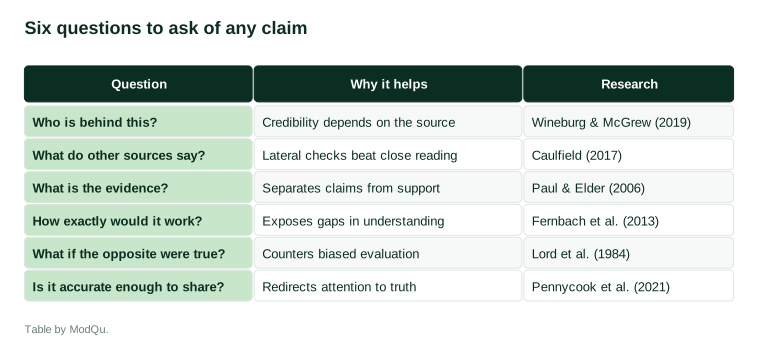
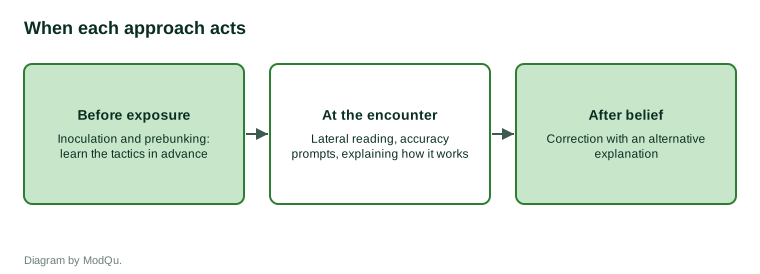
Figure 2 shows how the main approaches differ in timing: some act before exposure to a false claim, some at the moment of encounter and some afterwards.
Limits of the approach
Building resistance through questions is not a complete answer. It places responsibility on individuals, while much misinformation is spread by systems designed to maximise attention, and by a small number of highly active accounts. Questioning habits work alongside, not instead of, responsible design by platforms, publishers and organisations.
The effects of brief interventions also fade. Inoculation and media literacy effects are typically strongest soon after the intervention and weaken over weeks, so that repeated reminders or "booster" exposures may be needed. Effects also vary between audiences, as the contrast between urban and rural samples in the study by Guess et al. (2020) showed.
There is a further risk. Teaching people to doubt can make them doubt indiscriminately. Some interventions reduce belief in accurate news slightly as well as in false news. The goal is not more scepticism but better discrimination: greater confidence in claims that survive questioning and less in those that do not. Questions such as "what do other sources say?" and "how exactly would it work?" help with discrimination, because they can confirm a claim as easily as undermine it.
Teaching the habit
Questioning habits develop with practice. Kuhn (1991) found that the ability to generate alternative explanations and identify evidence that would count against one's own view varied widely among adults and was related more to education and practice than to general intelligence. The research reviewed here suggests a few principles for teaching it. Explain the techniques used to mislead, so that people can recognise them. Practise on real examples, including ones that turn out to be true. Make the questions short and memorable, so that they can be used in the few seconds people spend on most claims. And model the habit: leaders, teachers and colleagues who ask "how do we know?" without hostility make it normal for others to do so.
In organisations
The same questions protect organisations from acting on false or weak information. Market rumours, misleading statistics, overconfident vendor claims and internal assumptions repeated until they seem like facts all deserve questioning. Consider a hypothetical example. A company's leadership hears that a competitor is about to cut prices sharply, a claim passed on by several sales staff. Before responding, an analyst asks where the claim came from and finds that every report traces back to a single post on an online forum by an anonymous user. She asks what other sources say and finds no evidence in the competitor's announcements or among industry analysts. She asks what the company would expect to see if the claim were true, such as changes in the competitor's online prices or advertising, and finds none. The company holds its prices, and the rumoured price cut never happens. Afterwards, the sales team agrees to note the source of any market rumour when passing it on, so that claims can be traced quickly in future.
Conclusion
Misinformation cannot be eliminated, and correction alone will not keep pace with it. The research reviewed here shows that a more durable defence lies in habits of inquiry: anticipating manipulation, checking sources laterally, pausing to ask whether a claim is accurate, testing understanding by trying to explain it, and considering the opposite. These habits can be taught quickly and prompted easily. They turn each person who encounters a claim from a passive recipient into an active inquirer, and that, multiplied across a population or an organisation, is the strongest protection against false information.
References
Bago, B., Rand, D. G., & Pennycook, G. (2020). Fake news, fast and slow: Deliberation reduces belief in false (but not true) news headlines. Journal of Experimental Psychology: General, 149(8), 1608–1613. https://doi.org/10.1037/xge0000729
Caulfield, M. (2017). Web literacy for student fact-checkers. Pressbooks.
Cook, J., Lewandowsky, S., & Ecker, U. K. H. (2017). Neutralizing misinformation through inoculation: Exposing misleading argumentation techniques reduces their influence. PLoS ONE, 12(5), Article e0175799. https://doi.org/10.1371/journal.pone.0175799
Ecker, U. K. H., Lewandowsky, S., Cook, J., Schmid, P., Fazio, L. K., Brashier, N., Kendeou, P., Vraga, E. K., & Amazeen, M. A. (2022). The psychological drivers of misinformation belief and its resistance to correction. Nature Reviews Psychology, 1(1), 13–29. https://doi.org/10.1038/s44159-021-00006-y
Facione, P. A. (1990). Critical thinking: A statement of expert consensus for purposes of educational assessment and instruction. California Academic Press.
Fernbach, P. M., Rogers, T., Fox, C. R., & Sloman, S. A. (2013). Political extremism is supported by an illusion of understanding. Psychological Science, 24(6), 939–946. https://doi.org/10.1177/0956797612464058
Guess, A. M., Lerner, M., Lyons, B., Montgomery, J. M., Nyhan, B., Reifler, J., & Sircar, N. (2020). A digital media literacy intervention increases discernment between mainstream and false news in the United States and India. Proceedings of the National Academy of Sciences, 117(27), 15536–15545. https://doi.org/10.1073/pnas.1920498117
Kuhn, D. (1991). The skills of argument. Cambridge University Press.
Lewandowsky, S., & van der Linden, S. (2021). Countering misinformation and fake news through inoculation and prebunking. European Review of Social Psychology, 32(2), 348–384. https://doi.org/10.1080/10463283.2021.1876983
Lord, C. G., Lepper, M. R., & Preston, E. (1984). Considering the opposite: A corrective strategy for social judgment. Journal of Personality and Social Psychology, 47(6), 1231–1243. https://doi.org/10.1037/0022-3514.47.6.1231
McGuire, W. J. (1964). Inducing resistance to persuasion: Some contemporary approaches. Advances in Experimental Social Psychology, 1, 191–229. https://doi.org/10.1016/S0065-2601(08)60052-0
McGuire, W. J., & Papageorgis, D. (1961). The relative efficacy of various types of prior belief-defense in producing immunity against persuasion. Journal of Abnormal and Social Psychology, 62(2), 327–337. https://doi.org/10.1037/h0042026
Paul, R., & Elder, L. (2006). The art of Socratic questioning. Foundation for Critical Thinking.
Pennycook, G., Bear, A., Collins, E. T., & Rand, D. G. (2020). The implied truth effect: Attaching warnings to a subset of fake news headlines increases perceived accuracy of headlines without warnings. Management Science, 66(11), 4944–4957. https://doi.org/10.1287/mnsc.2019.3478
Pennycook, G., Epstein, Z., Mosleh, M., Arechar, A. A., Eckles, D., & Rand, D. G. (2021). Shifting attention to accuracy can reduce misinformation online. Nature, 592(7855), 590–595. https://doi.org/10.1038/s41586-021-03344-2
Roozenbeek, J., & van der Linden, S. (2019). Fake news game confers psychological resistance against online misinformation. Palgrave Communications, 5, Article 65. https://doi.org/10.1057/s41599-019-0279-9
Roozenbeek, J., van der Linden, S., Goldberg, B., Rathje, S., & Lewandowsky, S. (2022). Psychological inoculation improves resilience against misinformation on social media. Science Advances, 8(34), Article eabo6254. https://doi.org/10.1126/sciadv.abo6254
Rozenblit, L., & Keil, F. (2002). The misunderstood limits of folk science: An illusion of explanatory depth. Cognitive Science, 26(5), 521–562. https://doi.org/10.1207/s15516709cog2605_1
van der Linden, S., Leiserowitz, A., Rosenthal, S., & Maibach, E. (2017). Inoculating the public against misinformation about climate change. Global Challenges, 1(2), Article 1600008. https://doi.org/10.1002/gch2.201600008
Walter, N., & Murphy, S. T. (2018). How to unring the bell: A meta-analytic approach to correction of misinformation. Communication Monographs, 85(3), 423–441. https://doi.org/10.1080/03637751.2018.1467564
Wineburg, S., & McGrew, S. (2019). Lateral reading and the nature of expertise: Reading less and learning more when evaluating digital information. Teachers College Record, 121(11), 1–40.