
Inquiry · Ethics and limits
Barriers to Effective Inquiry and Strategies for Overcoming Them
Inquiry often fails not for lack of methods but because of barriers in the mind, the group and the organisation. This article maps the main barriers to effective inquiry, from confirmation bias and sunk costs to conformity, silence and information overload, and reviews the research on strategies that overcome them.
Most organisations have access to more data, tools and expertise than ever before, yet they still make decisions on untested assumptions, miss warning signs and repeat mistakes. The problem is rarely a lack of methods. It is that inquiry meets barriers: in how individuals think, in how groups interact, in how organisations are structured and in the sheer volume of information. Research in psychology and management has identified many of these barriers and tested ways of overcoming them. This article maps the main barriers and the strategies that work against them.
A map of barriers
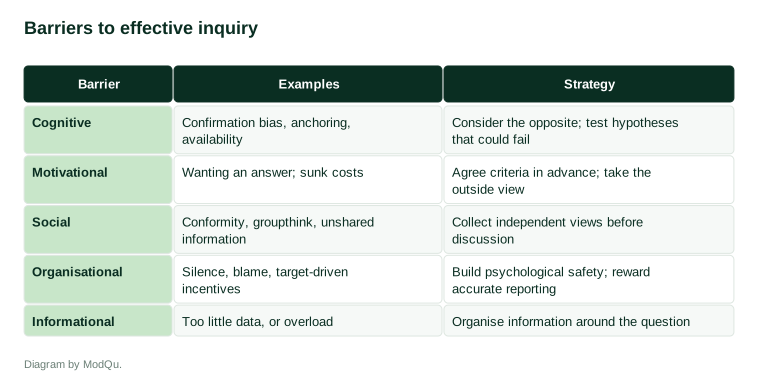
Figure 1 groups the barriers into five kinds, with a matching strategy for each. The sections that follow explain the research behind them.
Cognitive barriers
The most pervasive barrier is confirmation bias: the tendency to seek, interpret and remember information in ways that support what one already believes. Raymond Nickerson (1998) reviewed evidence for the bias across many settings and concluded that it is one of the most widespread and consequential problems in human reasoning. Peter Wason (1960) gave an early demonstration. Participants were told that the sequence 2, 4, 6 followed a rule and were asked to discover it by proposing other sequences. Most proposed sequences that fitted their own hypothesis, such as 8, 10, 12, and were surprised to learn that the rule was simply "any increasing numbers". Few tried sequences that could have shown their hypothesis was wrong.
Amos Tversky and Daniel Kahneman (1974) described further shortcuts that distort judgment, including anchoring, in which an initial number, even an arbitrary one, influences later estimates, and availability, in which vivid or recent examples are judged more common than they are. These shortcuts usually serve well enough, but they make inquiry vulnerable to whatever information arrives first or most memorably.
Motivational barriers
People do not only make honest mistakes; they also want particular answers. Ziva Kunda (1990) reviewed evidence that motivation shapes reasoning, leading people to search for and accept evidence that supports the conclusion they prefer while applying stricter standards to evidence against it.
Commitment adds to the problem. Hal Arkes and Catherine Blumer (1985) showed that people continue investing in a course of action because of what they have already spent, the sunk cost effect, even when future costs outweigh future benefits. An organisation that has spent heavily on a project has strong motives not to ask whether it should continue.
Social barriers
Groups can improve inquiry by pooling knowledge, but they also create pressures that suppress it. Solomon Asch (1956) asked participants to judge the length of lines in the presence of others who had been instructed to give wrong answers. Many participants went along with the group on at least some trials, despite clear evidence before their eyes. Irving Janis (1982) described groupthink in cohesive decision-making groups, where the desire for agreement overrides realistic appraisal of alternatives and dissent is quietly discouraged.
Garold Stasser and William Titus (1985) found that groups spend most of their discussion on information that all members already share, and often fail to bring out information held by only one member, even when that information is decisive. Inquiry in groups therefore requires deliberate effort to draw out what individuals know.
Questioning itself carries social risk. People often avoid asking questions for fear of appearing ignorant. Arthur Graesser and Natalie Person (1994) found that students asked very few questions in ordinary classrooms but many more in one-to-one tutoring, where the social cost of asking was lower. Yet asking questions often makes a better impression than people expect. Huang et al. (2017) found that people who asked more questions, particularly follow-up questions, in conversation were liked more by their partners. Alison Wood Brooks and Leslie John (2018) argued that many professionals underuse questions because they underestimate their value.
Organisational barriers
Organisations add barriers of structure, incentives and culture. Elizabeth Morrison and Frances Milliken (2000) described organisational silence: a collective pattern in which employees withhold information about problems because they believe speaking up is futile or dangerous. James Detert and Amy Edmondson (2011) found that employees hold implicit voice theories, taken-for-granted beliefs such as "don't embarrass the boss in public" or "don't challenge a decision without solid data", which lead them to stay silent even in organisations that formally welcome input.
Amy Edmondson (1999) showed that teams learn more when members feel safe to raise problems and admit mistakes, a condition she called psychological safety. Without it, the people who notice problems first, often those closest to customers and operations, keep their observations to themselves.
Incentives also matter. When people are rewarded for meeting targets rather than for accurate reporting, or when bad news is punished, inquiry produces the answers that are rewarded rather than the answers that are true.
Informational barriers
Finally, inquiry can be blocked by too little information or by too much. Martin Eppler and Jeanne Mengis (2004) reviewed research on information overload across management disciplines and found that decision quality tends to improve with more information up to a point and then decline, as people become unable to process what they receive. Overload leads to selective attention, reliance on simple rules and the neglect of relevant information. Inquiry needs not more data but the right data, organised around the question.
Barriers of time and habit
Inquiry takes time, and time is the resource most organisations feel they lack. Under pressure, people fall back on familiar answers and the first plausible explanation, and the step of checking is the first to be dropped. Routines create a related barrier. Reports produced in the same format every month, meetings that follow the same agenda and measures that have always been tracked can continue long after they have stopped answering the questions that matter. Because they look like inquiry, they can displace it. A periodic review of which regular reports are actually used, and what questions they answer, is a simple way to free time for questions that are more useful.
The wrong question
Perhaps the most costly barrier is asking the wrong question. Ian Mitroff and Tom Featheringham (1974) described the error of the third kind: solving the wrong problem precisely. Statistical training warns against two kinds of error in testing a hypothesis, wrongly rejecting a true one and wrongly accepting a false one, but neither helps if the hypothesis itself addresses the wrong problem. A company that asks "how can we make our advertising more memorable?" when the real problem is that customers do not trust the product may answer its question perfectly and still fail.
Wrong questions often come from accepting a problem as it was first presented, usually by the person with the most authority or the strongest view. A useful discipline is to state the question explicitly at the start of any inquiry, ask what decision it will inform, and ask whether a different framing would lead to different evidence and different actions.
Strategies that work
Research on overcoming these barriers suggests that good intentions are not enough. Simply telling people to avoid bias has little effect. Richard Larrick (2004) reviewed debiasing strategies and concluded that the most effective change the situation or the procedure rather than relying on willpower: asking people to generate reasons why their judgment might be wrong, using decision aids and statistical models, and building checks into the process. Figure 2 groups strategies by the level at which they operate.
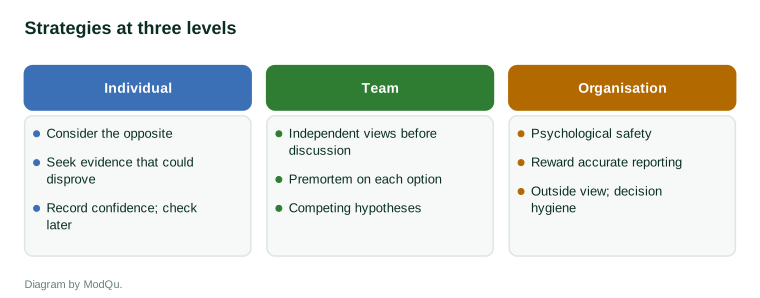
Consider the opposite. Charles Lord, Mark Lepper and Elizabeth Preston (1984) found that instructing people to be unbiased had little effect on biased evaluation of evidence, but asking them to consider what they would conclude if the evidence had pointed the other way substantially reduced the bias.
Imagine failure. Gary Klein (2007) proposed the premortem, in which a team imagines that a plan has failed and writes down why. It legitimises doubt and surfaces concerns that people might otherwise suppress.
Take the outside view. Dan Lovallo and Daniel Kahneman (2003) recommended comparing a plan with a reference class of similar past efforts, rather than relying only on the details of the plan itself, which tend to produce optimistic forecasts.
Use structured techniques. Richards Heuer (1999), drawing on his experience in intelligence analysis, described techniques such as the analysis of competing hypotheses, in which analysts list all plausible explanations and assess each piece of evidence against all of them, focusing on evidence that discriminates between hypotheses rather than evidence consistent with all.
Practise decision hygiene. Kahneman, Sibony and Sunstein (2021) argued that judgments are affected not only by bias but by noise, unwanted variability between judges and occasions. They recommended procedures such as gathering independent judgments before discussion, breaking complex judgments into parts and delaying intuitive conclusions until the evidence has been assessed.
Build psychological safety. Leaders can make inquiry safer by asking questions, acknowledging their own uncertainty, thanking people who raise problems and responding to bad news without blame (Edmondson, 1999). Specific invitations to speak help overcome implicit voice theories (Detert & Edmondson, 2011).
Frame the question explicitly. Write down the question the inquiry is meant to answer and the decision it will inform, and test alternative framings before collecting data. A few minutes spent on the question can prevent weeks spent answering the wrong one (Mitroff & Featheringham, 1974).
Bring in outsiders. People from other departments, customers, or independent reviewers are less bound by the group's assumptions and commitments. They can ask the naive questions that insiders have stopped asking, and they bear none of the sunk costs.
Collect independent views first. Because groups tend to share common information and converge early, asking members to record their views and information independently before discussion helps surface what each person knows (Stasser & Titus, 1985).
An example
The following example is hypothetical. A company has spent two years developing a new product line, and early sales are disappointing. The product team's explanation is that marketing has been insufficient, and it proposes a larger campaign. Several barriers are at work: sunk costs make abandonment painful, the team's explanation confirms its belief in the product, and junior staff who have heard customer complaints about the product's reliability have not raised them.
A review leader applies several strategies. She asks each team member to write down independently what they think explains the weak sales, before any discussion. Three different explanations emerge, including the reliability concerns. She lists all three as competing hypotheses and asks what evidence would distinguish them. Customer return data and a short survey of buyers show that reliability, not awareness, is the main problem. She asks the team to imagine that the proposed marketing campaign has failed and to explain why; the answer is obvious once the reliability problem is acknowledged. The company fixes the product before increasing its marketing. The review also changes the company's routine: product reviews now begin with independent written assessments, and customer service staff are invited to report recurring complaints directly to product teams each month. The barriers that hid the problem this time are less likely to hide the next one.
Conclusion
The barriers to effective inquiry are predictable. They arise from how individuals think, what they want to be true, how groups interact, how organisations reward behaviour and how much information people must process. Because they are predictable, they can be anticipated. The strategies that work best do not rely on people trying harder to be objective. They change the procedure: asking for the opposite, imagining failure, comparing with past cases, collecting independent views, structuring the analysis and making it safe to speak. Organisations that build these practices into their routines make inquiry the normal way of working rather than an act of individual courage.
References
Arkes, H. R., & Blumer, C. (1985). The psychology of sunk cost. Organizational Behavior and Human Decision Processes, 35(1), 124–140. https://doi.org/10.1016/0749-5978(85)90049-4
Asch, S. E. (1956). Studies of independence and conformity: I. A minority of one against a unanimous majority. Psychological Monographs: General and Applied, 70(9), 1–70. https://doi.org/10.1037/h0093718
Brooks, A. W., & John, L. K. (2018). The surprising power of questions. Harvard Business Review, 96(3), 60–67.
Detert, J. R., & Edmondson, A. C. (2011). Implicit voice theories: Taken-for-granted rules of self-censorship at work. Academy of Management Journal, 54(3), 461–488. https://doi.org/10.5465/amj.2011.61967925
Edmondson, A. (1999). Psychological safety and learning behavior in work teams. Administrative Science Quarterly, 44(2), 350–383. https://doi.org/10.2307/2666999
Eppler, M. J., & Mengis, J. (2004). The concept of information overload: A review of literature from organization science, accounting, marketing, MIS, and related disciplines. The Information Society, 20(5), 325–344. https://doi.org/10.1080/01972240490507974
Graesser, A. C., & Person, N. K. (1994). Question asking during tutoring. American Educational Research Journal, 31(1), 104–137. https://doi.org/10.3102/00028312031001104
Heuer, R. J., Jr. (1999). Psychology of intelligence analysis. Center for the Study of Intelligence, Central Intelligence Agency.
Huang, K., Yeomans, M., Brooks, A. W., Minson, J., & Gino, F. (2017). It doesn't hurt to ask: Question-asking increases liking. Journal of Personality and Social Psychology, 113(3), 430–452. https://doi.org/10.1037/pspi0000097
Janis, I. L. (1982). Groupthink: Psychological studies of policy decisions and fiascoes (2nd ed.). Houghton Mifflin.
Kahneman, D., Sibony, O., & Sunstein, C. R. (2021). Noise: A flaw in human judgment. Little, Brown Spark.
Klein, G. (2007). Performing a project premortem. Harvard Business Review, 85(9), 18–19.
Kunda, Z. (1990). The case for motivated reasoning. Psychological Bulletin, 108(3), 480–498. https://doi.org/10.1037/0033-2909.108.3.480
Larrick, R. P. (2004). Debiasing. In D. J. Koehler & N. Harvey (Eds.), Blackwell handbook of judgment and decision making (pp. 316–338). Blackwell. https://doi.org/10.1002/9780470752937.ch16
Lord, C. G., Lepper, M. R., & Preston, E. (1984). Considering the opposite: A corrective strategy for social judgment. Journal of Personality and Social Psychology, 47(6), 1231–1243. https://doi.org/10.1037/0022-3514.47.6.1231
Lovallo, D., & Kahneman, D. (2003). Delusions of success: How optimism undermines executives' decisions. Harvard Business Review, 81(7), 56–63.
Mitroff, I. I., & Featheringham, T. R. (1974). On systemic problem solving and the error of the third kind. Behavioral Science, 19(6), 383–393. https://doi.org/10.1002/bs.3830190605
Morrison, E. W., & Milliken, F. J. (2000). Organizational silence: A barrier to change and development in a pluralistic world. Academy of Management Review, 25(4), 706–725. https://doi.org/10.5465/amr.2000.3707697
Nickerson, R. S. (1998). Confirmation bias: A ubiquitous phenomenon in many guises. Review of General Psychology, 2(2), 175–220. https://doi.org/10.1037/1089-2680.2.2.175
Stasser, G., & Titus, W. (1985). Pooling of unshared information in group decision making: Biased information sampling during discussion. Journal of Personality and Social Psychology, 48(6), 1467–1478. https://doi.org/10.1037/0022-3514.48.6.1467
Tversky, A., & Kahneman, D. (1974). Judgment under uncertainty: Heuristics and biases. Science, 185(4157), 1124–1131. https://doi.org/10.1126/science.185.4157.1124
Wason, P. C. (1960). On the failure to eliminate hypotheses in a conceptual task. Quarterly Journal of Experimental Psychology, 12(3), 129–140. https://doi.org/10.1080/17470216008416717