
Share your experience of wearable technology
Tell us whether you wear a smartwatch or tracker, what you use it for and who you would share its data with. Your answers are combined with other people's and reported only as totals.
Start the wearable technology surveyAbout 5 minutes. No account needed. You can stop at any time.
What this topic covers
Wearable technology means electronic devices worn on the body that collect information or connect to a phone. The most common are:
- Smartwatches, which show notifications, run apps, take payments and track activity and health measures.
- Fitness trackers, simpler bands focused on steps, exercise, heart rate and sleep.
- Smart rings, small devices worn on a finger, often focused on sleep and recovery.
- Wireless earbuds with fitness or hearing features.
- Medical wearables, such as continuous glucose monitors for people with diabetes, heart monitors prescribed by a doctor, and some hearing aids.
- Smart glasses and other newer devices that are still used by a smaller group of people.
This topic is mainly about consumer devices bought by individuals, and about how people feel when the line between a gadget and a health device starts to blur.
What wearables measure
Most consumer wearables use sensors to estimate:
- steps and distance, using motion sensors;
- heart rate, using light shone into the skin;
- sleep length and stages, based on movement and heart rate;
- calories burned, estimated from activity and body details;
- location and route, for runs, walks and bike rides, using GPS;
- on some models, blood oxygen, skin temperature and heart rhythm readings.
Many of these are estimates. Step counts and heart rate during steady activity are usually close, while calorie and sleep stage estimates can be less precise. Some heart rhythm features on certain smartwatches have been cleared by health regulators for specific uses, such as alerting the wearer to a possible irregular rhythm, but a watch does not diagnose a condition. In Canada, Health Canada regulates devices sold for medical purposes.
Why people buy wearables
People give a range of reasons:
- Fitness goals: walking more, training for a race, or tracking workouts.
- General health: keeping an eye on sleep, heart rate and activity.
- Convenience: seeing messages and calls without taking out a phone, or paying by tapping the wrist.
- Safety: fall detection and emergency calling, which matter to older adults and people who exercise alone.
- Motivation: daily goals, badges and friendly competition with friends.
- Style: a watch is also jewellery, and many people choose by look.
Wearables are also a common gift, which means some owners did not choose the device themselves.
Example
An adult child gives a smartwatch with fall detection to a parent in their late seventies who lives alone. The parent dislikes charging it every night and often leaves it on the dresser. The family switches to a model with a longer battery life, and the parent starts wearing it every day.
Why people stop wearing them
A large share of people who buy a tracker or watch stop wearing it regularly at some point. Common reasons include:
- charging it too often;
- discomfort when sleeping or in hot weather;
- losing interest once the novelty wears off;
- feeling pressure or guilt from goals and reminders;
- doubts about whether the readings are accurate;
- the device breaking or the band wearing out.
People who keep wearing a device usually have a clear use for it, such as training for an event, tracking a health condition or using it for payments and messages.
Example
A nurse buys a fitness tracker to reach 10,000 steps a day. After a month of 12-hour shifts they find they reach the goal at work without trying, and the daily reminders on days off start to feel like nagging. They turn off the reminders and keep the tracker only for sleep tracking.
The example points to a question research on wearables often asks: whether goals and reminders help people change habits over time, or only at the start. The answer seems to differ from person to person, which is why surveys ask both about current use and about past devices that were set aside.
Health data and who sees it
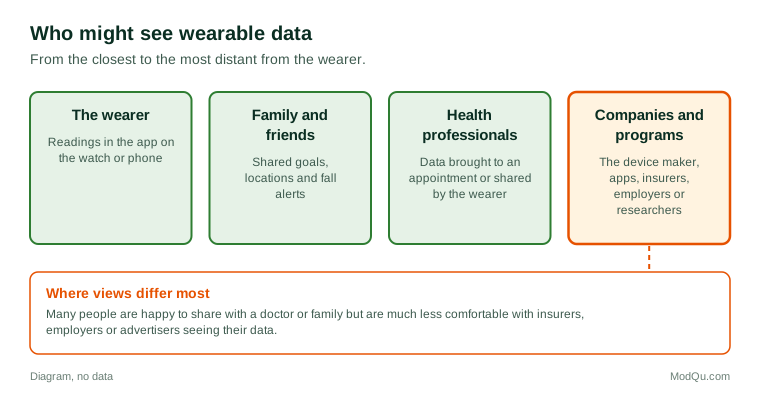
Wearables collect detailed personal information: where people go, how they sleep, their heart rate and, in some cases, menstrual cycles and other health details. This raises questions that people often have not thought about until asked:
- Who stores the data: the device maker, an app, or a cloud service.
- Who it is shared with: researchers, insurers, employers or advertisers.
- Whether it can be used to make decisions about insurance or employment.
- Whether people would share it with their doctor, and whether doctors want it.
Views vary a lot. Some people would gladly share data with a family doctor or a research study. Others would share with no one. Some insurance and employee wellness programs offer rewards for sharing activity data, which some people welcome and others see as intrusive.
Example (hypothetical figures)
An employer wellness program offers $20 in gift cards each month to staff who average 7,000 steps a day, measured by a tracker linked to the program. An employee who qualifies in 9 of 12 months earns $180 in a year. A co-worker with a knee injury cannot reach the target and says the program feels unfair.
Wearables and health care
Doctors and other health professionals have mixed views about consumer wearables. Data from a watch can start a useful conversation, for example about sleep or exercise habits, or prompt someone to seek care for symptoms. It can also cause worry over normal variations, or lead to visits that are not needed. Health systems are still working out how wearable data fits into medical records and appointments.
Medical wearables prescribed for a condition are a different case. A continuous glucose monitor, for example, can change how a person with diabetes manages daily life, and coverage for these devices varies by province and insurance plan.
What people disagree about
Opinion is divided on several questions: whether wearables make people healthier or just more anxious, whether children should wear trackers, whether employers and insurers should reward data sharing, how accurate the measures need to be, and whether the data belongs to the wearer or the company. As devices add more health features, these questions come up more often.
Key terms
- WearableAn electronic device worn on the body that collects data or connects to a phone.
- Fitness trackerA band or clip that records activity, heart rate and sleep.
- Heart rate monitorA sensor that measures how fast the heart is beating.
- GPSSatellite positioning used to record location and routes.
- Fall detectionA feature that senses a hard fall and can call for help.
- Resting heart rateThe heart rate when a person is calm and still.
- Sleep trackingEstimating how long and how well a person sleeps.
- Continuous glucose monitorA medical wearable that measures blood sugar through the day.
Full glossary: wearable technology terms on EditingTests.com.
Wearable technology vocabulary test
How well do you know the language of this topic? Try 8 quick questions. Your score is shown straight away and is not saved.
What the wearable technology survey asks
This survey is part of ModQu's Technology at Home survey. The wearable technology part takes about five minutes and covers:
- Whether you own a smartwatch, fitness tracker, smart ring or other wearable.
- What you use it for most, and how often you wear it.
- Whether you have stopped wearing one, and why.
- How much you trust its readings.
- Who you would share its data with: a doctor, researchers, an employer or an insurer.
- Which wearable features you would pay for in future.
After that you can choose to continue with other short parts of the Technology at Home survey, such as smartphones and mobile apps or internet and mobile plans, or stop.
Ready to take part?
Your answers help show what people really think and do. Results are only ever reported as totals; no one can see your individual answers.
Start the surveyQuestions about this survey
Who can take part?
Adults.
Do I have to give my name?
No. You may be asked for your age group, region and similar details so results can be broken down, but not your name. ModQu never asks for passwords, card numbers or account numbers.
How are the results used?
Answers are combined into totals and percentages and published in ModQu reports. Individual answers are never shown.
Is the vocabulary test part of the survey?
No. It is optional and separate, and your score is not stored.
Do I need to own a wearable to take part?
No. People who have never owned one, or who stopped using one, are asked about their reasons too.