
Share your plans for retirement
Tell us when you plan to retire, where you plan to live and what you will spend your time on. Your answers are combined with other people's and reported only as totals.
Start the retirement planning and lifestyle surveyAbout 5 minutes. No account needed. You can stop at any time.
Retirement as a life stage
Retirement once meant stopping work at a fixed age and receiving a pension. Today it takes many forms:
- full retirement at or around a state or company pension age;
- early retirement, by choice or because of health, caring duties or job loss;
- phased retirement, cutting hours gradually;
- working in retirement, part-time, as a consultant, in a new field or in a business;
- delayed retirement, working past pension age by choice or need.
Pension ages differ between countries and have risen in many of them as life expectancy has grown. In many countries, people may have a public pension, a workplace pension and personal savings, while in others family support remains the main source of income in old age. Many people in informal work have no pension at all.
When people plan to retire
The timing of retirement is shaped by:
- money: whether savings and pensions will cover expected costs;
- health, both one's own and a partner's;
- work: how physically demanding it is and how much the person enjoys it;
- family: caring for parents, grandchildren or a partner;
- pension rules, such as the earliest age a pension can be drawn;
- a partner's plans, since many couples try to retire together.
Many people find that their actual retirement date differs from their plan, often because of health, job loss or caring responsibilities.
Example
A 58-year-old factory supervisor planned to work until 65. After a back injury, they move to a desk role at reduced pay and decide to retire at 62. They say the change made them think about retirement for the first time in terms of what they would do, not only what they could afford.
Where people plan to live
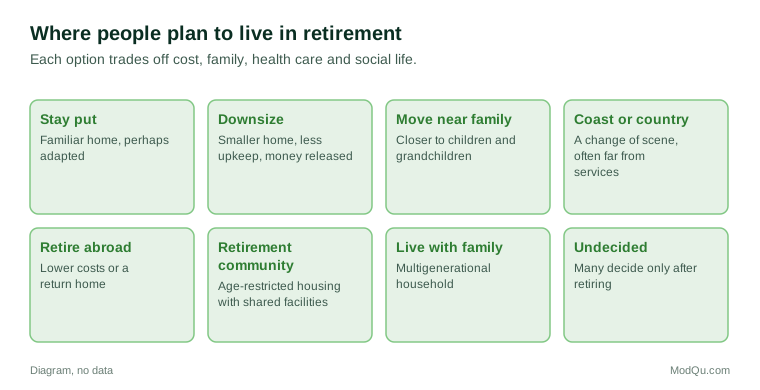
Housing is one of the biggest retirement decisions. Common options include:
- staying in the family home, often with changes such as a downstairs bathroom;
- downsizing to a smaller home, which may release money and reduce upkeep;
- moving closer to children and grandchildren;
- moving to the coast, countryside or a warmer region;
- retiring abroad, sometimes to the country of birth or to a place with lower costs;
- retirement villages and age-restricted communities;
- living with family in multigenerational homes, common in many cultures.
Each option involves trade-offs between cost, closeness to family, access to health care, social life and the ability to manage as health changes.
Example (hypothetical figures)
A couple sells a four-bedroom house for 600,000 dollars and buys a two-bedroom flat near their daughter for 380,000 dollars. Moving costs, fees and taxes come to 30,000 dollars. They release 190,000 dollars, and their yearly property costs fall from 9,000 dollars to 5,000 dollars, a saving of 4,000 dollars a year.
How people spend their time
People often say the hardest part of retirement is not money but losing the structure, purpose and social contact that work provided. Common activities include:
- travel, often more in the early years of retirement;
- caring for grandchildren;
- volunteering;
- hobbies, sport, gardening and learning new skills;
- part-time or freelance work;
- community, faith and club activities;
- caring for a partner or parent.
Some people plan carefully; others take a year to rest before deciding.
Example
A retired teacher volunteers two mornings a week at a literacy charity, swims three times a week and looks after a grandchild on Fridays. They say their week is as full as when they worked but that they now choose what fills it.
Money in retirement
Money questions in retirement include how much income will be needed, when to start drawing pensions, how to use savings, whether to work part-time and how to plan for care costs later in life. Many people use financial advisers, pension providers, government guidance services or online tools to estimate income. Rules on pensions, taxes and benefits differ widely by country.
A common rule of thumb is that spending is often higher in the early, active years of retirement, lower in the middle years and may rise again later if care is needed, but every household is different.
The first months after retiring
Many people describe the first months after retiring as a period of adjustment. Some feel relief and freedom; others miss colleagues, routine and a sense of being useful. Couples who retire at the same time sometimes need to renegotiate how they share time, space and household tasks. Retirement planning courses, offered by some employers and community groups, often cover these questions as well as money.
Common worries
People approaching retirement often worry about:
- running out of money;
- health and the cost of care;
- loneliness and losing work friendships;
- losing a sense of purpose;
- changes in the relationship with a partner who is now home all day;
- inflation and changes in pension rules.
Planning for later life
Retirement planning often includes steps for later years, such as making a will, setting up powers of attorney, discussing wishes for care, and adapting the home. Many people put these off, but advisers often suggest dealing with them while health is good.
What people disagree about
Retirement raises many debates:
- whether pension ages should keep rising;
- how much of retirement income should come from governments, employers or individuals;
- whether people should be encouraged to work longer;
- how care costs in later life should be paid for;
- whether retirees should move to be near family or stay in their communities.
Questions senior living operators, financial firms, travel companies and insurers want answered include when people plan to retire, where they will live, how they will spend their time and what they worry about.
Key terms
- Pension ageThe age at which a pension can normally be drawn.
- Phased retirementReducing working hours gradually instead of stopping all at once.
- DownsizingMoving to a smaller or cheaper home.
- Retirement villageA housing community designed for older people, often with shared facilities.
- Multigenerational homeA household with several generations living together.
- Workplace pensionA pension provided through an employer.
- Power of attorneyA legal document letting someone act for another person.
- Life expectancyThe average number of years a person is expected to live.
Full glossary: retirement planning terms on EditingTests.com.
Retirement planning and lifestyle vocabulary test
How well do you know the language of this topic? Try 8 quick questions. Your score is shown straight away and is not saved.
What the retirement planning and lifestyle survey asks
This survey is part of ModQu's Life Stages and Family survey. The retirement planning and lifestyle part takes about five minutes and covers:
- When you plan to retire, or when you retired.
- Whether you plan to stop work fully, reduce hours or keep working.
- Where you plan to live, and whether you will move.
- What you will spend your time on.
- What worries you most about retirement.
- Which sources of information you use to plan.
After that you can choose to continue with other short parts of the Life Stages and Family survey, such as ageing and senior living or weddings and celebrations, or stop.
Ready to take part?
Your answers help show what people really think and do. Results are only ever reported as totals; no one can see your individual answers.
Start the surveyQuestions about this survey
Who can take part?
Adults aged 50 and over.
Do I have to give my name?
No. You may be asked for your age group, region and similar details so results can be broken down, but not your name. ModQu never asks for passwords, card numbers or account numbers.
How are the results used?
Answers are combined into totals and percentages and published in ModQu reports. Individual answers are never shown.
Is the vocabulary test part of the survey?
No. It is optional and separate, and your score is not stored.
Does this page give financial advice?
No. It describes common choices. Rules on pensions and taxes differ by country.
Can I answer if I am already retired?
Yes. The survey asks retired people about their experience as well as people still planning.
Does the survey ask how much I have saved?
It may ask for broad ranges about income and savings. Every money question can be skipped.