
Share your experience of borrowing
Tell us whether you have taken a loan, what it was for, and how you chose the lender. Your answers are combined with other people's and reported only as totals.
Start the personal loans and payday lending surveyAbout 5 minutes. No account needed. You can stop at any time.
What counts as a personal loan
A personal loan is money borrowed from a bank, credit union or other lender that is paid back in regular instalments over an agreed period, usually between one and seven years. The interest rate may be fixed or variable. Most personal loans are unsecured, meaning nothing is pledged as security; some are secured against a car, savings or a home.
People use personal loans for many reasons:
- buying a car or paying for repairs;
- paying for a wedding, funeral or other large event;
- home improvements;
- medical or dental costs;
- combining several debts into one payment, known as debt consolidation;
- covering a period of reduced income.
Payday and other short-term loans
A payday loan is a small, short-term loan, usually meant to be repaid in full on the borrower's next pay date or within a few weeks. They are offered by specialist lenders in shops and online, often with fast decisions and few checks.
Related forms of short-term credit include:
- Instalment loans from the same lenders, repaid over a few months.
- Title loans, where a car is used as security.
- Pawn loans, where an item is left with a pawnbroker and can be bought back.
- Salary advances, offered by some employers or apps, which give early access to pay already earned.
- Informal loans from family, friends, community savings groups or money lenders, which remain very common in many parts of the world.
Payday loans are expensive for the amount borrowed, because the fees are high relative to the short period.
How the cost of borrowing is shown
Lenders show the cost of a loan in different ways, and comparing them takes care:
- Interest rate: the yearly percentage charged on the amount owed.
- Annual percentage rate (APR): a yearly figure that includes interest and most fees, designed to make loans comparable.
- Total amount repayable: everything the borrower will pay back over the life of the loan.
- Fee per amount borrowed: some short-term lenders quote a flat fee, such as a set charge for every 100 borrowed.
For a short loan, a fee that sounds small can equal a very high APR, because it is charged over a few weeks rather than a year.
Example (hypothetical figures)
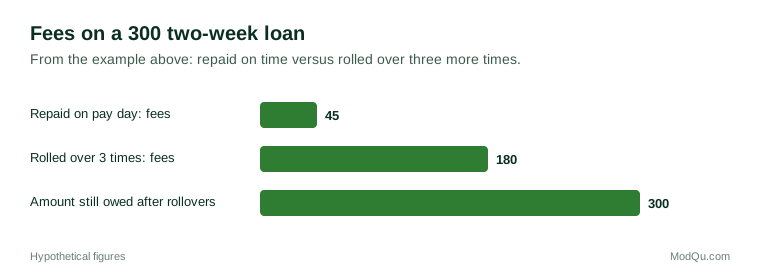
A worker borrows 300 for two weeks, with a fee of 45. They repay 345 on payday. The fee is 15% of the amount borrowed for just two weeks. If they could not repay and rolled the loan over three more times, paying 45 each time, they would have paid 180 in fees and still owe the original 300.
The figure below compares the total cost in that example with and without rolling the loan over.
Why people borrow
People use personal loans when they have a planned cost they cannot pay from savings, and when they qualify for a reasonable rate. People use payday and short-term loans most often when:
- an unexpected bill arrives before pay day, such as a car repair or a utility bill;
- they have no savings to fall back on;
- they cannot get a bank loan or credit card because of a low score or a thin credit file;
- they want a fast decision with little paperwork.
Example
A delivery driver's van breaks down. Without it they cannot work. They have no savings and their credit card is at its limit. A short-term lender approves a loan within an hour. The van is fixed the next day, but repaying the loan in one go leaves them short again at the end of the month.
The risk of repeat borrowing
The main risk with payday loans is a cycle of debt. A borrower who repays the whole loan on pay day may then be short for the rest of the month and borrow again. Some lenders allow loans to be rolled over, extending the deadline for another fee. Over several months the fees can exceed the original loan.
Signs that borrowing is becoming a problem include taking new loans to repay old ones, borrowing from several lenders at once, missing essential bills to make loan payments, and receiving calls from debt collectors. Free debt advice services exist in many countries and can help borrowers deal with lenders.
Choosing a lender
People who shop around tend to compare:
- the APR and the total amount repayable;
- the monthly payment and whether it fits their budget;
- whether there are fees for paying early;
- what happens if a payment is missed;
- how quickly the money arrives;
- whether the lender is licensed.
Example
A couple want to consolidate three card balances. They compare a loan from their bank, one from a credit union and one from an online lender. The online lender offers the fastest decision, but the credit union has the lowest total cost and no early repayment fee. They choose the credit union.
Rules and protections
Many countries limit what short-term lenders can charge or how they lend. Measures include caps on interest and fees, limits on rollovers, required checks that the borrower can afford the loan, cooling-off periods, and licensing of lenders. Some places ban payday loans altogether. In others, rules are lighter. Unlicensed money lending, sometimes called loan sharking, is illegal in most countries and can involve threats and violence.
What people disagree about
Some argue that short-term loans meet a real need for people with nowhere else to go, and that strict caps push borrowers toward illegal lenders. Others say the loans take advantage of people under pressure and that cheaper alternatives, such as credit union loans, salary advances and hardship grants, should replace them.
Questions that businesses want answered include who borrows, for what, how they choose a lender, how well they understand the cost, how often they borrow again, and what alternatives they would use.
Key terms
- Personal loanA sum borrowed and repaid in regular instalments over an agreed period.
- Unsecured loanA loan with nothing pledged as security.
- Secured loanA loan backed by an asset the lender can take if it is not repaid.
- Payday loanA small short-term loan meant to be repaid by the next pay day.
- APRA yearly rate that includes interest and most fees, used to compare loans.
- RolloverExtending a short-term loan for another fee instead of repaying it.
- Debt consolidationCombining several debts into one loan.
- Total amount repayableEverything a borrower pays back over the life of a loan.
Full glossary: consumer credit terms on EditingTests.com.
Personal loans and payday lending vocabulary test
How well do you know the language of this topic? Try 8 quick questions. Your score is shown straight away and is not saved.
What the personal loans and payday lending survey asks
This survey is part of ModQu's Money and Banking survey. The personal loans and payday lending part takes about five minutes and covers:
- Whether you have taken a personal, payday or other loan in the last two years.
- What you borrowed for and how much.
- Where you borrowed and how you chose the lender.
- Whether you compared the cost, and what you looked at.
- Whether you have rolled over a loan or borrowed again to repay one.
- What other options you considered, and why you did not use them.
After that you can choose to continue with other short parts of the Money and Banking survey, such as everyday banking or digital payments and wallets, or stop.
Ready to take part?
Your answers help show what people really think and do. Results are only ever reported as totals; no one can see your individual answers.
Start the surveyQuestions about this survey
Who can take part?
Adults who have borrowed money.
Do I have to give my name?
No. You may be asked for your age group, region and similar details so results can be broken down, but not your name. ModQu never asks for passwords, card numbers or account numbers.
How are the results used?
Answers are combined into totals and percentages and published in ModQu reports. Individual answers are never shown.
Is the vocabulary test part of the survey?
No. It is optional and separate, and your score is not stored.