
Share how you follow major events
Tell us whether you watched the last Olympics, which events you follow and whether you would travel to a major tournament. Your answers are combined with other people's and reported only as totals.
Start the olympics and major tournaments surveyAbout 5 minutes. No account needed. You can stop at any time.
What this topic covers
Major sporting events are competitions held every few years that bring together athletes or teams from many countries. They include:
- the Summer and Winter Olympic Games, organized under the International Olympic Committee (IOC);
- the Summer and Winter Paralympic Games for athletes with disabilities, held after the Olympics in the same host city;
- men's and women's world cups in football, cricket, rugby, basketball and other sports;
- continental championships, such as continental football tournaments and the Asian, African, Pan American and Commonwealth Games;
- world championships in athletics, swimming and other individual sports.
This topic covers how people follow these events, how they watch, whether they attend or travel, and what they think about hosting them.
Why people follow major events
Many people who rarely watch sport follow major events. Reasons include:
- national pride and supporting their country;
- the sense of a shared event watched by the whole country or the world;
- the chance to see sports they never normally watch, such as rowing, fencing or curling;
- stories of individual athletes;
- social occasions, such as watching with friends or at work;
- a home event creating excitement locally.
Example
A woman who never watches sport ends up following the Olympics closely when an athlete from her small home town reaches the final of a swimming event. She watches the heats at work on her phone, the final at a neighbour's house with twenty people, and later finds herself watching sports she had never seen before, such as canoe slalom and track cycling.
How people watch
Most people follow major events on television, often free-to-air, as many countries protect the biggest events so that everyone can watch them. Streaming has become important, letting viewers choose among many events running at the same time. Other ways to follow include:
- public screens and fan zones in city centres;
- bars, cafés and community viewing centres;
- highlights and clips on social media;
- radio and live text coverage;
- medal tables and results apps.
Time zones strongly affect viewing. When an event is held far away, many key moments happen in the middle of the night, and people watch replays or highlights instead.
Travelling to events
Attending a major event is a once-in-a-lifetime experience for many fans. Costs can be high, including tickets, flights, accommodation (which often rises sharply in price during events) and visas. Tickets for popular events are often sold through ballots because demand is much higher than supply.
Example (hypothetical figures)
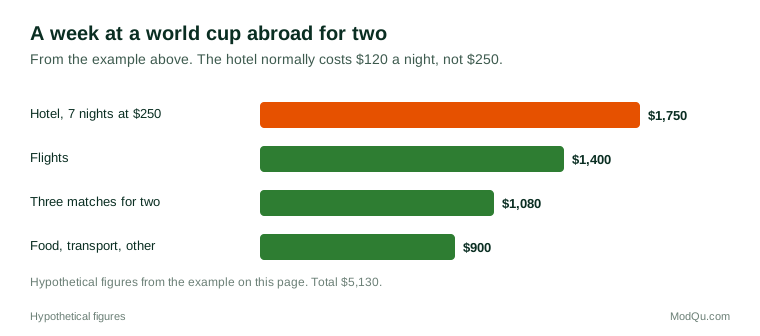
A couple plan to travel to a world cup abroad for one week. Flights cost $1,400 for two, a hotel costs $250 a night for seven nights ($1,750), tickets for three matches cost $180 each per person ($1,080), and food, local transport and other spending come to about $900. The trip costs $5,130 in total. The same hotel normally costs $120 a night, so the event roughly doubled their accommodation bill.
Many fans instead attend events in their own country, or travel only for the final stages if their team does well. Some volunteer at events, which gives access and a role in the event without buying tickets.
Hosting
Countries and cities bid to host major events, hoping for economic benefits, tourism, international attention, national pride, new sports facilities and better transport. Hosting is also very expensive, involving stadiums, transport, security and athlete villages.
Research on the economics of hosting has often found that costs exceed budgets and that the long-term economic gains are smaller than promised. Some venues have been left unused after events, though others have been well used for decades. Concerns also include the displacement of residents, the treatment of construction workers, environmental impact and public money spent on events rather than other needs. Several cities have withdrawn bids after public opposition or referendums.
In response, organizers have encouraged the use of existing and temporary venues, and some recent events have been shared between cities or countries.
Example
A city considers bidding for a future Games. A local residents' group asks for a public vote. Supporters point to new transport links and jobs; opponents point to cost overruns in other host cities and fear rising rents near the planned venues. In a close referendum, residents vote against the bid, and the city withdraws.
The Paralympics
The Paralympic Games have grown in profile, with larger audiences, more coverage and well-known athletes. Many viewers say the Paralympics changed how they think about disability. Coverage and sponsorship are still much smaller than for the Olympics, and athletes with disabilities often have less funding and access to facilities.
Legacy
"Legacy" means the lasting effects of an event on a host city or country. Organizers often promise legacies such as more people playing sport, regenerated neighbourhoods, new housing and better transport. Evidence on participation is mixed: interest often rises during and after an event but does not always lead to more people playing sport over the long term, unless backed by investment in local clubs and facilities.
Integrity and controversy
Major events have faced controversies over doping, corruption in awarding hosting rights, human rights in host countries, and the treatment of athletes. These issues affect how some people feel about following the events, and some fans and athletes have called for boycotts.
Sponsors and major events
Major events depend heavily on sponsorship. Global sponsors pay large sums for the right to use event logos and to advertise as official partners, and host countries add local sponsors. Organizers protect these rights strictly, and rules often limit other brands from advertising near venues, a practice sometimes called "clean venue" rules. Brands without official rights sometimes try "ambush marketing", linking themselves to an event without paying.
Many viewers remember some official sponsors, but research on sponsorship recall has often found that people also name brands that were not sponsors at all. Questions about which sponsors people remember help organizers and brands judge whether sponsorship is noticed.
What people disagree about
People disagree about whether hosting is worth the cost, whether events should be held in countries with poor human rights records, whether expanding tournaments with more teams improves or weakens them, whether new sports added to the Olympics fit the Games, and whether the money spent on elite sport should go to community sport instead.
Questions that organizers, broadcasters, sponsors, tourism bodies and governments want answered include how many people watched the last events, how they watched, which events they follow, whether they would travel to an event and what they think of hosting.
Key terms
- IOCThe International Olympic Committee, which organizes the Olympic Games.
- Paralympic GamesThe major international multi-sport event for athletes with disabilities.
- Host cityThe city chosen to stage a major event.
- BidA city's or country's formal proposal to host an event.
- Fan zoneA public area with screens and facilities for watching an event together.
- LegacyThe lasting effects of an event on a host city or country.
- Medal tableA ranking of countries by medals won.
- Ticket ballotA random draw used to allocate tickets when demand exceeds supply.
Full glossary: sports management terms on EditingTests.com.
Olympics and major tournaments vocabulary test
How well do you know the language of this topic? Try 8 quick questions. Your score is shown straight away and is not saved.
What the olympics and major tournaments survey asks
This survey is part of ModQu's Sports survey. The olympics and major tournaments part takes about five minutes and covers:
- Whether you watched the last Summer or Winter Olympics or Paralympics, and how.
- Which major events and sports you follow.
- Whether you have attended a major event, at home or abroad.
- Whether you would travel to a major tournament, and what would stop you.
- Whether you think hosting major events is worth the cost.
- Which sponsors of major events you remember.
After that you can choose to continue with other short parts of the Sports survey, such as football (soccer) fans or playing team sports, or stop.
Ready to take part?
Your answers help show what people really think and do. Results are only ever reported as totals; no one can see your individual answers.
Start the surveyQuestions about this survey
Who can take part?
Adults.
Do I have to give my name?
No. You may be asked for your age group, region and similar details so results can be broken down, but not your name. ModQu never asks for passwords, card numbers or account numbers.
How are the results used?
Answers are combined into totals and percentages and published in ModQu reports. Individual answers are never shown.
Is the vocabulary test part of the survey?
No. It is optional and separate, and your score is not stored.