
Share your experience of digital banks
Tell us whether you use an app-only bank, why you opened it, and how it compares with your other bank. Your answers are combined with other people's and reported only as totals.
Start the mobile-only and digital banks surveyAbout 5 minutes. No account needed. You can stop at any time.
What a digital bank is
A digital bank (also called a neobank, challenger bank or app-only bank) is a bank or financial company that serves customers mainly or entirely through a mobile app and website. Opening an account usually takes minutes: the customer takes a photo of an identity document and a short video or selfie, and the account is ready.
The term covers a range of businesses:
- Fully licensed digital banks that hold their own banking licence.
- Digital brands of traditional banks, set up to reach younger or online customers.
- Payment and e-money companies that offer accounts and cards but are not banks, and may hold customer money with a partner bank.
- Super-apps, common in parts of Asia, Africa and Latin America, that combine messaging, shopping, payments and accounts.
The difference between a licensed bank and an e-money company matters for how deposits are protected, which is explained below.
Why people open a digital bank account
People give a mix of reasons:
- Low or no fees, including no monthly charge and cheaper foreign spending.
- Speed: instant notifications, instant transfers and quick account opening.
- Budgeting tools: spending categories, savings pots and round-ups.
- Travel: cards that work well abroad with clear exchange rates.
- Access: people without a local credit history or a nearby branch can often open an account.
- Design: an app that is easier to use than their old bank's.
Example
A university student opens a digital account in five minutes using their passport and phone. They use the savings pots feature to set aside money for rent and books, and turn on notifications so they see every payment. They keep their old bank account only because their scholarship is paid into it.
How people use them
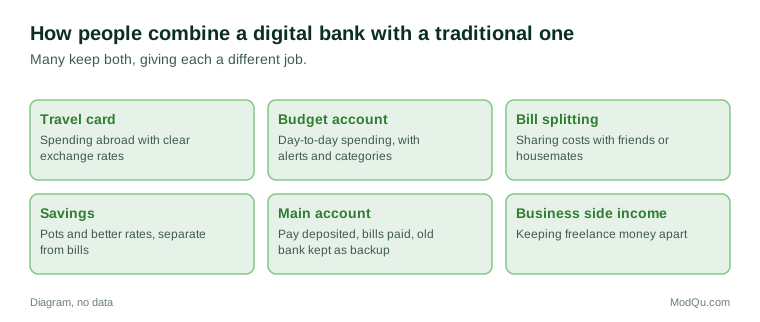
Many people use a digital bank as a second account rather than replacing their main bank. Common patterns are a travel card, a budgeting account for day-to-day spending, a place to split bills with friends, or a savings account with a better rate.
Some customers move their pay to the digital bank and use it as their main account. In some countries and age groups this has become common.
The figure below shows the main ways people combine a digital bank with a traditional one.
Deposit protection and regulation
In most countries, deposits at licensed banks are protected up to a limit by a national deposit insurance or guarantee scheme if the bank fails. Licensed digital banks are usually covered in the same way.
E-money and payment companies are often treated differently. They may be required to keep customer money separate from their own (known as safeguarding), but the money may not be covered by deposit insurance. If such a company fails, getting money back can take longer. Customers who want to know their protection need to check whether the company is a licensed bank and what scheme covers it.
Example (hypothetical figures)
A freelancer keeps 3,000 for day-to-day spending in a payment app and 20,000 in savings at a licensed digital bank. When they check, they find the savings are covered by their country's deposit insurance up to the national limit, but the money in the payment app is safeguarded rather than insured. They decide to keep only spending money in the app.
What can go wrong
Digital banks have drawbacks, and complaints often focus on:
- Customer service that is only available by chat, with slow responses.
- Account freezes when automated checks flag unusual activity, sometimes leaving customers without access to money for days.
- Cash: depositing cash can be hard or impossible.
- Limited products: some do not offer mortgages, larger loans or joint accounts.
- Business models: some have struggled to make a profit and have changed fees or closed.
- Reliance on the phone: losing or breaking a phone can mean losing access.
Example
A shop owner's digital account is frozen after a large customer payment triggers a fraud check. The app's chat says the review will take up to ten working days. They cannot pay their supplier and have to borrow from family. They open a second account at a bank with a branch as a backup.
Digital banking around the world
Digital banks have grown in different ways in different regions. In some countries with many large, long-established banks, digital banks grew by offering better apps and lower fees for travel and everyday spending. In countries where many adults had no bank account, mobile money services and super-apps brought basic accounts to millions of people for the first time, often through a phone number rather than a branch visit. Elsewhere, governments have issued special licences for digital-only banks to increase competition.
Because of this, the same word can describe quite different services. In one country a digital bank may be a stylish app for urban professionals; in another it may be the first account a market trader or farmer has ever held. Survey questions about digital banking therefore need to be clear about what kind of service is meant.
Trust and switching
Trust is one of the main reasons people keep their old bank as their main account. Customers often say they are not sure a newer company will last, or worry about how they would reach a person if something went wrong. Trust tends to grow with use: people who have used a digital bank for longer are more likely to move their pay to it.
Traditional banks have responded by improving their apps, adding instant notifications and cutting some fees, which has narrowed the gap.
What people disagree about
Supporters say digital banks have pushed the whole industry to become cheaper and easier to use, and have brought banking to people who were poorly served. Sceptics say that fast growth and automated checks can lead to errors, frozen accounts and weak service, and that some customers do not understand whether their money is protected.
Questions that businesses want answered include who uses digital banks, whether as a main or second account, why they opened one, which features they use, how much they trust it, and what would make them move their pay.
Key terms
- Digital bankA bank that serves customers mainly through an app and website.
- NeobankAnother name for a newer digital-only bank.
- E-money companyA company that holds money and issues cards or payments but is not a bank.
- SafeguardingKeeping customer money separate from a company's own funds.
- Deposit insuranceProtection of eligible deposits, up to a limit, if a bank fails.
- Savings potA separate space in an app for setting money aside.
- Round-upRounding each purchase up and saving the difference.
- Know your customer (KYC)The identity checks a bank must carry out when opening an account.
Full glossary: digital banking terms on EditingTests.com.
Mobile-only and digital banks vocabulary test
How well do you know the language of this topic? Try 8 quick questions. Your score is shown straight away and is not saved.
What the mobile-only and digital banks survey asks
This survey is part of ModQu's Money and Banking survey. The mobile-only and digital banks part takes about five minutes and covers:
- Whether you have an account with a bank that has no branches.
- Whether it is your main or second account, and what you use it for.
- Why you opened it and which features you use most.
- How much you trust it compared with a traditional bank.
- Whether you know how your money is protected.
- What would make you move your pay to it, or away from it.
After that you can choose to continue with other short parts of the Money and Banking survey, such as everyday banking or digital payments and wallets, or stop.
Ready to take part?
Your answers help show what people really think and do. Results are only ever reported as totals; no one can see your individual answers.
Start the surveyQuestions about this survey
Who can take part?
Adults with a bank account.
Do I have to give my name?
No. You may be asked for your age group, region and similar details so results can be broken down, but not your name. ModQu never asks for passwords, card numbers or account numbers.
How are the results used?
Answers are combined into totals and percentages and published in ModQu reports. Individual answers are never shown.
Is the vocabulary test part of the survey?
No. It is optional and separate, and your score is not stored.