
Share your experience of small insurance policies
Tell us whether you have bought low-cost cover through your phone, a group or a lender. Your answers are combined with other people's and reported only as totals.
Start the microinsurance surveyAbout 5 minutes. No account needed. You can stop at any time.
What microinsurance is
Microinsurance is insurance designed for people on low or irregular incomes. Premiums are small and can often be paid daily, weekly or monthly. Cover amounts are modest, and policies are kept simple so they can be understood without an agent. The aim is to protect households from shocks, such as illness, death, crop failure or livestock loss, that can push them into debt or poverty.
It grew alongside microfinance, which provides small loans and savings accounts, and is most common in parts of Africa, Asia and Latin America, though similar products exist elsewhere.
Why traditional insurance leaves people out
Traditional insurance can be hard to reach for people with low incomes because:
- premiums are paid in large yearly or monthly amounts;
- policies require documents, bank accounts and paperwork;
- agents focus on customers who buy larger policies;
- claims processes can be slow and complex;
- products are not designed for risks such as crop failure or informal work.
Microinsurance tries to remove these barriers through lower costs, simple products and new ways of selling.
How it is sold
Microinsurance reaches customers through partners who already have contact with them:
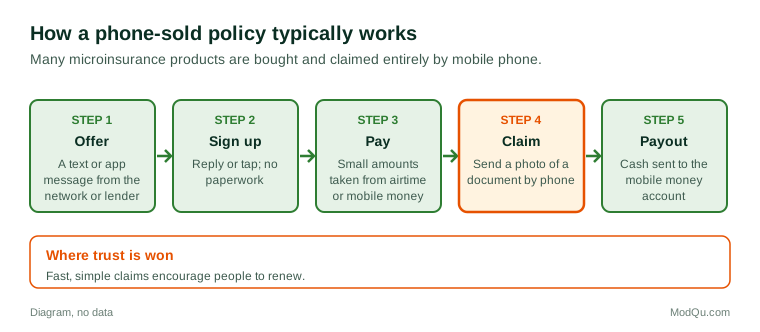
- Mobile phone networks and mobile money services: customers sign up by text or app, and premiums are taken from airtime or mobile money balances.
- Microfinance institutions: life or credit cover is attached to small loans.
- Cooperatives and farmer groups: crop or livestock cover for members.
- Retailers and agricultural suppliers: cover sold with seeds, fertiliser or goods.
- Health providers and community groups.
The figure below shows the typical journey of a mobile-sold policy.
Example
A market trader receives a text from her mobile network offering hospital cover for a small weekly amount taken from her airtime. She signs up by replying to the message. When she is admitted to hospital for three nights, she sends a photo of her discharge note by phone and receives a cash payment to her mobile money account within days.
Common types of microinsurance
- Credit life: pays off a loan if the borrower dies, so the family does not inherit the debt.
- Life and funeral cover: a small payment to the family on death.
- Hospital cash: a fixed amount for each night in hospital.
- Health cover: help with clinic and medicine costs.
- Crop insurance: payments when harvests fail because of drought or flood.
- Livestock insurance: payments when animals die.
- Property cover: for small shops, stock or homes against fire or theft.
Index-based insurance
Checking every farm after a drought is expensive. Index-based or parametric insurance pays out based on a measurable index rather than an inspection of each loss. For example, a policy might pay if rainfall measured at a weather station falls below a set level, or if satellite data show poor vegetation.
Example (hypothetical figures)
A farmer pays a premium of 15 for a season. The policy pays 200 if rainfall at the local station is below 300 mm in the growing season. Rainfall is 240 mm, so all policyholders in the area receive 200 automatically, without filing claims.
The advantage is speed and low cost. The drawback is basis risk: a farmer may suffer losses that the index does not show, or the index may trigger a payment when a particular farm did fine.
Benefits for households
Supporters point to several benefits:
- families avoid selling assets, such as livestock or tools, after a shock;
- children are less likely to be taken out of school to save money;
- farmers may invest more in better seeds when crop risk is insured;
- lenders may lend more to insured borrowers;
- people build familiarity with insurance, which can lead to fuller products later.
Microinsurance and climate risk
As droughts, floods and storms become more frequent in some regions, microinsurance has been linked to climate adaptation. Some governments and international bodies pay part of the premium for farmers, or buy cover at a national or regional level that pays out quickly to fund relief after a disaster. Quick payouts can help families buy food and seed before they are forced to sell animals or land.
Example
A livestock herder in a dry region is enrolled in an index scheme that uses satellite images of pasture. When grazing land dries out, payouts arrive before animals start dying, and the herder buys feed to keep the herd alive until the rains return.
Challenges and criticisms
Microinsurance also faces problems:
- Low awareness: people may not know they are covered, especially when cover is bundled with a loan or phone plan.
- Low claims: some products pay out very little relative to premiums, raising questions about value.
- Trust: people who have never claimed may doubt insurance pays.
- Cost of delivery: small premiums leave little margin for administration.
- Renewals: many customers do not renew after the first year.
Regulators in several countries have created specific rules for microinsurance to encourage simple, fair products.
What people disagree about
Some see microinsurance as an important tool for reducing poverty and building resilience to climate change. Others argue that public safety nets, such as health systems and social protection, do more, and that some products mainly benefit lenders and phone companies rather than customers. There is also debate about whether governments or donors should subsidize premiums.
Questions that businesses want answered include how many people hold small policies, how they bought them, whether they know they are covered, whether they have claimed, how quickly they were paid, and what would make them renew or buy more.
Key terms
- MicroinsuranceLow-cost insurance designed for people on low or irregular incomes.
- Credit lifeCover that pays off a loan if the borrower dies.
- Hospital cashA fixed payment for each night spent in hospital.
- Index-based insuranceInsurance that pays out based on a measured index, such as rainfall.
- Parametric insuranceAnother name for index-based insurance.
- Basis riskThe chance that an index payout does not match a person's actual loss.
- Mobile moneyA service for storing and sending money using a mobile phone.
- Claims ratioThe share of premiums paid back to customers as claims.
Full glossary: microfinance terms on EditingTests.com.
Microinsurance vocabulary test
How well do you know the language of this topic? Try 8 quick questions. Your score is shown straight away and is not saved.
What the microinsurance survey asks
This survey is part of ModQu's Insurance survey. The microinsurance part takes about five minutes and covers:
- Whether you have bought a small insurance policy through a phone, lender, group or shop.
- What it covered and how you pay for it.
- Whether you knew you were covered and understood the terms.
- Whether you have made a claim, and how quickly you were paid.
- Whether you would buy cover paid in small weekly or daily amounts.
- What would make you renew or buy more cover.
After that you can choose to continue with other short parts of the Insurance survey, such as car insurance or home and tenant insurance, or stop.
Ready to take part?
Your answers help show what people really think and do. Results are only ever reported as totals; no one can see your individual answers.
Start the surveyQuestions about this survey
Who can take part?
Adults on low or irregular incomes.
Do I have to give my name?
No. You may be asked for your age group, region and similar details so results can be broken down, but not your name. ModQu never asks for passwords, card numbers or account numbers.
How are the results used?
Answers are combined into totals and percentages and published in ModQu reports. Individual answers are never shown.
Is the vocabulary test part of the survey?
No. It is optional and separate, and your score is not stored.
Is microinsurance only available in lower-income countries?
It is most common there, but similar low-cost products are sold in many countries.
How do I claim on a policy bought by phone?
Usually by text, app or a call, often with a photo of a document. Check the instructions in your sign-up message.