
Tell us about your health and travel coverage
Tell us what health and travel coverage you have, how you got it and how your claims went. Your answers are combined with other people's and reported only as totals.
Start the health and travel insurance surveyAbout 5 minutes. No account needed. You can stop at any time.
What public health plans cover and what they do not
In Canada, each province and territory runs a public health insurance plan that covers medically necessary doctor and hospital services. Many everyday health costs are not covered, or are covered only for certain groups such as seniors, children or people on social assistance. Common gaps include:
- prescription drugs outside hospital;
- dental care;
- eye exams for adults, glasses and contact lenses;
- physiotherapy, massage therapy, chiropractic and psychology;
- ambulance fees in some provinces;
- private or semi-private hospital rooms;
- medical care outside the province or country.
Governments have added some programs, such as public dental coverage for eligible people and pharmacare measures, but coverage still depends on where people live and their circumstances. In the United States, health insurance works differently, with most people covered through employers, government programs or plans bought individually.
Workplace health benefits
For many Canadians, supplementary coverage comes through work. Group health and dental plans usually pay a share of drug, dental, vision and paramedical costs, up to yearly limits. Some employers offer a health spending account, a set amount that employees can use for eligible expenses.
Workers without benefits include many self-employed people, gig workers, part-time and contract staff, and people in small businesses. Retirees often lose their workplace coverage when they stop working.
Example
A freelance photographer has no workplace benefits. After paying $1,400 for dental work in one year, they compare individual health and dental plans. They find that the yearly premiums would be close to what they spend, so they decide to set aside money for health costs instead and buy coverage only for prescription drugs.
Individual health and dental plans
People without workplace coverage can buy individual plans from insurers. These usually come in tiers, with higher premiums for more coverage. Plans that do not require medical questions often have lower limits or exclude existing conditions. Plans that do ask medical questions may offer more coverage but can decline applicants or exclude conditions.
People often find these plans hard to compare because of different limits, waiting periods and co-insurance percentages.
Co-payments, deductibles and limits
Supplementary plans rarely pay everything. Common features include:
- co-insurance: the plan pays a percentage, such as 80%, and the member pays the rest;
- deductibles: an amount the member pays each year before the plan starts paying;
- annual or per-visit limits, for example on massage or physiotherapy;
- dispensing fee limits on prescriptions;
- frequency limits, such as one pair of glasses every two years.
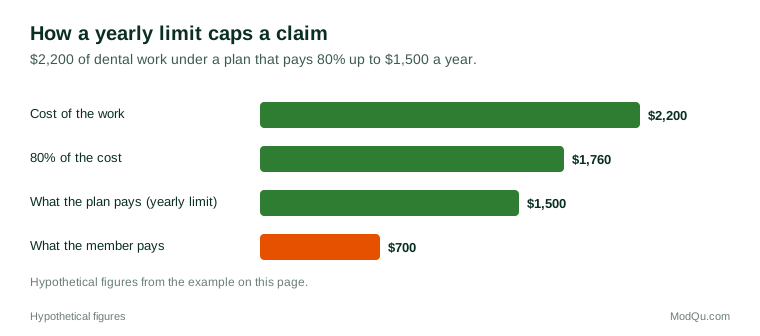
Example (hypothetical figures)
A plan pays 80% of dental costs up to $1,500 a year. A member has $2,200 of work done. The plan pays 80% of $2,200, which is $1,760, but the yearly limit caps the payment at $1,500. The member pays the remaining $700.
Travel medical insurance
Provincial plans pay very little for medical care outside Canada, and hospital costs in some countries, especially the United States, can be very high. Travel medical insurance covers emergency medical care while away. Policies may be bought for a single trip, as a yearly multi-trip plan, through a credit card or through a workplace plan.
Important details include:
- pre-existing condition clauses, which may exclude conditions that were not stable for a set period before departure;
- maximum trip length on multi-trip and credit card policies;
- age limits and higher premiums for older travellers;
- requirements to call the insurer's assistance line before or soon after treatment.
Example
A retired couple spend three months in the southern United States each winter. One spouse has a heart condition that changed medication two months before departure. The insurer asks medical questions, and the couple must decide whether to declare the change and pay more, or risk having a related claim denied.
Trip cancellation and other travel coverage
Beyond medical coverage, travel insurance can include:
- trip cancellation and interruption, if a trip must be cancelled or cut short for a covered reason;
- baggage loss and delay;
- flight delay coverage;
- rental car damage coverage.
People often learn the limits of these policies only when they claim, for example that "change of mind" or a work conflict is not a covered reason for cancellation.
How people buy coverage and compare
People buy health and travel insurance from insurers, brokers, banks, travel agents, airlines, online comparison sites and credit card issuers. Many rely on coverage they have without checking it, such as insurance included with a credit card. Common sources of confusion are what is already covered, what "pre-existing" means and how much coverage is enough.
Claims and disputes
Health benefit claims are often submitted through apps or directly by pharmacies and clinics. Travel claims usually need receipts, medical reports and proof of travel dates. Disputes commonly involve pre-existing conditions, missing documents, policy exclusions and delays in payment. Some travellers face large bills while waiting for the insurer to pay.
What insurers and employers want to know
Insurers, employers and governments want to understand who has supplementary coverage, who does not, how people choose plans, what they use them for and what gaps cause the most hardship. Changing public programs also raise questions about how private plans should adapt.
Key terms
- Supplementary health insuranceInsurance that pays for health costs not covered by public plans.
- Co-insuranceThe share of a cost the plan pays, with the member paying the rest.
- Annual maximumThe most a plan will pay for a type of service in a year.
- Health spending accountAn employer-funded amount employees can use for eligible health costs.
- Travel medical insuranceInsurance for emergency medical care while travelling.
- Pre-existing conditionA health condition that existed before coverage started.
- Stability periodThe time a condition must be unchanged before a trip for coverage to apply.
- Trip cancellation insuranceCoverage for prepaid travel costs when a trip is cancelled for a covered reason.
Full glossary: travel insurance terms on EditingTests.com.
Health and travel insurance vocabulary test
How well do you know the language of this topic? Try 8 quick questions. Your score is shown straight away and is not saved.
What the health and travel insurance survey asks
This survey is part of ModQu's Insurance survey. The health and travel insurance part takes about five minutes and covers:
- Whether you have health or dental benefits through work, an individual plan or neither.
- Which health costs you pay yourself, and which cause the most strain.
- Whether you bought travel insurance for your last trip, and where.
- How well you understand what your coverage includes.
- Your experience of any health or travel insurance claim, including refusals.
- What coverage you would most like to have that you do not.
After that you can choose to continue with other short parts of the Insurance survey, such as car insurance or home and tenant insurance, or stop.
Ready to take part?
Your answers help show what people really think and do. Results are only ever reported as totals; no one can see your individual answers.
Start the surveyQuestions about this survey
Who can take part?
Adults who travel or have private health cover.
Do I have to give my name?
No. You may be asked for your age group, region and similar details so results can be broken down, but not your name. ModQu never asks for passwords, card numbers or account numbers.
How are the results used?
Answers are combined into totals and percentages and published in ModQu reports. Individual answers are never shown.
Is the vocabulary test part of the survey?
No. It is optional and separate, and your score is not stored.
Will you ask about my health conditions?
The survey asks about coverage and claims, not your diagnoses. Any question about health is optional.
Can ModQu help me with a refused claim?
No. ModQu runs surveys and does not give insurance advice. Your insurer's complaints process and, in Canada, the OmbudService for Life and Health Insurance can help with disputes.