
Tell us about your car insurance
Tell us how you bought your car insurance, when you last compared quotes and how your claims went. Your answers are combined with other people's and reported only as totals.
Start the car insurance surveyAbout 5 minutes. No account needed. You can stop at any time.
What car insurance covers
Car insurance protects drivers against the costs of accidents, theft and damage. A policy usually combines several types of coverage:
- Third-party liability: pays for injury or damage you cause to other people and their property. It is required by law.
- Accident benefits: pays for medical care, rehabilitation and lost income after a collision, regardless of who was at fault in many provinces.
- Collision: pays to repair or replace your own vehicle after a collision.
- Comprehensive: covers theft, vandalism, fire, falling objects, hail and other damage not caused by a collision.
- Uninsured motorist coverage: protects you if you are hit by a driver without insurance.
Optional extras include rental car coverage while your vehicle is repaired, loss-of-use coverage and accident forgiveness.
Public and private insurance
How car insurance is sold depends on where you live. In Canada, British Columbia, Saskatchewan and Manitoba have public insurers that provide basic coverage, and drivers can often buy extra coverage from private insurers. In Quebec, a public plan covers bodily injury while private insurers cover property damage. In the other provinces, insurance is sold by private companies under provincial rules. In the United States, insurance is private and regulated by each state.
These differences affect how people shop. In public systems, much of the coverage and price is set, so choice is limited. In private systems, prices can vary widely between companies for the same driver.
What affects the price
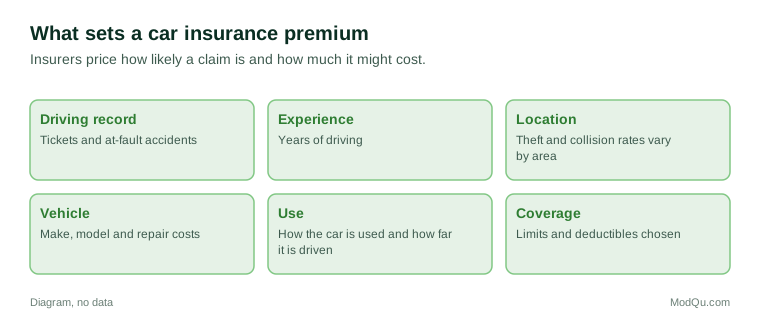
Insurers set premiums based on how likely a driver is to make a claim and how much a claim might cost. Common factors include:
- driving record, including tickets and at-fault accidents;
- years of driving experience;
- where the car is parked and driven, since theft and collision rates vary by area;
- the vehicle's make, model and repair costs;
- how the car is used and how far it is driven;
- coverage levels and deductibles chosen;
- in some places, age and other personal factors, within the limits allowed by regulators.
Example (hypothetical figures)
Two drivers with identical cars and clean records live 20 minutes apart. One pays $1,600 a year and the other $2,300, because the second lives in an area with more claims for collisions and theft. Neither knew the postal code affected the price so much until they compared notes.
Deductibles and coverage choices
A deductible is the amount the policyholder pays toward a claim before the insurer pays the rest. Choosing a higher deductible lowers the premium but means paying more out of pocket after an incident. Some drivers drop collision coverage on older cars whose value is low, accepting that they would pay for repairs themselves.
These choices involve trade-offs that many drivers find hard to judge, especially when they cannot predict whether they will have an accident.
How drivers shop for insurance
In private markets, drivers can buy insurance in several ways:
- directly from an insurance company, by phone or online;
- through a broker, who compares several insurers;
- through an agent who represents one company;
- through a group plan linked to an employer, professional association or alumni group;
- by bundling car and home insurance with one insurer for a discount.
Many drivers renew automatically each year. Some compare quotes only when the premium rises, when they buy a new car or when they move.
Example
A driver's renewal notice shows a 14% increase with no change in their record. They call a broker, who finds a policy with the same coverage for less. They switch, then wonder why they had not compared in the five previous years.
Usage-based insurance
Usage-based insurance, also called telematics insurance, uses an app or device to record how a car is driven: speed, hard braking, time of day and distance. Safe driving can earn a discount. Some drivers welcome the chance to prove they drive safely. Others refuse because of privacy concerns or worry that the data could raise their premium.
Making a claim
After an accident or theft, the policyholder reports the claim. The insurer assigns an adjuster, assesses fault and damage, arranges repairs or a settlement, and handles injury claims. Common frustrations include long repair times, disputes over fault, low settlements for written-off vehicles and premium increases after an at-fault claim.
How a claim is handled has a large effect on whether people stay with an insurer. Some drivers avoid claiming for small damage to protect their record.
Example
After a minor parking lot collision, a driver gets a repair estimate of $900. Their deductible is $500 and they worry an at-fault claim would raise their premium for years. They pay for the repair themselves rather than claim.
Rising costs and new vehicles
Repairs have become more expensive as cars carry more sensors, cameras and electronics. Vehicle theft has also increased in some areas, and certain models are targeted more than others. These trends have pushed premiums up and led some insurers to ask for anti-theft devices on high-risk models. Electric vehicles bring their own questions, such as battery repair costs.
Young and new drivers
New drivers usually pay the most because they have the least experience. In Canada, graduated licensing programs restrict new drivers for their first years. Families often add young drivers to a parent's policy as occasional drivers, which can cost less than a separate policy but must reflect who really drives the car. Completing an approved driver training course can earn a discount with many insurers.
What insurers and regulators want to know
Insurers, brokers and regulators study how drivers choose and switch policies. Questions include how often people compare quotes, what makes them switch, how they feel about telematics, how satisfied they are with claims and how premium increases affect their choices about driving and car ownership.
Key terms
- PremiumThe amount paid for an insurance policy.
- DeductibleThe amount the policyholder pays toward a claim before the insurer pays.
- Third-party liabilityCoverage for injury or damage you cause to others.
- Collision coverageCoverage for damage to your own car from a collision.
- Comprehensive coverageCoverage for theft, vandalism, fire, hail and similar damage.
- At-fault accidentA collision for which the insurer finds you responsible.
- TelematicsTechnology that records how a vehicle is driven.
- AdjusterThe person who assesses a claim and its cost.
Full glossary: personal lines insurance terms on EditingTests.com.
Car insurance vocabulary test
How well do you know the language of this topic? Try 8 quick questions. Your score is shown straight away and is not saved.
What the car insurance survey asks
This survey is part of ModQu's Insurance survey. The car insurance part takes about five minutes and covers:
- Who insures your vehicle and how you bought the policy: directly, through a broker or through a group plan.
- When you last compared quotes, and what prompted it.
- How your premium has changed in recent years.
- Whether you would let an insurer track your driving for a lower price.
- Your experience of any claim in the last few years.
- What would make you switch insurer.
After that you can choose to continue with other short parts of the Insurance survey, such as home and tenant insurance or life insurance, or stop.
Ready to take part?
Your answers help show what people really think and do. Results are only ever reported as totals; no one can see your individual answers.
Start the surveyQuestions about this survey
Who can take part?
Drivers who insure a vehicle.
Do I have to give my name?
No. You may be asked for your age group, region and similar details so results can be broken down, but not your name. ModQu never asks for passwords, card numbers or account numbers.
How are the results used?
Answers are combined into totals and percentages and published in ModQu reports. Individual answers are never shown.
Is the vocabulary test part of the survey?
No. It is optional and separate, and your score is not stored.