
Tell us about your workplace benefits
Tell us which benefits you have at work, which you use and how well you understand them. Your answers are combined with other people's and reported only as totals.
Start the workplace benefits and group insurance surveyAbout 5 minutes. No account needed. You can stop at any time.
What group benefits are
Group benefits are insurance and related programs that an employer arranges for its employees, usually through an insurance company. Because the plan covers a group, it can often be offered without individual medical exams and at a lower cost per person than individual policies. The employer may pay the full cost or share it with employees through payroll deductions.
Plans vary widely between employers, from a basic package to extensive coverage with many options.
What a typical plan includes
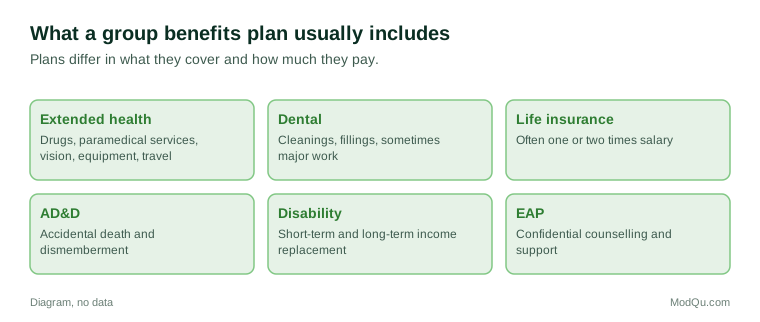
Common parts of a group benefits plan are:
- Extended health care: prescription drugs, paramedical services such as physiotherapy, massage and psychology, vision care, medical equipment and out-of-country emergency coverage.
- Dental care: preventive care such as cleanings, basic work such as fillings, and sometimes major work and orthodontics.
- Group life insurance: often one or two times salary, sometimes with optional extra coverage.
- Accidental death and dismemberment coverage.
- Disability insurance: short-term disability for a few weeks or months, and long-term disability for longer absences.
- Employee assistance program (EAP): confidential counselling and support services.
- Critical illness coverage on some plans.
Example
A new employee receives a 40-page benefits booklet on their first day and puts it in a drawer. A year later, they pay for physiotherapy out of pocket after a sports injury, not realizing their plan would have paid 80% of the cost up to a yearly limit.
Health and dental details
Health and dental plans usually pay a percentage of eligible costs, such as 80% or 100%, up to yearly maximums. Some services have limits per visit or per year. Plans may require that drugs be on an approved list, called a formulary, and may encourage generic substitutes.
Dental plans often set fees according to a provincial fee guide. If a dentist charges more than the guide, the employee pays the difference.
Disability insurance
Disability insurance replaces part of an employee's income if they cannot work because of illness or injury. Short-term disability often starts after a short waiting period and lasts weeks or months. Long-term disability usually starts after short-term benefits end, and can continue for years if the employee remains unable to work.
Employees often value health and dental benefits most because they use them often. Disability coverage is used less often but can matter more financially when it is needed.
Example (hypothetical figures)
An employee earning $5,000 a month before tax has a long-term disability plan that pays 60% of salary. After a serious back injury, the plan pays $3,000 a month. Whether this benefit is taxable depends on who paid the premiums, which the employee had never checked.
Flexible plans and spending accounts
Many employers now offer more choice:
- Flexible benefit plans let employees choose between levels of coverage, sometimes using credits provided by the employer.
- Health spending accounts give each employee a set amount each year for eligible health and dental expenses.
- Wellness or lifestyle spending accounts cover items such as gym memberships, fitness equipment or other approved expenses, and are usually taxable.
These options let employees match benefits to their needs, but they also require more decisions.
What employees understand
Many employees are unsure:
- what percentage of costs their plan pays;
- what their yearly maximums are;
- whether family members are covered;
- how to submit claims;
- whether they have disability or optional life coverage;
- what happens to their coverage if they leave the job or retire.
Benefit apps, online portals and direct billing by pharmacies and clinics have made claims easier, but understanding what is covered still depends on reading plan documents.
Which benefits employees value
When asked to rank benefits, employees often place health and dental coverage near the top, followed by retirement savings matching, paid time off and flexible work arrangements. Mental health support has become more important to many employees, and some plans have increased psychology coverage. Younger employees may value different things from older employees, such as student loan help or fertility coverage.
Example
Two employees at the same company compare notes. One, with three children, uses the dental and vision coverage heavily and sees benefits as worth thousands of dollars a year. The other, who is single and rarely sick, would prefer a larger wellness account and more vacation time.
Making the most of a benefits plan
Employees who get the most value from their plans tend to:
- read the plan summary when they join and again at each renewal;
- add a spouse or children during the enrolment window, since later changes may need medical evidence;
- coordinate benefits with a spouse's plan, so costs not paid by one plan can be claimed under the other;
- book cleanings, eye exams and paramedical visits before yearly limits reset;
- use the employee assistance program for counselling, legal or financial advice when it is available;
- check whether optional life or disability coverage is worth adding.
Example
A couple both have benefits at work. By submitting their child's orthodontic bills first to one plan and the unpaid balance to the other, they recover most of the cost instead of half.
Benefits when changing jobs or retiring
Group coverage usually ends when employment ends. Some insurers offer conversion options that let people buy individual coverage without medical questions, but only within a short time after leaving. Retirees may be offered retiree benefits or may need to buy individual plans. People between jobs, starting a business or retiring early often face a gap in coverage.
Benefits for small businesses
Small businesses can offer group benefits through insurers, brokers and association plans designed for small groups. Owners often weigh the cost against the need to attract and keep staff. Health spending accounts are popular with small employers because costs are predictable.
What employers and insurers want to know
Employers, insurers and benefit advisers want to know which benefits employees use, which they value, which they misunderstand, and how benefits affect decisions to join or leave an employer.
Key terms
- Group benefitsInsurance and related programs an employer arranges for employees.
- Extended health careCoverage for health costs not paid by public plans, such as drugs and physiotherapy.
- Short-term disabilityIncome replacement for a few weeks or months when an employee cannot work.
- Long-term disabilityIncome replacement for longer absences due to illness or injury.
- Employee assistance programA confidential counselling and support service for employees.
- Health spending accountAn employer-funded amount for eligible health and dental costs.
- FormularyThe list of drugs a plan covers.
- Conversion optionThe right to buy individual coverage after leaving a group plan.
Full glossary: group benefits insurance terms on EditingTests.com.
Workplace benefits and group insurance vocabulary test
How well do you know the language of this topic? Try 8 quick questions. Your score is shown straight away and is not saved.
What the workplace benefits and group insurance survey asks
This survey is part of ModQu's Insurance survey. The workplace benefits and group insurance part takes about five minutes and covers:
- Which benefits your employer provides, and whether family members are covered.
- Which benefits you used in the last year.
- How well you understand what your plan covers.
- Which benefits you value most, and which you would change.
- How you submit claims, and how easy it is.
- Whether benefits affected your decision to take or stay in your job.
After that you can choose to continue with other short parts of the Insurance survey, such as car insurance or home and tenant insurance, or stop.
Ready to take part?
Your answers help show what people really think and do. Results are only ever reported as totals; no one can see your individual answers.
Start the surveyQuestions about this survey
Who can take part?
Employees with workplace benefits.
Do I have to give my name?
No. You may be asked for your age group, region and similar details so results can be broken down, but not your name. ModQu never asks for passwords, card numbers or account numbers.
How are the results used?
Answers are combined into totals and percentages and published in ModQu reports. Individual answers are never shown.
Is the vocabulary test part of the survey?
No. It is optional and separate, and your score is not stored.