
Share your views on funeral planning
Tell us whether you have a funeral plan or burial cover, and what you expect a funeral to cost. Your answers are combined with other people's and reported only as totals.
Start the funeral and burial insurance surveyAbout 5 minutes. No account needed. You can stop at any time.
Why people plan for funeral costs
A funeral brings together many costs at a difficult time: the funeral director's services, a burial plot or cremation, a coffin or casket, transport, a ceremony, flowers, a headstone or memorial, and often a gathering afterwards. Families may also face travel costs and time off work. In some cultures, funerals involve several days of rituals and large gatherings, which adds to the cost.
People plan ahead for several reasons:
- to spare family members the cost;
- to record their wishes about the type of funeral;
- to lock in today's prices against future rises;
- to ensure religious or cultural requirements can be met;
- because they have little savings and want something set aside.
The main ways to pay in advance
There are several kinds of product, and the names vary between countries:
- Prepaid funeral plans: the person pays a funeral provider in advance, in a lump sum or instalments, for a specified funeral.
- Funeral or burial insurance: a small life insurance policy, often with no medical questions, that pays a set amount on death to cover funeral costs.
- Over-50s or final expense life insurance: a small whole-of-life policy marketed to older people.
- Burial societies and community schemes: members pay small regular contributions to a group fund that pays out when a member or relative dies. These are common in many parts of Africa and Asia, and among some diaspora communities.
- Savings or a regular life insurance policy that the family can use.
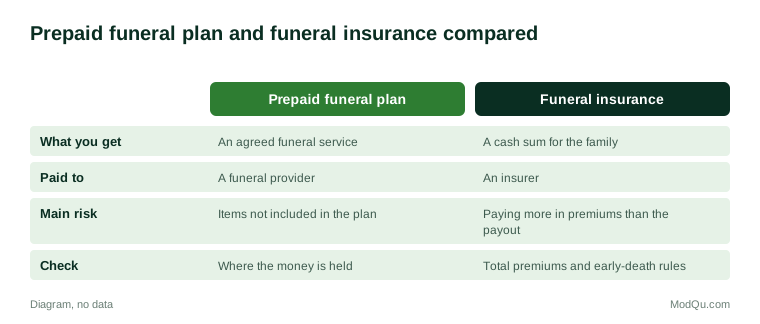
The figure below compares a prepaid plan with funeral insurance.
Prepaid plans
With a prepaid plan, the customer chooses a package of services, such as collection of the body, a basic coffin, a hearse and cremation or burial, and pays now. When they die, the provider carries out the funeral. Some plans fix the price of the services included; others do not cover items outside the provider's control, such as cemetery or crematorium fees, which the family must still pay.
Example
A widow buys a prepaid plan that covers the funeral director's services and cremation. When she dies years later, her family find that the plan covers most of the funeral, but they still pay for the venue for the gathering, flowers and a death notice, which were not included.
Funeral and over-50s insurance
These policies pay a fixed cash amount to the family or estate when the policyholder dies. They often accept anyone within an age range without health questions, but usually pay only premiums back, or a reduced amount, if death happens in the first year or two.
A key point is that monthly premiums are often paid for life. If the person lives a long time, they may pay more in premiums than the policy pays out.
Example (hypothetical figures)
A 60-year-old takes out a policy paying 5,000 on death, costing 25 a month. If they die at 85, they will have paid 7,500 in premiums for a payout of 5,000. If they die at 68, they will have paid 2,400 for the same 5,000.
Burial societies and community schemes
In many communities, funerals are funded collectively. Members of a burial society pay small regular amounts. When a member or a covered relative dies, the society pays an agreed sum and may help with food, transport and arrangements. Some societies are informal; others are registered or linked to insurers. They offer social support as well as money, but informal schemes can be at risk if funds are mismanaged.
Cultural and religious differences
Funeral customs shape costs and products. Some religions require burial within a day or two, which leaves little time to arrange finance. Others prefer cremation. Some families repatriate the body to a country of origin, which can be very expensive. Products aimed at particular communities may include repatriation, religious requirements or extended family members.
Example
A family living abroad wants to bury a parent in their home country. Their burial society covers repatriation costs, which would otherwise have been several times the cost of a local funeral. Friends without such cover had to raise money quickly through relatives and an online fundraiser.
Risks and what to check
Consumer groups and regulators in several countries have raised concerns about funeral products. Points people are encouraged to check include:
- exactly what the plan or policy covers, and what the family will still pay;
- whether the money for a prepaid plan is held in a trust or insurance policy, protected if the provider fails;
- whether premiums are paid for life, and the total cost compared with the payout;
- what happens if payments stop;
- cancellation rights and refunds;
- whether the provider is regulated.
Some countries have introduced regulation after providers failed or sold unsuitable plans.
Talking about funeral wishes
Many people say they have not discussed their funeral wishes with their family. Writing down wishes, telling relatives where documents are kept, and naming who should arrange the funeral can reduce stress and disagreement, whether or not a product is bought.
What people disagree about
Supporters say funeral plans and insurance give peace of mind and protect families from sudden costs. Critics say some products are poor value, especially policies where people pay more than they receive, and that savings or general life insurance can be better. There is also debate about whether governments should help more with funeral costs for people on low incomes.
Questions that businesses want answered include how many people have funeral cover, what type, why they bought it, what they expect a funeral to cost, whether they have discussed their wishes, and which features matter most.
Key terms
- Prepaid funeral planA funeral paid for in advance with a provider.
- Funeral insuranceA small life policy that pays a set amount to cover funeral costs.
- Over-50s planA small whole-of-life policy marketed to older people.
- Burial societyA group whose members pay into a fund that pays out for funerals.
- Third-party costsCosts outside the funeral director's control, such as cemetery fees.
- RepatriationReturning a body to another country for burial.
- Trust-backed planA prepaid plan whose money is held in a trust for protection.
- Whole-of-life policyInsurance that pays whenever death occurs, as long as premiums are paid.
Full glossary: life insurance terms on EditingTests.com.
Funeral and burial insurance vocabulary test
How well do you know the language of this topic? Try 8 quick questions. Your score is shown straight away and is not saved.
What the funeral and burial insurance survey asks
This survey is part of ModQu's Insurance survey. The funeral and burial insurance part takes about five minutes and covers:
- Whether you have a funeral plan, funeral insurance or belong to a burial society.
- Why you chose it, or why you have not planned ahead.
- How much you expect a funeral to cost where you live.
- Whether you have discussed your funeral wishes with family.
- Which features matter most, such as religious needs or repatriation.
- How you would pay for a family member's funeral if it happened tomorrow.
After that you can choose to continue with other short parts of the Insurance survey, such as car insurance or home and tenant insurance, or stop.
Ready to take part?
Your answers help show what people really think and do. Results are only ever reported as totals; no one can see your individual answers.
Start the surveyQuestions about this survey
Who can take part?
Adults aged 40 and over.
Do I have to give my name?
No. You may be asked for your age group, region and similar details so results can be broken down, but not your name. ModQu never asks for passwords, card numbers or account numbers.
How are the results used?
Answers are combined into totals and percentages and published in ModQu reports. Individual answers are never shown.
Is the vocabulary test part of the survey?
No. It is optional and separate, and your score is not stored.
Is a funeral plan the same as life insurance?
No. A prepaid plan pays for a funeral service; funeral insurance pays a cash sum that the family can use.
Can I cancel a funeral plan?
Rules differ. Check cancellation rights and refunds before buying.