
Share how you buy insurance
Tell us how you bought your last policy, what you compared, and what decided your choice. Your answers are combined with other people's and reported only as totals.
Start the choosing and comparing insurance online surveyAbout 5 minutes. No account needed. You can stop at any time.
The main ways to buy insurance
People buy car, home, travel, pet and other personal insurance through several routes:
- Direct from an insurer, by website, app or phone.
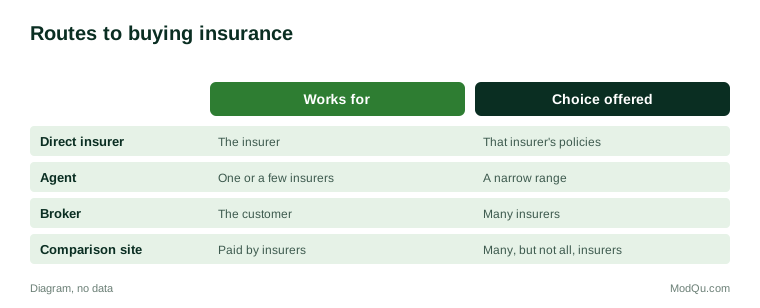
- Through a broker, who is independent of insurers and searches the market for the customer.
- Through an agent, who represents one insurer or a small group of insurers.
- On a comparison website, which shows quotes from many providers side by side.
- Bundled with something else, such as travel cover with a bank account or pet cover with a pet shop.
- Through an employer or membership group, such as an association or union.
The mix of routes differs by country. In some markets, comparison sites dominate car insurance; in others, agents and brokers remain the main channel, especially for older customers and more complex needs.
The figure below shows the main routes and who the seller works for.
How comparison sites work
A comparison site asks a set of questions once, then shows quotes from many insurers. When the customer clicks through and buys, the site is usually paid a commission or fee by the insurer. Some sites also earn money from advertising.
Comparison sites make it quick to see a range of prices. They do not always include every insurer, because some insurers choose not to appear on them. The order in which results appear may depend on price, but sometimes also on commercial arrangements, which should be disclosed.
Example
A driver enters their details on a comparison site and gets fifteen quotes. The cheapest has an excess of 1,000 and no courtesy car. The third cheapest has an excess of 250 and includes a courtesy car. After comparing the details, they choose the third.
What to compare besides price
Price matters, but policies at the same price can differ a great deal. Points people commonly compare include:
- Excess: how much the customer pays toward each claim.
- Limits: the most the policy will pay for each type of loss.
- Exclusions: what is not covered.
- Extras: legal cover, breakdown cover, courtesy car, accidental damage.
- Claims service: how claims are made and how quickly they are settled.
- Reviews and complaints records, where these are published.
- Payment method: paying monthly can cost more than paying once a year.
Example (hypothetical figures)
Two home insurance quotes cost 300 and 340 a year. The cheaper has an excess of 500 and does not cover accidental damage. The dearer has an excess of 150 and includes accidental damage. If the household spills paint on a carpet costing 800 to replace, the cheaper policy pays nothing, while the dearer one pays 650.
Brokers and agents
Brokers can help with less common situations: a driver with past convictions, a home in a flood-risk area, a valuable collection, or a small business. They can explain policy wording and help with claims. They are usually paid by commission from insurers, a fee from the customer, or both. Customers may ask how a broker is paid.
Agents represent particular insurers. They can be helpful and local, but they offer a narrower choice than a broker or a comparison site.
Common mistakes when buying online
Buying online is fast, which can lead to mistakes:
- giving wrong answers, for example about past claims or who drives a car, which can lead to a refused claim later;
- accepting default answers without checking them;
- choosing the cheapest quote without reading the excess and exclusions;
- forgetting to cancel an old policy, or letting it renew automatically alongside a new one;
- buying cover already included elsewhere, such as through a bank account.
Example
A young driver lists a parent as the main driver of the car to get a lower price, although the young driver uses it every day. This practice, often called fronting, is a form of misrepresentation. After an accident, the insurer investigates and refuses the claim.
Apps, chatbots and automated quotes
Newer insurers sell entirely through apps, using short questionnaires and automated pricing. Some use chatbots to answer questions and handle simple claims. Many customers like the speed. Others are concerned about how their data is used to set prices, and about reaching a person when something goes wrong.
Who uses which channel
Patterns vary by product and country, but surveys often find that younger customers are more likely to buy online and use comparison sites, while older customers and those with complex needs are more likely to use brokers, agents or the phone. Price-sensitive products, such as car insurance, are compared more often than products like life insurance.
Rules that protect buyers
In many countries, insurance sellers must give clear information about cover, price and fees, and treat customers fairly. Some require insurers to show the previous year's price at renewal, or ban charging existing customers more than new ones. Comparison sites and brokers are usually regulated as insurance intermediaries. Most countries also have an ombudsman or complaints scheme for disputes.
Reading the policy documents
Before buying, insurers must usually provide a summary document and the full policy wording. The summary lists the main features, limits and exclusions in a standard format in many countries, which makes it easier to compare products. Few buyers read the full wording, but checking the summary for the excess, the limits that matter most and the main exclusions takes only a few minutes and prevents many later disputes.
What people disagree about
Some say comparison sites have made insurance cheaper and more competitive. Others say they have focused buyers on price alone and encouraged policies with high excesses and low limits. There is also debate about whether brokers' advice is worth paying for when quotes are available instantly online.
Questions that businesses want answered include which channels people use, how many quotes they compare, what decides their choice, how often they read the policy wording, and how satisfied they are after a claim.
Key terms
- Comparison siteA website that shows insurance quotes from many providers side by side.
- BrokerAn intermediary who searches the market for insurance on the customer's behalf.
- AgentA seller who represents one insurer or a small group of insurers.
- ExcessThe amount the policyholder pays toward each claim.
- LimitThe most a policy will pay for a type of loss.
- CommissionA payment from an insurer to the seller for each policy sold.
- FrontingNaming a lower-risk person as the main driver to get a cheaper price.
- MisrepresentationGiving false or misleading information when buying insurance.
Full glossary: insurance brokerage terms on EditingTests.com.
Choosing and comparing insurance online vocabulary test
How well do you know the language of this topic? Try 8 quick questions. Your score is shown straight away and is not saved.
What the choosing and comparing insurance online survey asks
This survey is part of ModQu's Insurance survey. The choosing and comparing insurance online part takes about five minutes and covers:
- How you bought your last insurance policy and which type it was.
- Whether you used a comparison site, broker, agent or went direct.
- How many quotes you compared and what you looked at besides price.
- What decided your final choice.
- Whether you read the policy wording before buying.
- How you would prefer to buy insurance in future.
After that you can choose to continue with other short parts of the Insurance survey, such as car insurance or home and tenant insurance, or stop.
Ready to take part?
Your answers help show what people really think and do. Results are only ever reported as totals; no one can see your individual answers.
Start the surveyQuestions about this survey
Who can take part?
Adults who bought any insurance in the last two years.
Do I have to give my name?
No. You may be asked for your age group, region and similar details so results can be broken down, but not your name. ModQu never asks for passwords, card numbers or account numbers.
How are the results used?
Answers are combined into totals and percentages and published in ModQu reports. Individual answers are never shown.
Is the vocabulary test part of the survey?
No. It is optional and separate, and your score is not stored.
Do comparison sites show every insurer?
No. Some insurers choose not to appear, so it can be worth checking a few insurers directly.
Do I pay more by using a broker?
Not always. Brokers may be paid by commission, a fee, or both. You can ask how they are paid.