
Share your experience of travel insurance
Tell us whether you insure your trips, where you buy cover, and whether you have claimed. Your answers are combined with other people's and reported only as totals.
Start the travel insurance and trip cancellation surveyAbout 5 minutes. No account needed. You can stop at any time.
What travel insurance covers
Travel insurance is a bundle of different kinds of cover sold together. A typical policy includes some or all of the following:
- Emergency medical expenses abroad, including hospital treatment and, in serious cases, flying the person home.
- Cancellation: refunds of non-refundable costs if the trip has to be cancelled for a covered reason, such as illness or a death in the family.
- Curtailment: costs if the trip has to be cut short.
- Delay and missed departure: payments for long delays or for extra costs when a connection is missed.
- Baggage and personal belongings: lost, stolen or damaged items, usually with limits per item.
- Personal liability: if the traveller accidentally injures someone or damages property.
- Optional extras: winter sports, cruises, business equipment, adventure activities or cover for pre-existing medical conditions.
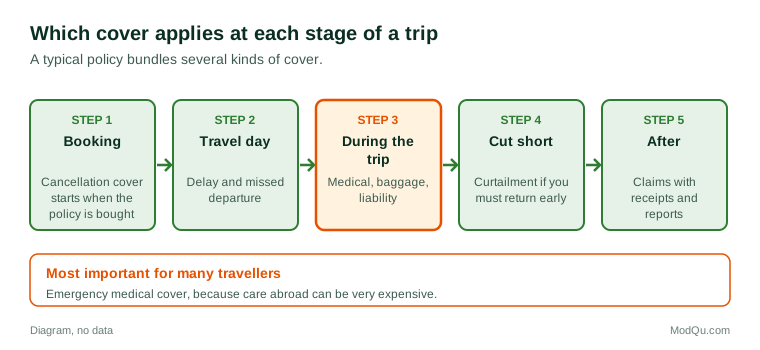
The figure below shows which part of a trip each kind of cover applies to.
Why medical cover matters most
For many travellers the most important part of a policy is medical cover. Health care abroad can be very expensive, and public health systems usually do not pay for treatment in another country, unless there is an agreement between the two countries. An accident or sudden illness can lead to large bills, and bringing someone home by air ambulance can cost far more than the trip itself.
Example (hypothetical figures)
A traveller breaks a leg hiking abroad. The hospital bill is 9,000, and returning home with a medical escort costs another 6,000. Their policy covers both, minus an excess of 100. Without insurance, the family would have needed to find 15,000 at short notice.
Single-trip, annual and bundled cover
People buy travel insurance in several ways:
- Single-trip policies cover one journey.
- Annual multi-trip policies cover any number of trips in a year, each up to a set length, and are often cheaper for frequent travellers.
- Packaged cover comes with some bank accounts and premium credit cards.
- Cover bought with the trip from airlines, tour operators or booking sites.
- Long-stay and backpacker policies for trips of several months.
Packaged cover can be useful, but people often do not know it exists, or do not know its limits, age restrictions or rules about pre-existing conditions.
Cancellation cover and what counts as a reason
Cancellation cover usually applies only for reasons listed in the policy. Common covered reasons include serious illness or injury of the traveller or a close relative, a death in the family, being called for jury service, or the home being badly damaged. Common reasons that are usually not covered include simply changing one's mind, not being able to afford the trip, or a known event that was already happening when the policy was bought.
Example
A couple buy insurance the day they book a holiday six months away. Two months later, one of them is diagnosed with an illness that means they cannot travel. Because the policy started when they booked, the cancellation is covered. Friends who waited to buy insurance until a week before travelling would not have been covered for problems that began before that.
This is why consumer guides often suggest buying cover when the trip is booked rather than just before departure.
Common exclusions
Exclusions are the situations a policy does not cover. They differ by policy, but common ones include:
- medical conditions the traveller already had and did not declare;
- injuries while under the influence of alcohol or drugs;
- risky activities not listed in the policy;
- travel to places the government advises against visiting;
- items left unattended or valuables in checked luggage;
- pandemics and other widespread events, depending on the policy;
- losses not reported to the police or carrier within a set time.
Reading the exclusions and limits is one of the most important steps when choosing a policy.
How claims work
Claims usually start with a phone call to the insurer's emergency line, for medical problems, or an online claim form after the trip. Insurers commonly ask for:
- receipts and booking confirmations;
- medical reports or death certificates;
- police reports for theft;
- airline reports for lost or delayed luggage;
- proof of the reason for cancellation.
Example
A traveller's suitcase is lost on the way out. They get a report from the airline at the airport, keep receipts for essentials bought while waiting, and submit them on return. The insurer pays for the essentials but deducts the amount the airline has already paid as compensation.
Many disputes come from missing paperwork, undeclared medical conditions or situations the traveller thought were covered but were not.
Travel insurance for older travellers and people with health conditions
Older travellers and people with long-term health conditions often find cover harder to get or more expensive. Some insurers set upper age limits on annual policies. Declaring conditions accurately matters, because an undeclared condition can lead to a refused claim even if the problem abroad seems unrelated. Specialist insurers and comparison tools that focus on medical conditions exist in many markets.
Comparing policies
When people compare travel policies, price is only one part. Other points that make a large difference include the medical cover limit, the excess per claim, the cancellation limit compared with the cost of the trip, the cover for valuables, the activities included, and whether the insurer has a 24-hour emergency line. Two policies at the same price can give very different protection, and the cheapest policies often have the lowest limits and highest excesses.
What people disagree about
Some travellers see insurance as essential for any trip abroad. Others think it is poor value for short or cheap trips, or rely on bank or card cover without checking it. Opinions also differ on whether insurers are too quick to refuse claims, and whether new kinds of cover, such as "cancel for any reason" options, are worth the higher price.
Questions that businesses want answered include how many travellers buy insurance, when and where they buy it, whether they read the policy, whether they rely on packaged cover, and how claims experiences affect their next purchase.
Key terms
- Single-trip policyTravel insurance covering one journey.
- Annual multi-trip policyTravel insurance covering any number of trips in a year.
- Cancellation coverRepayment of non-refundable costs if a trip is cancelled for a covered reason.
- CurtailmentCutting a trip short, and the cover for costs that result.
- Pre-existing conditionA medical condition the traveller had before buying the policy.
- ExcessThe part of a claim the policyholder pays themselves.
- RepatriationBringing a traveller home, often for medical reasons.
- ExclusionA situation the policy does not cover.
Full glossary: travel insurance terms on EditingTests.com.
Travel insurance and trip cancellation vocabulary test
How well do you know the language of this topic? Try 8 quick questions. Your score is shown straight away and is not saved.
What the travel insurance and trip cancellation survey asks
This survey is part of ModQu's Insurance survey. The travel insurance and trip cancellation part takes about five minutes and covers:
- Whether you bought travel insurance for your last trip, and when.
- Where you bought it, or whether you relied on bank or card cover.
- Which kinds of cover matter most to you.
- Whether you read the policy and declared any medical conditions.
- Whether you have made a claim, and how it went.
- How claims and prices affect where you buy next time.
After that you can choose to continue with other short parts of the Insurance survey, such as car insurance or home and tenant insurance, or stop.
Ready to take part?
Your answers help show what people really think and do. Results are only ever reported as totals; no one can see your individual answers.
Start the surveyQuestions about this survey
Who can take part?
Adults who travelled in the last two years.
Do I have to give my name?
No. You may be asked for your age group, region and similar details so results can be broken down, but not your name. ModQu never asks for passwords, card numbers or account numbers.
How are the results used?
Answers are combined into totals and percentages and published in ModQu reports. Individual answers are never shown.
Is the vocabulary test part of the survey?
No. It is optional and separate, and your score is not stored.
Does my bank account or credit card include travel insurance?
Some do. Check the terms, limits, age rules and whether medical conditions are covered before relying on it.
Is travel insurance required?
It is optional for most trips, but some countries and some tour operators require proof of medical cover.