
Share your experience after a loss
Tell us what support you used after your loss, how much time off work you had and which practical task was hardest. Your answers are combined with other people's and reported only as totals.
Start the grief and bereavement surveyAbout 5 minutes. No account needed. You can stop at any time.
About this page
This page is written for people who have lost someone and for those who want to understand what bereavement involves. It describes common experiences and does not replace professional help. If you are struggling, health services, bereavement charities and helplines in your country can offer support.
What grief is like
Grief is the response to loss. It affects feelings, thoughts, the body and daily life. People describe:
- sadness, longing and crying;
- shock and numbness, especially after a sudden death;
- anger, guilt or regret;
- tiredness, poor sleep and changes in appetite;
- difficulty concentrating;
- relief, after a long illness, sometimes mixed with guilt.
There is no fixed timetable. Many people find that grief comes in waves, with hard days around anniversaries, birthdays and holidays. Older models described grief as a series of stages; many professionals now say that people move back and forth between focusing on the loss and getting on with life, and that grief often changes rather than ends.
For some people, grief remains very intense and disabling for a long time. Health professionals may call this prolonged grief, and specialist help is available.
Support people turn to
People use many kinds of support:
- family and friends, the most common source;
- faith communities and religious leaders;
- bereavement charities, with helplines, counselling and support groups;
- doctors and mental health services;
- hospice bereavement services for families of people who died in their care;
- online communities and forums;
- books, podcasts and memorial activities.
Some losses, such as the death of a child, suicide, a death during pregnancy or a death in violent circumstances, have specialist support groups.
Example
After their father dies, a woman in her forties feels she should be coping because she has a family and a job. A friend suggests a bereavement support group run by the hospice that cared for him. She attends monthly for a year and says that hearing others describe the same feelings helped more than she expected.
Time off work
Workplaces respond to bereavement in different ways. Some countries have legal rights to bereavement leave, often for close relatives, and a few have specific rights for parents who lose a child. In many countries it is left to employers' policies, which may give a few days of paid leave. People often take extra time as holiday, sick leave or unpaid leave.
Returning to work can be hard. Common requests include a phased return, flexible hours, time off for the funeral and estate matters, and colleagues knowing how to respond.
Example
An employee is given three days of paid bereavement leave after their mother's death, which is the company policy. The funeral takes place abroad, so they add a week of holiday. On returning, their manager agrees to a month of reduced hours. They say the manager asking what would help mattered more than the policy itself.
Practical tasks after a death
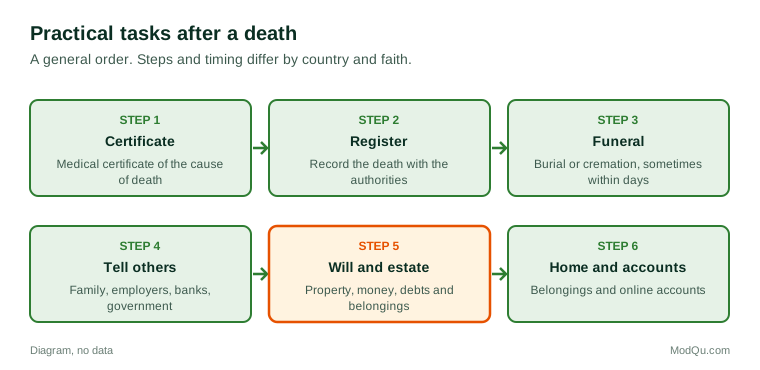
A death brings practical tasks, often in the first days and weeks. The details vary by country and religion, but common steps include:
- obtaining a medical certificate of the cause of death;
- registering the death with the authorities;
- arranging the funeral, burial or cremation, sometimes within a day or two in some faiths;
- telling family, friends, employers, banks, government departments and service providers;
- finding the will, if there is one;
- dealing with the estate: property, money, debts and belongings;
- closing or memorializing online accounts;
- dealing with the deceased person's home and possessions.
Some countries offer a single service to notify several government departments at once. Funeral directors, lawyers and advice services can help with parts of the process.
Costs and money
Bereavement can bring unexpected costs, including funerals, travel, legal fees and lost income. Some families face disputes over money or belongings.
Example (hypothetical figures)
A family arranges a funeral costing 6,500 dollars: 3,500 for the funeral director's services, 1,800 for burial, 700 for flowers and a reception and 500 for an obituary and printing. A life insurance policy pays out 5,000 dollars after eight weeks. The family covers the 1,500 dollar difference from savings and splits the reception costs among three siblings.
Some governments provide funeral payments or bereavement benefits for people on low incomes or for surviving partners with children.
Grief at work and among friends
Many bereaved people say that colleagues and friends did not know what to say and so said nothing, which felt hurtful. Simple acknowledgement, such as saying they are sorry, using the person's name and offering practical help, is often what people value most. Some workplaces now provide guidance for managers and colleagues on how to support someone after a death.
Children and grief
Children grieve too, though they may show it differently, through play, questions or changes in behaviour. Many experts suggest being honest in words suitable for their age, keeping routines and involving them in rituals if they wish. Schools and children's bereavement charities can help.
Remembering
People keep memories alive in many ways: anniversaries, visits to graves, memorial trees and benches, photo books, online memorial pages, fundraising for causes linked to the person, and religious rites on set days after the death. Different cultures have long traditions of remembering the dead, such as annual days of remembrance.
What people disagree about
Bereavement raises a few public debates:
- whether paid bereavement leave should be a legal right, and for which relationships;
- how much funerals should cost and whether prices should be clearer;
- how social media accounts of people who have died should be handled;
- how much grief should be treated as a medical issue.
Questions funeral services, employers, insurers and support services want answered include what support people used, how much time off they had, which tasks were hardest and what would have helped.
Key terms
- BereavementThe experience of losing someone close through death.
- GriefThe emotional and physical response to loss.
- Prolonged griefIntense grief that lasts a long time and disrupts daily life.
- Bereavement leaveTime off work after a death, paid or unpaid.
- Registering a deathOfficially recording a death with the authorities.
- EstateEverything a person owned and owed when they died.
- ExecutorThe person named in a will to deal with the estate.
- Memorialized accountAn online account kept as a memorial after its owner's death.
Full glossary: funeral homes terms on EditingTests.com.
Grief and bereavement vocabulary test
How well do you know the language of this topic? Try 8 quick questions. Your score is shown straight away and is not saved.
What the grief and bereavement survey asks
This survey is part of ModQu's Life Stages and Family survey. The grief and bereavement part takes about five minutes and covers:
- Your relationship to the person who died, and roughly when.
- What support you used, and what helped most.
- How much time off work you had, and how your workplace responded.
- Which practical task was hardest.
- Any costs that were hard to meet.
- What would have made things easier.
After that you can choose to continue with other short parts of the Life Stages and Family survey, such as ageing and senior living or weddings and celebrations, or stop.
Ready to take part?
Your answers help show what people really think and do. Results are only ever reported as totals; no one can see your individual answers.
Start the surveyQuestions about this survey
Who can take part?
Adults who lost someone close in the last five years.
Do I have to give my name?
No. You may be asked for your age group, region and similar details so results can be broken down, but not your name. ModQu never asks for passwords, card numbers or account numbers.
How are the results used?
Answers are combined into totals and percentages and published in ModQu reports. Individual answers are never shown.
Is the vocabulary test part of the survey?
No. It is optional and separate, and your score is not stored.
Do I have to describe the death?
No. The survey does not ask how the person died, and every question can be skipped.
What if answering is upsetting?
You can stop at any time. Support is available from bereavement charities, health services and helplines in your country.