
Share your experience of buying fuel
Tell us how much you spend on fuel a month, whether you drive further for cheaper fuel and how you choose a station. Your answers are combined with other people's and reported only as totals.
Start the fuel prices and filling up surveyAbout 5 minutes. No account needed. You can stop at any time.
What this topic covers
This topic covers how drivers buy petrol (gasoline), diesel and, in some countries, liquefied petroleum gas (LPG) or compressed natural gas (CNG) for their vehicles. It looks at:
- how much drivers spend on fuel;
- what they know about why prices change;
- how they respond to price rises;
- how they choose a fuel station;
- their use of fuel price apps, loyalty schemes and discounts;
- how fuel prices affect decisions about driving and buying vehicles.
Electric vehicle charging is covered in a separate topic, though many drivers now compare the two.
What makes up the price of fuel
The price at the pump is made up of several parts:
- Crude oil: the cost of the raw material, traded on world markets in US dollars;
- Refining: turning crude oil into petrol and diesel;
- Distribution and retail: transport, storage and the station's costs and profit;
- Taxes: fuel duties, excise taxes, sales or value-added tax and sometimes carbon taxes.
Taxes vary enormously between countries. In some European countries taxes make up around half of the pump price or more; in some oil-producing countries fuel is subsidized and sells for much less than the world market price. These differences explain why fuel costs very different amounts in neighbouring countries.
Why prices change
Prices change for reasons such as:
- changes in world crude oil prices, driven by supply, demand, conflicts and decisions by producing countries;
- changes in exchange rates against the US dollar;
- refinery outages and seasonal changes in fuel blends;
- tax changes and the end or start of subsidies;
- local competition between stations.
Drivers often notice that pump prices seem to rise quickly when oil prices rise but fall slowly when oil prices fall. Economists sometimes call this "rockets and feathers". Competition authorities in several countries have studied whether it happens and why.
How much drivers spend
Fuel spending depends on how far people drive, their vehicle's fuel economy and local prices. For households that drive a lot, such as people in rural areas or those who drive for work, fuel can be a large share of the budget. Many drivers do not know exactly how much they spend each month, because they fill up in small amounts or by the amount they can afford.
Example
A delivery driver who uses their own car notices that fuel now takes almost a quarter of their weekly earnings, up from about a sixth a year earlier. They start planning routes more carefully, keep the tyres properly inflated and turn off the engine while waiting, which they say makes a small but noticeable difference.
How drivers respond to price rises
When prices rise, drivers report several responses:
- shopping around for cheaper stations;
- filling up when prices are expected to rise, or waiting when they are expected to fall;
- driving less, combining trips and using public transport or cycling;
- driving more gently to save fuel;
- car-sharing for commuting;
- cutting other spending;
- thinking about a more efficient or electric vehicle for their next purchase.
Short-term changes in how much people drive are usually small, because many journeys are necessary. Longer-term changes, such as vehicle choice and where people live, respond more.
How drivers choose a fuel station
Common factors include:
- Price, often the main factor for people who drive a lot;
- Location and convenience: on the way to work or near home;
- Loyalty schemes and discounts linked to supermarkets, cards or apps;
- Fuel quality and trust in the brand;
- Facilities: shops, food, toilets, car washes and air;
- Payment options, including pay-at-pump and app payment;
- Safety and lighting, especially at night;
- Service: in some countries attendants fill the tank.
Example
A commuter in a town with five fuel stations used to fill up wherever was closest. After downloading a price app, they find that prices at a supermarket station on their way home are usually a few cents lower, and that its loyalty scheme adds a further discount each month. They now fill up there once a week and say the habit took no extra time.
Is driving further for cheaper fuel worth it?
Many drivers drive to a cheaper station further away. Whether it saves money depends on the price difference, the size of the fill and the extra distance.
Example (hypothetical figures)
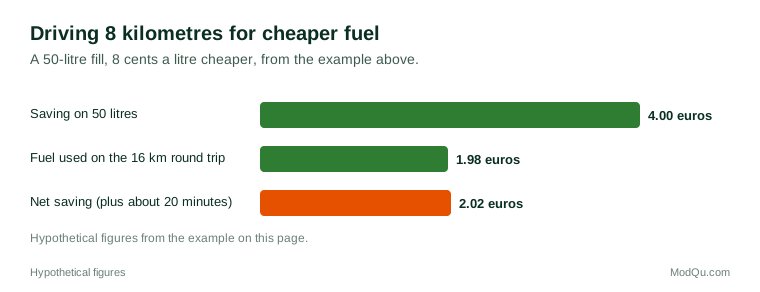
A driver fills a 50-litre tank. A nearby station charges 1.80 euros a litre; one 8 kilometres away charges 1.72 euros. Filling at the cheaper station saves 50 × 0.08 = 4.00 euros. The round trip of 16 kilometres uses about 1.1 litres in a car using 7 litres per 100 kilometres, costing about 1.98 euros. The net saving is about 2.02 euros, plus around 20 minutes of the driver's time.
Figure 1 shows the saving in the example. If the station were further away, or the tank smaller, the saving would shrink or disappear.
Apps, loyalty schemes and discounts
Ways drivers try to pay less include:
- Fuel price apps and websites, some run by governments that require stations to report prices in real time, as in parts of Australia, Germany and other countries;
- Supermarket and loyalty discounts per litre;
- Credit cards with cashback on fuel;
- Fuel cards for businesses;
- Membership warehouse stations with lower prices for members.
Some drivers say the savings are small compared with the effort; others enjoy finding the best price.
Trends and debates
Trends include more price transparency through apps, growing numbers of electric and hybrid vehicles, and stations adding charging points, food and services. Debates include the level of fuel taxes, the fairness of fuel prices for rural drivers and low-income households, fuel subsidies and their cost to governments, and whether prices fall as quickly as they rise.
Questions that businesses want answered here include how much people spend on fuel, how sensitive they are to price, how they choose stations, and how they use apps and loyalty schemes.
Key terms
- Pump priceThe price per litre or gallon shown at the fuel station.
- Crude oilUnrefined oil from which petrol and diesel are made.
- Fuel dutyA tax charged on each litre or gallon of fuel.
- Fuel economyHow far a vehicle travels on a given amount of fuel.
- Fuel subsidyGovernment support that keeps fuel prices below market levels.
- Rockets and feathersThe idea that fuel prices rise quickly but fall slowly.
- LPGLiquefied petroleum gas, an alternative vehicle fuel in some countries.
- Pay-at-pumpPaying by card or app at the pump without going inside.
Full glossary: fuel analytics terms on EditingTests.com.
Fuel prices and filling up vocabulary test
How well do you know the language of this topic? Try 8 quick questions. Your score is shown straight away and is not saved.
What the fuel prices and filling up survey asks
This survey is part of ModQu's Cars and Getting Around survey. The fuel prices and filling up part takes about five minutes and covers:
- How much you spend on fuel in a typical month.
- What kind of vehicle and fuel you use.
- How you respond when fuel prices rise.
- Whether you drive further for cheaper fuel, and how far.
- How you choose a fuel station, and whether you use price apps or loyalty schemes.
- Whether fuel prices affect your plans for your next vehicle.
After that you can choose to continue with other short parts of the Cars and Getting Around survey, such as buying a car or electric vehicles, or stop.
Ready to take part?
Your answers help show what people really think and do. Results are only ever reported as totals; no one can see your individual answers.
Start the surveyQuestions about this survey
Who can take part?
Drivers.
Do I have to give my name?
No. You may be asked for your age group, region and similar details so results can be broken down, but not your name. ModQu never asks for passwords, card numbers or account numbers.
How are the results used?
Answers are combined into totals and percentages and published in ModQu reports. Individual answers are never shown.
Is the vocabulary test part of the survey?
No. It is optional and separate, and your score is not stored.
Why does fuel cost more on motorways?
Stations on motorways and major highways often have fewer competitors nearby and higher operating costs, so prices are often higher than in towns.
Does premium fuel save money?
For most cars designed for regular fuel, premium fuel gives little benefit. Some engines are designed for higher-octane fuel; the vehicle handbook says which fuel to use.