
Share your views on values-based finance
Tell us whether your values affect how you bank, save or invest, and what you look for. Your answers are combined with other people's and reported only as totals.
Start the ethical and islamic finance surveyAbout 5 minutes. No account needed. You can stop at any time.
Money and values
Most financial products are chosen for cost, return and convenience. A growing number of people also ask what their money is used for. A bank lends deposits to businesses and households; a pension fund buys shares in companies. Values-based finance tries to make those choices match the beliefs of the customer.
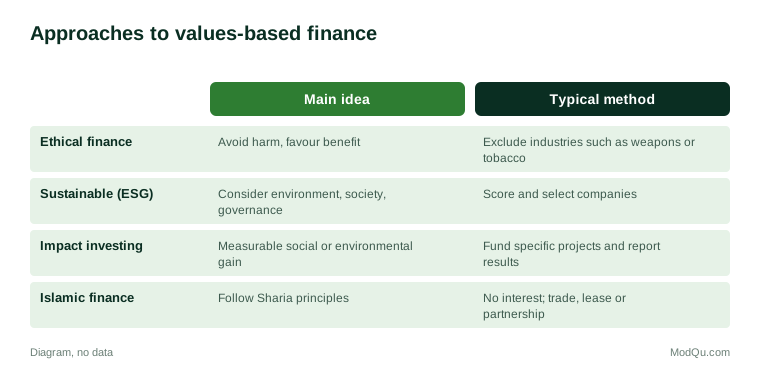
There are several related approaches:
- Ethical finance: avoiding activities seen as harmful, such as weapons, tobacco or gambling, and favouring those seen as beneficial.
- Sustainable or ESG investing: considering environmental, social and governance factors when choosing investments.
- Impact investing: aiming for a measurable social or environmental benefit as well as a financial return.
- Faith-based finance: following religious principles, of which Islamic finance is the largest and most developed example.
The figure below compares these approaches.
How ethical and sustainable products work
Ethical and sustainable products use a few common methods:
- Exclusion (negative screening): leaving out companies in certain industries.
- Selection (positive screening): choosing companies that score well on environmental or social measures.
- Engagement: owning shares and using votes and meetings to push companies to change.
- Thematic funds: focusing on areas such as renewable energy, water or affordable housing.
- Ethical banks and credit unions: lending only to projects that meet their criteria and publishing what they lend to.
Example
A teacher discovers that their pension fund invests in companies they object to. They find that their scheme offers a sustainable fund option that excludes several industries. They switch part of their contributions to it after checking its fees and what it actually excludes.
The basics of Islamic finance
Islamic finance follows principles from Islamic law (Sharia). Key features include:
- No interest (riba): money should not earn money simply by being lent. Products are structured as trade, leasing or partnership instead.
- Shared risk: profits and losses are shared between the provider and the customer in some products.
- No excessive uncertainty (gharar) or speculation.
- Avoiding prohibited activities, such as alcohol, gambling and pork-related businesses.
- Backing by real assets: transactions are linked to a tangible asset or activity.
Islamic banks have a Sharia supervisory board of scholars who review products. Islamic finance is well established in many Muslim-majority countries and is offered by specialist banks and windows within conventional banks in many others.
Common Islamic finance products
- Murabaha (cost-plus sale): the bank buys an item, such as a car or home, and sells it to the customer at an agreed higher price paid in instalments.
- Ijara (lease): the bank owns an asset and leases it to the customer, sometimes with ownership passing at the end.
- Musharaka (partnership): the bank and customer co-own an asset or business and share profit and loss; in home finance, the customer gradually buys the bank's share.
- Mudaraba (profit-sharing): one party provides money and the other management, sharing profits by agreement.
- Sukuk: certificates linked to assets, often described as Islamic bonds.
- Takaful: a cooperative form of insurance in which members contribute to a shared fund.
Example (hypothetical figures)
A family wants a home priced at 200,000. Under a diminishing partnership, they pay 40,000 and the bank pays 160,000. Each month they pay rent on the bank's share plus an amount to buy more of it. After the agreed term, they own the whole home. The monthly cost may be similar to a conventional mortgage, but it is structured as rent and purchase rather than interest.
Who uses values-based finance
People who choose these products often say they want to:
- follow religious rules;
- avoid funding industries they object to;
- support climate action or social causes;
- encourage better behaviour by companies;
- feel good about where their money goes.
Many non-Muslims also use Islamic products, and many people of faith use conventional ones. Interest in sustainable investing has grown among younger savers in particular.
Values-based finance in everyday banking
Values-based choices are not limited to investments. Some people choose a current account at a bank that publishes all its loans, or a credit union that lends only in its local community. Some cards donate a share of spending to charity. Islamic current accounts usually pay no interest, and Islamic savings accounts may pay an expected profit rate instead. Some apps show the estimated carbon footprint of each purchase. For many customers, these everyday choices are the first step before considering pensions or investments.
Questions and criticisms
Values-based finance faces several questions:
- Labels: terms such as sustainable, green or ethical are not always defined, and funds may hold companies a customer would not expect. This is sometimes called greenwashing.
- Cost: some products charge higher fees or offer fewer choices.
- Returns: people disagree on whether screening reduces, increases or has little effect on returns over time.
- Form versus substance: some critics say certain Islamic products are very similar in cost to interest-based ones; supporters say the structure and risk-sharing matter.
- Availability: in many countries, few providers offer these products.
Example
A couple choose a fund labelled sustainable. When they read the list of holdings, they find several companies they wanted to avoid. They move to a fund that publishes clear exclusion rules and full holdings each quarter.
What people disagree about
Some argue that finance should focus only on financial return and that social goals belong to governments. Others say that how money is invested shapes the economy and that savers have a right to choose. There is also debate about how strict rules for labels should be, and who should certify that a product is ethical or Sharia-compliant.
Questions that businesses want answered include how many people consider values when choosing products, which issues matter most to them, whether they would accept lower returns or higher fees, how much they trust labels, and whether they would use Islamic or other faith-based products.
Key terms
- Ethical financeBanking and investing that avoids activities seen as harmful.
- ESGEnvironmental, social and governance factors used to assess companies.
- Negative screeningExcluding companies in certain industries from investments.
- Impact investingInvesting to achieve a measurable social or environmental benefit as well as a return.
- RibaInterest, which Islamic finance prohibits.
- MurabahaA cost-plus sale used in Islamic finance, paid in instalments.
- SukukAsset-linked certificates, often called Islamic bonds.
- TakafulA cooperative form of insurance used in Islamic finance.
Full glossary: green finance terms on EditingTests.com.
Ethical and Islamic finance vocabulary test
How well do you know the language of this topic? Try 8 quick questions. Your score is shown straight away and is not saved.
What the ethical and islamic finance survey asks
This survey is part of ModQu's Money and Banking survey. The ethical and islamic finance part takes about five minutes and covers:
- Whether you consider your values when choosing banks, savings or investments.
- Which issues or industries matter most to you.
- Whether you have used an Islamic, ethical or sustainable financial product.
- Whether you would accept lower returns or higher fees for values-based options.
- How much you trust labels such as ethical, sustainable or Sharia-compliant.
- What would make these products easier to choose.
After that you can choose to continue with other short parts of the Money and Banking survey, such as everyday banking or digital payments and wallets, or stop.
Ready to take part?
Your answers help show what people really think and do. Results are only ever reported as totals; no one can see your individual answers.
Start the surveyQuestions about this survey
Who can take part?
Adults with savings or loans.
Do I have to give my name?
No. You may be asked for your age group, region and similar details so results can be broken down, but not your name. ModQu never asks for passwords, card numbers or account numbers.
How are the results used?
Answers are combined into totals and percentages and published in ModQu reports. Individual answers are never shown.
Is the vocabulary test part of the survey?
No. It is optional and separate, and your score is not stored.
Can non-Muslims use Islamic finance products?
Yes. Islamic banks and products are generally open to anyone who meets the provider's usual requirements.
How do I know if a fund is really sustainable?
Look for published exclusion rules and a full list of holdings, and check how the provider defines terms such as sustainable or ethical.