
Share your experience of screen time
Tell us how much you use your phone, whether you have tried to cut down and what worked. Your answers are combined with other people's and reported only as totals.
Start the digital wellbeing and screen time surveyAbout 5 minutes. No account needed. You can stop at any time.
What this topic covers
Screen time is the amount of time a person spends looking at digital screens: phones, tablets, computers, televisions and games consoles. Digital wellbeing is a broader idea. It is about whether a person's use of technology fits the life they want, supports their health and relationships, and leaves them feeling in control.
This topic focuses mainly on smartphones, because they are carried everywhere and used many times a day. It covers:
- how much time people spend on their phones, and on what;
- how people feel about that time;
- attempts to cut down or change habits;
- built-in tools such as screen-time reports, app limits and focus modes;
- family rules for children and teenagers;
- the effects people notice on sleep, attention, mood and relationships.
Screen time on its own does not tell the whole story. An hour of video calls with family abroad, an hour of study and an hour of scrolling are all an hour of screen time, but people experience them very differently.
How people measure their screen time
Most smartphones now record how long the screen is on, which apps are used, how many notifications arrive and how many times the phone is picked up. People often find these reports surprising, because short checks of a few seconds or minutes are easy to forget.
When surveys ask people to estimate their own screen time, the answers often differ from what their phones record. Some people underestimate; others overestimate because they worry about their use. Researchers therefore treat self-reported screen time with care, and some studies ask people to read the figure from their phone's own report instead of guessing.
Example
A university student guesses they use their phone for about two hours a day. When they open the phone's weekly report, it shows nearly twice that, mostly in short sessions on messaging and video apps between classes. They are not sure the number is a problem, but they decide to look at which apps take the most time.
Why people try to cut down
People who try to change their phone habits give many reasons:
- Sleep: using the phone late at night and being woken by notifications.
- Attention: finding it hard to read, study or work without checking the phone.
- Time: feeling that hours disappear without being chosen.
- Mood: feeling worse after comparing themselves with others or reading upsetting news.
- Relationships: partners, children or friends complaining that they are always on the phone.
- Physical comfort: eye strain, neck pain or sore thumbs.
- Being a role model: parents wanting to set an example for their children.
Not everyone wants to cut down. Many people are content with their screen time because their phone helps them stay in touch, learn, work or relax, and they see it as no different from reading or watching television.
Tools and methods people use
People use a mix of built-in tools, separate apps and plain habits. The most common methods are shown below.
Built-in phone tools
- Screen-time reports and weekly summaries.
- Daily limits for particular apps or types of app.
- Focus, sleep or do-not-disturb modes that silence notifications at set times.
- Grey-scale display, which makes the screen less eye-catching.
- Parental controls that set limits on children's devices.
Habits and environment
- Turning off most notifications.
- Moving distracting apps off the home screen, or deleting them.
- Keeping the phone out of the bedroom and using a separate alarm clock.
- Phone-free meals or phone-free times of day.
- Logging out of apps so that opening them takes more effort.
Bigger changes
- A "digital detox": a set period, such as a weekend, without social apps or without the phone at all.
- Switching to a simpler phone for calls and messages only, at least some of the time.
Example
A parent who works from home notices that they check work messages late into the evening. They set a focus mode that silences work apps after 7 p.m., keep their phone charging in the kitchen overnight and buy a cheap alarm clock. After a month they say they sleep better, although they still check the phone first thing in the morning.
What tends to work and what does not
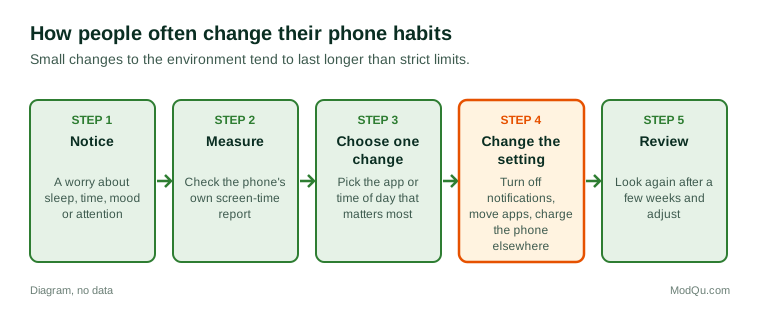
People's experiences of cutting down vary. A common pattern is that strict limits work for a few days and are then switched off, while small changes to the environment last longer. Turning off notifications and keeping the phone out of reach at certain times are changes many people keep, because they do not require constant willpower.
Figure 1 shows a simple way to think about the steps people often go through.
People who use a limit set by someone else, such as an employer's rules on work messages or a school's ban on phones in class, sometimes find it easier to keep than a limit they set for themselves.
Children, teenagers and families
Screen time is one of the most common worries for parents. Families set rules about when children can have a phone, which apps they can use, how long they can spend on screens and whether phones are allowed at meals or in bedrooms.
Example
A family agrees that the two teenagers will put their phones on a charging shelf in the hallway at 10 p.m. on school nights, and the parents will do the same. The teenagers negotiate an extra hour at weekends. The parents find the hardest part is keeping to the rule themselves.
Rules and advice differ by country. Some governments and health bodies publish guidance on screen time for young children, and some schools and countries restrict phone use during the school day. Others leave decisions to families. Survey research often asks parents what rules they set, how well they are kept, and what worries them most.
What research says and does not say
Research on screen time and wellbeing is active and often debated. Some studies find links between heavy use of certain apps and poorer sleep or mood, especially for some young people. Others find small or mixed effects, and point out that how a screen is used, what it replaces and a person's wider circumstances matter more than total hours.
Points that are widely agreed include:
- using screens late at night can affect sleep for many people;
- the type of activity matters, not only the amount of time;
- measuring screen time accurately is harder than it seems;
- links found in surveys do not prove that one thing causes another.
Because of this, careful surveys ask about the kinds of use, the time of day, and how people feel, not only about hours.
Debates about responsibility
People disagree about who should be responsible for healthy screen habits:
- Individuals and families, who decide how they use their devices.
- App and device makers, whose design choices, such as endless feeds and frequent notifications, can encourage longer use.
- Employers, who may expect staff to answer messages outside working hours. Some countries have discussed or introduced a "right to disconnect".
- Schools and governments, which set rules for children and may regulate design features.
Questions that businesses want answered here include how much people use their phones, which features they would like to help them manage use, whether they would pay for such tools, and how attitudes differ by age and country.
Key terms
- Screen timeThe amount of time spent looking at digital screens.
- Digital wellbeingWhether a person's technology use supports their health, relationships and sense of control.
- Focus modeA phone setting that silences chosen notifications and apps at set times.
- App limitA daily time allowance for an app, after which the phone blocks or warns.
- Digital detoxA period of deliberately not using a phone, social apps or other devices.
- NotificationAn alert from an app that appears on the screen or makes a sound.
- Pick-upsThe number of times a phone is unlocked or looked at in a day.
- Right to disconnectThe idea that workers should not have to answer work messages outside working hours.
Full glossary: digital health terms on EditingTests.com.
Digital wellbeing and screen time vocabulary test
How well do you know the language of this topic? Try 8 quick questions. Your score is shown straight away and is not saved.
What the digital wellbeing and screen time survey asks
This survey is part of ModQu's Technology at Home survey. The digital wellbeing and screen time part takes about five minutes and covers:
- How many hours a day you spend on your phone, and whether you checked your phone's report.
- What you mainly use your phone for.
- Whether you have tried to cut down or change your phone habits, and why.
- Which tools or methods you have used, such as limits, focus modes or a digital detox, and what worked.
- How your phone use affects your sleep, attention, mood or relationships.
- For parents: what screen rules you set for your children, and how well they are kept.
After that you can choose to continue with other short parts of the Technology at Home survey, such as smartphones and mobile apps or internet and mobile plans, or stop.
Ready to take part?
Your answers help show what people really think and do. Results are only ever reported as totals; no one can see your individual answers.
Start the surveyQuestions about this survey
Who can take part?
Adults who use a smartphone.
Do I have to give my name?
No. You may be asked for your age group, region and similar details so results can be broken down, but not your name. ModQu never asks for passwords, card numbers or account numbers.
How are the results used?
Answers are combined into totals and percentages and published in ModQu reports. Individual answers are never shown.
Is the vocabulary test part of the survey?
No. It is optional and separate, and your score is not stored.