
Share your views on illness and disability cover
Tell us whether you have cover for serious illness or being unable to work, and why or why not. Your answers are combined with other people's and reported only as totals.
Start the critical illness and disability insurance surveyAbout 5 minutes. No account needed. You can stop at any time.
The problem these policies address
For most working-age adults, the largest financial asset is their future income. A serious illness or injury that stops someone working can affect mortgage or rent payments, household bills and savings. Public sickness and disability benefits exist in many countries, but they often replace only part of earnings and may have strict conditions.
Several types of insurance try to fill that gap:
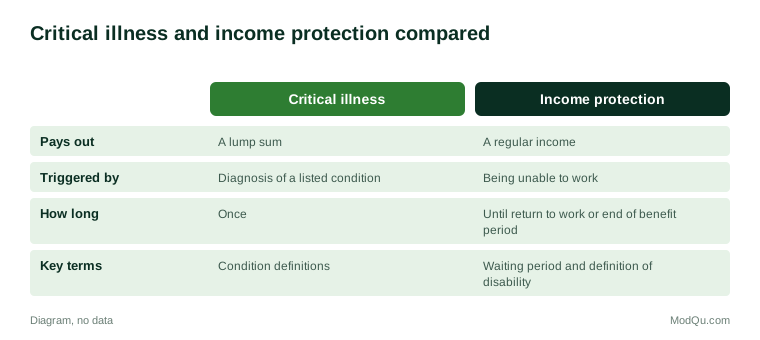
- Critical illness insurance pays a lump sum if the policyholder is diagnosed with a listed serious condition.
- Disability or income protection insurance pays a regular income if the policyholder cannot work because of illness or injury.
- Accident insurance pays set amounts for specific injuries.
- Hospital cash plans pay a small daily amount for each day in hospital.
The figure below compares the two main types.
Critical illness insurance
A critical illness policy lists the conditions it covers. Common examples include certain cancers, heart attack, stroke, kidney failure, major organ transplant and multiple sclerosis, each with a definition of how severe it must be. If the policyholder is diagnosed with a listed condition and meets the definition, the policy pays a tax-free lump sum in many countries, which the person can use however they like.
Example (hypothetical figures)
A 42-year-old with a 50,000 critical illness policy is diagnosed with a cancer that meets the policy definition. The insurer pays 50,000. They use it to pay off part of their mortgage and to cover living costs while they reduce their working hours during treatment.
Some policies pay a smaller amount for less severe forms of a condition. Others include cover for children.
Disability and income protection insurance
Income protection or disability insurance replaces part of a person's income, typically a set percentage of earnings, while they cannot work. Key features include:
- Waiting period (also called the deferred or elimination period): how long the person must be unable to work before payments start, for example four weeks, three months or a year. Longer waiting periods make premiums cheaper.
- Benefit period: how long payments can last, from one or two years up to retirement age.
- Definition of disability: whether the person must be unable to do their own job, any job they are suited to, or any work at all. "Own occupation" is the most generous.
- Benefit amount: usually capped at a share of earnings so that people do not earn more by not working.
Example
A self-employed electrician injures their back and cannot work for eight months. Their income protection policy has a 13-week waiting period. After that, it pays a monthly amount until they return to work. They used savings to get through the first three months.
Through work or bought personally
Many employers provide some disability or illness cover as part of a benefits package, sometimes called group income protection or long-term disability insurance. Employees may not know they have it or what it covers. Workplace cover usually ends when the person leaves the job.
Personal policies stay with the person when they change jobs but cost more and require health questions. Self-employed people, who have no employer cover and often limited public sickness benefits, are a group for whom personal cover is frequently discussed.
Why many people go without
Surveys in several countries find that many working adults have no cover of this kind. Common reasons include:
- thinking it will not happen to them;
- cost, especially for older people or those in risky jobs;
- confusion between the different types;
- believing that public benefits or employer sick pay will be enough;
- distrust of insurers after hearing about refused claims;
- not knowing what cover they already have through work.
Example
A nurse assumes their employer's sick pay will cover any long illness. When they check, they find full pay lasts six months and half pay three more. After that they would rely on public benefits. They look at a personal policy with a nine-month waiting period to match.
Claims and disputes
Claims usually require medical evidence, and for income protection, proof of earnings and regular updates on the person's condition. Disputes most often arise when:
- the condition does not meet the exact policy definition;
- the insurer finds health information that was not disclosed when the policy was taken out;
- there is disagreement about whether the person can return to work.
Answering health questions fully and accurately when applying is one of the most important steps to avoid a refused claim later.
Mental health and changing work patterns
Mental health conditions and musculoskeletal problems, such as back pain, are among the most common reasons people are off work for long periods. Some policies treat them differently from physical illnesses or have specific exclusions. The growth of self-employment and gig work also means more people have no employer cover, and insurers have been designing more flexible products for these groups.
How premiums are set
Premiums for these policies depend on age, health, smoking, occupation, the amount of cover and, for income protection, the waiting and benefit periods. Some policies have premiums that stay the same for the whole term; others rise as the person gets older. Jobs with physical risks, such as construction, usually cost more to insure than office work.
What people disagree about
Some people see income protection as the most important insurance a working adult can hold. Others see it as expensive and complicated, and argue that public benefits should provide an adequate safety net instead. There is also debate about whether critical illness policies, which pay only for listed conditions, give people a false sense of security.
Questions that businesses want answered include how many people hold these policies, whether through work or personally, how well they understand what they have, why people do not buy, and what would make cover more attractive.
Key terms
- Critical illness insuranceA policy that pays a lump sum on diagnosis of a listed serious condition.
- Income protection insuranceA policy that pays a regular income while the holder cannot work.
- Waiting periodThe time a person must be unable to work before payments start.
- Benefit periodHow long income payments can continue.
- Own occupationA definition under which a claim is paid if the person cannot do their own job.
- Group coverInsurance provided by an employer for its staff.
- Non-disclosureFailing to give relevant information when applying for insurance.
- PremiumThe amount paid for an insurance policy.
Full glossary: life insurance terms on EditingTests.com.
Critical illness and disability insurance vocabulary test
How well do you know the language of this topic? Try 8 quick questions. Your score is shown straight away and is not saved.
What the critical illness and disability insurance survey asks
This survey is part of ModQu's Insurance survey. The critical illness and disability insurance part takes about five minutes and covers:
- Whether you have critical illness, disability or income protection cover.
- Whether it is through work or a personal policy.
- How long you could manage financially if you could not work.
- Why you bought cover, or why you have not.
- How well you understand what your cover pays and when.
- Whether you have claimed, and how it went.
After that you can choose to continue with other short parts of the Insurance survey, such as car insurance or home and tenant insurance, or stop.
Ready to take part?
Your answers help show what people really think and do. Results are only ever reported as totals; no one can see your individual answers.
Start the surveyQuestions about this survey
Who can take part?
Working adults.
Do I have to give my name?
No. You may be asked for your age group, region and similar details so results can be broken down, but not your name. ModQu never asks for passwords, card numbers or account numbers.
How are the results used?
Answers are combined into totals and percentages and published in ModQu reports. Individual answers are never shown.
Is the vocabulary test part of the survey?
No. It is optional and separate, and your score is not stored.
Is income protection the same as life insurance?
No. Life insurance pays when someone dies; income protection pays while a living person cannot work.
Do public benefits replace my income if I cannot work?
In many countries they replace only part of income and have conditions. Rules vary widely.