
Share how you cook at home
Tell us how often you cook, where you find recipes and how confident you feel in the kitchen. Your answers are combined with other people's and reported only as totals.
Start the cooking at home surveyAbout 5 minutes. No account needed. You can stop at any time.
What cooking at home covers
Cooking at home means preparing food in a home kitchen rather than buying it ready to eat. It can mean many things: cooking a meal from raw ingredients, assembling a salad or sandwich, finishing a meal kit, baking bread, or reheating food cooked earlier in the week. Surveys about cooking usually ask people to say what they count as "cooking", because answers differ widely.
In many households one person does most of the cooking, often a woman, although patterns are changing in many places. In others, cooking is shared, or different people cook on different days. In some extended families, grandparents do much of the cooking while parents work.
Home cooking is closely tied to culture. What counts as an everyday meal, how many dishes are made, how long food takes to prepare and how often people eat together differ greatly between countries, regions, religions and generations.
How often people cook
How often people cook depends on time, money, skills, household size, equipment and access to shops. Common patterns include:
- Daily cooking of main meals, common in many households and in many cultures where fresh food is bought often.
- Batch cooking: preparing larger amounts once or twice a week and eating them over several days.
- Weekday shortcuts and weekend cooking: quick meals during the week and longer cooking at weekends.
- Mostly ready meals or takeaway, with occasional cooking.
- Cooking for special occasions only.
Example
A couple who both work long hours cook a large pot of stew and a tray of roasted vegetables every Sunday. They divide it into containers for four weekday dinners and eat out or order food on Friday. They say batch cooking saves them money and the stress of deciding what to eat each evening.
What gets in the way
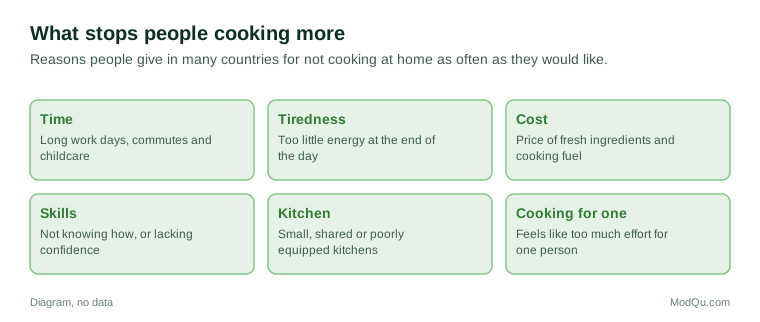
People who would like to cook more give similar reasons in many countries:
- Lack of time after work, commuting and childcare.
- Tiredness at the end of the day.
- Cost of ingredients, especially fresh meat, fish and vegetables.
- Lack of skills or confidence.
- Small or shared kitchens, or no oven or freezer.
- Cooking for one, which can feel like too much effort.
- Different tastes in a household, making one meal hard to agree on.
- Cleaning up afterwards.
The cost of energy for cooking also matters in many places, especially where gas, electricity or fuel prices are high, or where people cook with wood or charcoal.
Where recipes come from
People find recipes and ideas in many places:
- family members, especially parents and grandparents;
- cookbooks and magazines;
- recipe websites and apps;
- video sites and social media, including short cooking videos;
- television cooking programs;
- packaging and supermarket leaflets;
- friends and neighbours;
- cooking classes.
Many home cooks rely on a small set of dishes they know well and repeat often, adding new recipes now and then. Short video recipes have made it easier to see each step, which many people find more useful than written instructions.
Example
A student who moved away from home calls their mother each week to ask how to make a family dish. They write the steps in a notebook, because the original recipe was never written down and the amounts are given as "a handful" and "until it smells right".
Skills and confidence
Cooking skills are often learned at home by watching and helping. Some people learn at school, in classes or from videos. Confidence varies: some people feel able to cook without a recipe, while others follow instructions exactly or avoid cooking altogether.
Basic skills include chopping safely, using heat, cooking rice and grains, preparing vegetables, cooking meat and fish safely, seasoning and planning a meal so that parts are ready at the same time. Food safety knowledge, such as keeping raw meat apart from other foods and cooling leftovers quickly, is an important part of cooking skills.
Costs: home cooking and eating out
Cooking at home is often cheaper than eating out or ordering takeaway, though not always when ingredients are wasted or when cooking for one. It can also be healthier, since cooks control salt, sugar, fat and portion sizes.
Example (hypothetical figures)
A household of three compares two dinners. A home-cooked pasta dish with vegetables costs 9 for ingredients and about 1 for energy, a total of 10, in local currency. Ordering a similar meal for three costs 36 including delivery. Over four such dinners a week, cooking saves 104 a week.
Equipment and kitchens
Kitchens differ around the world. Some households have a full range of appliances; others cook on a single gas ring, a wood stove or a shared stove. Small appliances such as rice cookers, slow cookers, pressure cookers, air fryers and microwaves change how people cook and how much time it takes. Access to a fridge and freezer affects how often people need to shop and whether they can cook in bulk.
Trends and what people disagree about
Home cooking has changed with work patterns, prices and technology. Food delivery apps and ready meals offer alternatives to cooking. At the same time, interest in cooking has grown among some groups, helped by online videos and rising food prices that make eating out more expensive.
People disagree about whether cooking skills are declining, whether home cooking is always healthier, and whether cooking should be taught in all schools. There are also differing views on who should do the cooking at home, and on whether convenience foods have made life easier or eating habits worse.
Questions that food brands, grocers and appliance makers want answered include how many evenings a week people cook, where they find recipes, how confident they feel, and what would help them cook more.
Key terms
- Batch cookingCooking large amounts at once to eat over several days.
- Meal planningDeciding meals in advance, often for the week.
- Scratch cookingMaking a dish from raw, basic ingredients.
- Cross-contaminationSpreading germs from raw food to other food or surfaces.
- LeftoversCooked food kept to eat later.
- SeasoningAdding salt, spices or herbs to bring out flavour.
- Convenience foodFood sold partly or fully prepared to save time.
- SimmerTo cook liquid gently just below boiling.
Full glossary: food science terms on EditingTests.com.
Cooking at home vocabulary test
How well do you know the language of this topic? Try 8 quick questions. Your score is shown straight away and is not saved.
What the cooking at home survey asks
This survey is part of ModQu's Food and Drink survey. The cooking at home part takes about five minutes and covers:
- How many evenings a week you cook a main meal at home.
- Who usually cooks in your household.
- Where you find recipes and cooking ideas.
- How confident you feel in the kitchen.
- What stops you cooking more often.
- Which appliances you use most for cooking.
After that you can choose to continue with other short parts of the Food and Drink survey, such as eating habits or coffee, tea and beverages, or stop.
Ready to take part?
Your answers help show what people really think and do. Results are only ever reported as totals; no one can see your individual answers.
Start the surveyQuestions about this survey
Who can take part?
Adults.
Do I have to give my name?
No. You may be asked for your age group, region and similar details so results can be broken down, but not your name. ModQu never asks for passwords, card numbers or account numbers.
How are the results used?
Answers are combined into totals and percentages and published in ModQu reports. Individual answers are never shown.
Is the vocabulary test part of the survey?
No. It is optional and separate, and your score is not stored.
Does heating a ready meal count as cooking?
The survey asks you to say what kind of cooking you do, so heating ready meals is recorded separately from cooking from scratch.
Can people who never cook take part?
Yes. Their answers about why they do not cook are just as useful.
Does the survey ask about diets or health?
It asks a few questions about what you cook, but its focus is on how and how often you cook, not on diet advice.