
Share how your household handles food waste
Tell us how much food you throw away, what it is and what you do to reduce waste. Your answers are combined with other people's and reported only as totals.
Start the food waste surveyAbout 5 minutes. No account needed. You can stop at any time.
Food loss and food waste
Researchers and international bodies separate two ideas:
- Food loss happens earlier in the supply chain: on farms, in storage, in transport and in processing. Causes include pests, poor storage, lack of refrigeration and damage in transit.
- Food waste happens later: in shops, restaurants, catering and homes, when food that could have been eaten is thrown away.
The United Nations Environment Programme's Food Waste Index Reports estimate that households account for the largest share of food waste among retail, food service and households. United Nations Sustainable Development Goal target 12.3 aims to halve per-capita global food waste at the retail and consumer levels by 2030 and to reduce food losses along supply chains.
Food waste matters because of the money spent on food that is not eaten, the land, water and energy used to produce it, and the greenhouse gases released when it rots in landfill.
Why households waste food
Common reasons people give include:
- buying more than needed, often because of offers or uncertain plans;
- food going off before it is used, especially fresh produce, bread and dairy;
- cooking too much and not eating leftovers;
- confusion about date labels;
- poor storage, such as the wrong fridge temperature;
- children or other household members not eating what is served;
- plans changing, such as eating out at short notice;
- not knowing how to use up odds and ends.
Some waste is unavoidable, such as bones, eggshells, fruit stones and tea leaves. Surveys usually try to separate this from food that could have been eaten.
Example
A household does a large shop every Saturday. By Thursday, a bag of salad has gone slimy, half a loaf of bread is stale and a pot of yogurt is past its date. They had planned to cook at home every night, but two evenings they ate out with friends. Most of the waste came from food bought for meals that never happened.
Which foods are wasted most
The foods thrown away most often at home tend to be those that spoil quickly:
- fresh fruit and vegetables, especially salad leaves and soft fruit;
- bread and bakery items;
- milk and dairy products;
- cooked leftovers;
- meat and fish past their date.
Fresh produce is wasted in large amounts by volume, while meat and fish, though wasted in smaller amounts, cost more and have higher environmental costs per kilogram.
Date labels
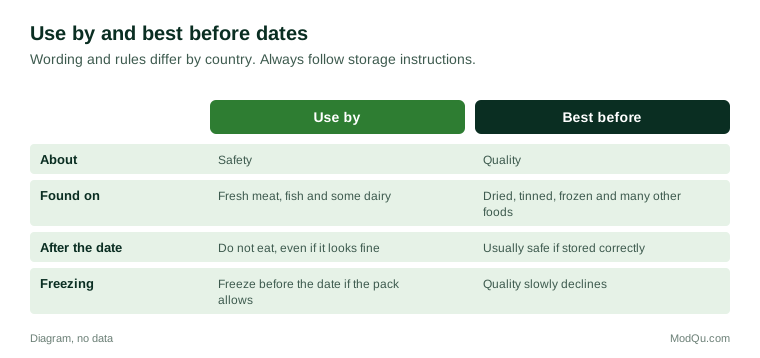
Date labels cause much confusion. Labels and their meaning differ between countries, but two main types are common:
- Use by: a safety date. Food should not be eaten after this date, even if it looks and smells fine. It is usually found on highly perishable foods such as fresh meat, fish and some dairy products.
- Best before: a quality date. Food is usually safe after this date if stored correctly, but its flavour or texture may decline.
Some countries also use "sell by" or "display until" dates, which are meant for shops rather than shoppers. Many people throw away food on or after a best before date when it is still safe to eat. Some governments and retailers have removed best before dates from fresh fruit and vegetables to reduce waste.
What people do to waste less
Households report a range of habits:
- planning meals and writing shopping lists;
- checking the fridge and cupboards before shopping;
- buying smaller amounts more often;
- storing food correctly, such as keeping the fridge at a cool enough temperature;
- freezing bread, leftovers and food near its date;
- eating leftovers for lunch or turning them into new meals;
- using apps that share surplus food with neighbours or sell surplus food from shops at a discount;
- composting or using food waste collections for scraps that cannot be eaten.
Example (hypothetical figures)
A family estimates they throw away food worth 15 a week, in local currency, which is 780 a year. After they start writing a shopping list, freezing half of each loaf of bread and having a "leftovers night" once a week, they estimate the waste falls to 6 a week. That saves about 468 a year.
Measuring household food waste
Food waste is hard to measure. People tend to underestimate how much they throw away when asked, partly because they do not notice small amounts and partly because they want to give a good impression. Researchers use several methods: questionnaires, diaries kept over a week, photos of discarded food, and analysis of the contents of bins. Diaries and bin studies usually show more waste than simple questions.
Example
A household asked in a survey says they waste "almost nothing". When they keep a food waste diary for a week, they record a half-eaten pot of rice, three bananas, the end of a loaf and a carton of milk that went sour. They say they had not thought of these as waste.
Food redistribution
Shops, restaurants and caterers produce surplus food that can be given away rather than thrown out. Food banks, community fridges and charities collect and redistribute it. Some countries encourage or require supermarkets to donate unsold edible food. Others give tax incentives for donations or protect donors from liability. Rules differ widely between countries.
What people disagree about
People disagree about who is most responsible for food waste: households, supermarkets with offers that encourage over-buying, rules on cosmetic standards for fruit and vegetables, or date labels. Views also differ on whether governments should charge for food waste collection, require donations from shops, or change labelling rules.
Questions that food brands, grocers, waste services and environmental groups want answered include how much food households throw away, which foods are wasted most, what people understand by date labels and what they do to reduce waste.
Key terms
- Food lossFood lost on farms, in storage, transport or processing before it reaches shops.
- Food wasteEdible food thrown away by shops, restaurants or households.
- Use by dateA safety date after which food should not be eaten.
- Best before dateA quality date after which food is usually still safe.
- Avoidable wasteFood that could have been eaten but was thrown away.
- CompostingTurning food scraps and plant material into soil improver.
- Food redistributionPassing surplus food to people who can use it, often through charities.
- Food waste diaryA record kept of all food thrown away over a period.
Full glossary: waste recycling terms on EditingTests.com.
Food waste vocabulary test
How well do you know the language of this topic? Try 8 quick questions. Your score is shown straight away and is not saved.
What the food waste survey asks
This survey is part of ModQu's Food and Drink survey. The food waste part takes about five minutes and covers:
- How much food your household throws away in a typical week.
- Which foods are thrown away most often.
- Why food is wasted in your household.
- How you read use by and best before dates.
- What you do to reduce food waste.
- How food scraps are collected or disposed of where you live.
After that you can choose to continue with other short parts of the Food and Drink survey, such as eating habits or coffee, tea and beverages, or stop.
Ready to take part?
Your answers help show what people really think and do. Results are only ever reported as totals; no one can see your individual answers.
Start the surveyQuestions about this survey
Who can take part?
Adults who buy groceries.
Do I have to give my name?
No. You may be asked for your age group, region and similar details so results can be broken down, but not your name. ModQu never asks for passwords, card numbers or account numbers.
How are the results used?
Answers are combined into totals and percentages and published in ModQu reports. Individual answers are never shown.
Is the vocabulary test part of the survey?
No. It is optional and separate, and your score is not stored.
Should I count peelings and bones?
The survey asks about edible food and unavoidable scraps separately, so you can say how much of each.
Is an estimate good enough?
Yes. Most people estimate. The survey may invite some people to keep a short diary for a more detailed picture.
Will the survey judge my household?
No. There are no right answers, and honest estimates are the most useful.