
Share your eating habits
Tell us how often you cook at home, whether you use meal kits and what you eat for lunch on a workday. Your answers are combined with other people's and reported only as totals.
Start the eating habits surveyAbout 5 minutes. No account needed. You can stop at any time.
What "eating habits" covers
Eating habits are the regular patterns in how people eat. They include:
- what people eat: types of food, how much is fresh, processed or prepared;
- when they eat: meal times, skipping meals, snacking and late-night eating;
- where they eat: at home, at work or school, in restaurants, in the car;
- how food is prepared: cooked from scratch, partly prepared, ready-made, takeout or delivery;
- with whom: alone, with family, with colleagues or friends;
- why: hunger, routine, health goals, culture, cost, convenience, enjoyment or emotion.
This page describes general eating patterns. It does not give dietary or medical advice. Canada's Food Guide, published by Health Canada, offers general public guidance on healthy eating.
Meal patterns
The classic pattern of three meals a day, breakfast, lunch and dinner, is still common, but many people's days look different:
- Breakfast is often quick or skipped, especially on workdays, and may be eaten on the way to work.
- Lunch on workdays is often brought from home, bought near work, or eaten at a desk.
- Dinner is usually the main meal and the one most often cooked at home and shared.
- Snacks fill gaps between meals for many people.
- Grazing, eating small amounts often throughout the day, replaces set meals for some.
- Time-restricted eating, limiting eating to certain hours of the day, is a pattern some people follow.
Shift workers, students, parents of young children and people who work from home often have different patterns from people with standard office hours.
Example
A hospital nurse on rotating shifts eats breakfast at 6 p.m. before a night shift, a packed meal at 2 a.m. and a light snack at 8 a.m. before sleeping. On days off they try to switch back to family meal times, which they say takes a day or two to adjust to.
Cooking at home
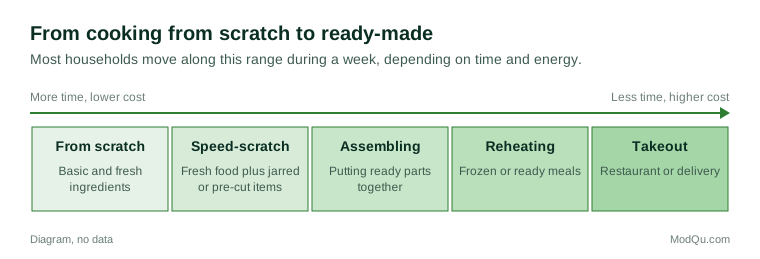
Cooking at home ranges from preparing meals from raw ingredients to heating up a frozen dinner. People often describe a scale:
- cooking from scratch with fresh or basic ingredients;
- speed-scratch cooking, combining fresh ingredients with prepared items such as jarred sauce, pre-cut vegetables or a roast chicken;
- assembling meals from ready-made parts;
- reheating frozen or ready meals.
How often people cook depends on time, skills, cost, household size, kitchen space and whether they enjoy cooking. Households with children often cook more at home, while people living alone may find it harder to cook for one.
Common reasons people give for cooking at home include saving money, eating more healthily, controlling ingredients for allergies or diets, enjoying cooking and eating together. Common reasons for not cooking include lack of time, tiredness after work, lack of skills or confidence, and small kitchens.
Meal planning, deciding meals for the week in advance, and batch cooking, making large amounts to eat over several days or freeze, are habits some households use to cook more with less effort.
Example (hypothetical figures)
A couple compares the cost of a weeknight pasta dinner. Cooking from scratch with dry pasta, canned tomatoes, vegetables and cheese costs about $9 for two. Using a jarred sauce adds $3, for $12. A takeout pasta for two costs $38 before tip and delivery. Cooking the scratch version four nights a month instead of ordering takeout saves them about $116 a month.
Convenience foods
Convenience foods are foods that save time in buying, preparing or cooking. They include:
- frozen meals, pizzas and vegetables;
- ready-to-eat salads, sandwiches and hot meals from grocery stores;
- canned and boxed foods;
- pre-cut and pre-washed produce;
- meal kits, with measured ingredients and recipes;
- snack foods and bars.
Some convenience foods are highly processed; others, such as frozen vegetables or canned beans, are simple ingredients made easier to use. Views on convenience foods vary widely. Many people value them on busy days; others try to avoid them for health, cost or taste.
Workday lunches
Lunch on a workday is shaped by work schedules and settings:
- packing a lunch from home, often leftovers or sandwiches;
- buying lunch from a cafeteria, food court, café, restaurant or grocery store;
- delivery to the workplace;
- eating at a desk, which many office workers do;
- skipping lunch because of time or workload;
- eating at home for people working remotely.
Hybrid work has changed lunch habits for many people. On home days they may eat leftovers or simple meals, and on office days they may buy lunch or eat with colleagues. Questions that businesses want answered here include how many people bring or buy lunch, what they spend, and how hybrid work has changed this.
What shapes food choices
Many factors influence what people eat:
- Price: food costs strongly shape choices, especially when prices rise.
- Time and convenience.
- Taste and habit: people tend to eat foods they like and know.
- Health: goals such as eating more vegetables, less sugar or salt, or managing a condition.
- Culture and religion: traditional foods, festivals, fasting and dietary rules such as halal and kosher.
- Family: children's preferences and shared meals.
- Allergies and intolerances.
- Ethics and environment: animal welfare, local food, packaging and climate concerns.
- Social media and advertising, which shape trends.
- Where people live: access to grocery stores and fresh food, which is limited in some rural, remote and northern communities. In northern Canada, the federal Nutrition North Canada program subsidizes some foods because of high costs.
Food labels, including the Nutrition Facts table and, in Canada, front-of-package nutrition symbols for foods high in saturated fat, sugars or sodium required by Health Canada, are designed to help people compare foods.
Example
A parent with two teenagers tries to cut down on sugary breakfast cereals. They compare labels and switch to a plain cereal with fruit added at home. One teenager is happy; the other starts buying their own cereal with part-time job money. The parent says changing family habits is harder than changing their own.
Family meals and eating alone
Eating together as a family is widely valued, and research has linked regular family meals with benefits for children, although it is hard to separate the meals themselves from other things about families who eat together. Work schedules, after-school activities and screens can make shared meals harder to arrange.
At the same time, more people live alone, and many eat alone most of the time. Some enjoy it; others say it makes them less likely to cook or eat well.
Trends and what people disagree about
Eating habits change over time. Recent trends include more interest in plant-based foods, high-protein foods and gut health, more use of delivery apps, rising food prices that push people toward cheaper options, and more people working from home and eating there at lunch.
There is disagreement about many food topics. What counts as healthy eating, and how much should people rely on official guidance? How harmful are ultra-processed foods? Are family meals as important as people believe? And should governments do more to change eating habits, through labels, taxes on sugary drinks or limits on food advertising to children?
Key terms
- Convenience foodFood that saves time in buying, preparing or cooking.
- Meal planningDeciding meals in advance, often for a week.
- Batch cookingMaking large amounts of food to eat over several days or freeze.
- Speed-scratch cookingCombining fresh ingredients with prepared items to save time.
- GrazingEating small amounts often instead of set meals.
- Nutrition Facts tableA label showing calories and nutrients in a set serving of food.
- Ultra-processed foodFood made mostly from industrial ingredients with many additives.
- Food desertAn area with poor access to affordable, fresh food.
Full glossary: food science terms on EditingTests.com.
Eating habits vocabulary test
How well do you know the language of this topic? Try 8 quick questions. Your score is shown straight away and is not saved.
What the eating habits survey asks
This survey is part of ModQu's Food and Drink survey. The eating habits part takes about five minutes and covers:
- How many evenings a week you cook at home, and how you usually cook.
- How often you use convenience foods, meal kits or ready meals.
- What you usually eat for lunch on a workday, and where.
- Which meals you skip, if any, and why.
- What most influences what you eat.
- Whether your eating habits have changed in the past year, and why.
After that you can choose to continue with other short parts of the Food and Drink survey, such as coffee, tea and beverages or food safety and labels, or stop.
Ready to take part?
Your answers help show what people really think and do. Results are only ever reported as totals; no one can see your individual answers.
Start the surveyQuestions about this survey
Who can take part?
Adults.
Do I have to give my name?
No. You may be asked for your age group, region and similar details so results can be broken down, but not your name. ModQu never asks for passwords, card numbers or account numbers.
How are the results used?
Answers are combined into totals and percentages and published in ModQu reports. Individual answers are never shown.
Is the vocabulary test part of the survey?
No. It is optional and separate, and your score is not stored.
Will I be asked about my weight or health?
No. The survey asks about eating patterns and choices, not your weight or medical history.