
Share your views on food safety and labels
Tell us how much you trust the safety of food in stores, which labels you look for and whether you have heard of a recent food recall. Your answers are combined with other people's and reported only as totals.
Start the food safety and labels surveyAbout 5 minutes. No account needed. You can stop at any time.
Who keeps food safe in Canada
Food safety in Canada is shared between several public bodies and the food industry:
- Health Canada sets food safety and nutrition standards and policies, including rules on food additives, contaminants and labelling of nutrition and allergens.
- The Canadian Food Inspection Agency (CFIA) enforces food safety rules, inspects food businesses, and manages food recalls.
- The Public Health Agency of Canada investigates outbreaks of foodborne illness that cross provincial borders, working with provincial and local public health.
- Provincial and local public health units inspect restaurants and food service, and investigate local outbreaks.
- Food businesses are responsible for producing safe food. Under the Safe Food for Canadians Regulations, many need licences and written preventive control plans.
In the United States, similar roles are played by the Food and Drug Administration (FDA), the Department of Agriculture and the Centers for Disease Control and Prevention.
Foodborne illness
Foodborne illness, often called food poisoning, is caused by eating food contaminated with harmful bacteria, viruses, parasites or toxins. Well-known causes include Salmonella, E. coli O157, Listeria and norovirus. Most cases are mild, but some can be serious, especially for older adults, young children, pregnant people and people with weakened immune systems.
Contamination can happen at any stage: on the farm, in processing, during transport, in stores, in restaurants or at home.
Food recalls
A food recall is when a food is removed from sale, or consumers are told not to eat it, because it may be unsafe or does not meet regulations. Reasons include:
- contamination with bacteria such as Listeria or Salmonella;
- undeclared allergens, such as milk, peanuts or sesame not listed on the label, one of the most common reasons;
- foreign objects such as plastic, metal or glass;
- incorrect labelling.
The CFIA classifies recalls by level of health risk and publishes recalls and allergy alerts on the government's recalls and safety alerts website, by email and through social media. Stores may post notices, and some contact customers who bought a recalled product through loyalty programs.
Example
A parent receives an email alert about a recall of a brand of frozen vegetables for possible Listeria contamination. They check the freezer, find a bag with the lot code listed, and return it to the store for a refund. A neighbour who does not subscribe to alerts hears about it only a week later from the news.
Questions that businesses and safety bodies want answered here include how people hear about recalls, how many check their homes when they do, and how much a recall affects trust in a brand or store.
Safe handling at home
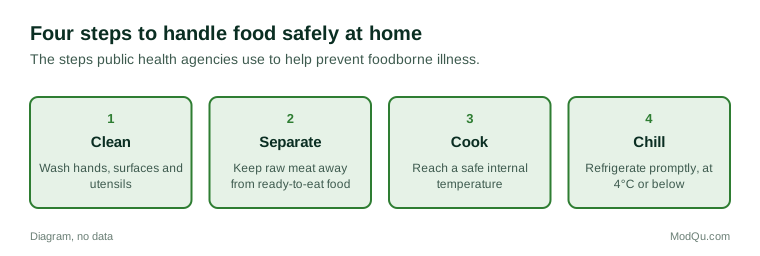
Many cases of foodborne illness start at home. Public health guidance usually focuses on four steps, often summed up as clean, separate, cook and chill:
- Clean: wash hands, surfaces and utensils.
- Separate: keep raw meat, poultry and seafood away from ready-to-eat foods, to prevent cross-contamination.
- Cook: cook food to a safe internal temperature, checked with a food thermometer.
- Chill: refrigerate perishable food promptly and keep the fridge at 4°C or below.
Health Canada publishes safe internal cooking temperatures for meat, poultry and other foods.
Date labels
Date labels are a common source of confusion, and of food waste. In Canada:
- A best before date is about quality, not safety. It tells you how long an unopened food will keep its freshness, taste and nutritional value when stored properly. Foods can often be eaten after this date, though quality may decline. It is required on prepackaged foods that keep for 90 days or less.
- An expiration date is required only on a few foods, such as infant formula, meal replacements and nutritional supplements, and these should not be used after the date.
- Packaged on dates appear on foods packaged in stores, such as meat, often with a best before date.
In the United States, terms such as "sell by" and "use by" are also used, and rules differ.
Example (hypothetical figures)
A household audits its fridge for one week and throws out food worth $28. Of that, $16 was items past their best before date that were still unopened and stored correctly. The household had assumed best before meant unsafe. When they learn the difference, they check and smell such items instead of throwing them away, while still discarding anything mouldy or spoiled.
Ingredient, allergen and nutrition labels
Most prepackaged foods in Canada must show:
- a list of ingredients, in descending order by weight;
- priority allergens, which in Canada include peanuts, tree nuts, milk, eggs, fish, crustaceans and shellfish, sesame, soy, wheat and triticale, and mustard, plus gluten sources and added sulphites;
- a Nutrition Facts table showing calories and nutrients for a serving;
- since the mid-2020s, a front-of-package nutrition symbol on many foods high in saturated fat, sugars or sodium;
- information in both English and French.
Precautionary allergen statements, such as "may contain peanuts", are voluntary and are used when a food might have been in contact with an allergen during production. People with allergies often find them confusing.
Claims: organic, local, natural and more
Packages often carry claims, and people vary in how much they trust them:
- Organic: in Canada, products labelled organic and carrying the Canada Organic logo must be certified under the Canadian Organic Standards, which cover how food is grown and processed.
- Local: the CFIA's interim policy says "local" means food produced in the province or territory where it is sold, or within 50 km of the province or territory border.
- Product of Canada and Made in Canada: "Product of Canada" means all or nearly all of the food, processing and labour is Canadian; "Made in Canada" means the last substantial change happened in Canada, and labels should say whether ingredients are imported.
- Natural: should mean the food has not had anything added or removed beyond limited processing, but people often interpret it more broadly.
- Free-range, grass-fed, non-GMO, gluten-free and heart-healthy are other claims with varying definitions and rules.
Example
A shopper buys strawberries labelled "local" at a supermarket in Ottawa, then learns they were grown in Québec within 50 km of the Ontario border. They feel misled, though the label met the definition. At a farmers market the next week, they ask growers directly where their farms are.
Trust and what people disagree about
Many people trust that food in stores is generally safe, but trust can drop sharply after a large recall or outbreak. People also differ in how much they trust labels and claims, and in how much attention they pay to them.
There are debates about food safety and labels. Should all foods carry clearer date labels to reduce waste? Should genetically modified ingredients be labelled? Are front-of-package warnings helpful? Should "may contain" statements be more strictly controlled? And how should regulators balance cost to producers with protection for consumers?
Key terms
- Food recallRemoving a food from sale or warning consumers because it may be unsafe or mislabelled.
- Best before dateA date about quality, not safety, for unopened food stored properly.
- Cross-contaminationSpreading harmful germs from one food or surface to another.
- Priority allergenOne of the foods that most often cause serious allergic reactions and must be declared.
- Internal temperatureThe temperature inside cooked food, used to check it is safe.
- Foodborne illnessIllness caused by eating contaminated food.
- Lot codeA code on a package that identifies when and where it was made.
- Certified organicFood produced and certified under organic standards.
Full glossary: food safety terms on EditingTests.com.
Food safety and labels vocabulary test
How well do you know the language of this topic? Try 8 quick questions. Your score is shown straight away and is not saved.
What the food safety and labels survey asks
This survey is part of ModQu's Food and Drink survey. The food safety and labels part takes about five minutes and covers:
- How much you trust the safety of food sold in stores and restaurants.
- Which labels and claims you look for, such as organic, local or allergen information.
- How you understand date labels, and how they affect what you throw away.
- Whether you have heard of a recent food recall, and how.
- What you did after hearing about a recall that affected you.
- What would make labels clearer or more useful to you.
After that you can choose to continue with other short parts of the Food and Drink survey, such as eating habits or coffee, tea and beverages, or stop.
Ready to take part?
Your answers help show what people really think and do. Results are only ever reported as totals; no one can see your individual answers.
Start the surveyQuestions about this survey
Who can take part?
Adults who buy food.
Do I have to give my name?
No. You may be asked for your age group, region and similar details so results can be broken down, but not your name. ModQu never asks for passwords, card numbers or account numbers.
How are the results used?
Answers are combined into totals and percentages and published in ModQu reports. Individual answers are never shown.
Is the vocabulary test part of the survey?
No. It is optional and separate, and your score is not stored.
Do I need to have food allergies to take part?
No. Anyone who buys food can take part. The survey asks about allergen labels only if they matter to your household.