
Investigation · Market and consumer investigation
Consumer Protection Investigations by Regulators
Consumer protection regulators investigate businesses suspected of misleading or exploiting their customers. This article explains how those investigations start, the powers and methods regulators use, how they choose between enforcement options, and what businesses can learn from them.
When a business misleads customers about price, hides fees, makes false claims about a product or pressures people into contracts they do not want, the people harmed often lack the time, money or information to act alone. Consumer protection regulators exist to investigate and stop such practices on their behalf. Their investigations produce evidence about how markets actually treat consumers, and their outcomes shape the behaviour of whole industries.
This article explains where regulatory investigations come from, the legal basis and powers that support them, the methods regulators use to gather evidence, and how they decide what action to take.
The legal basis
Most countries prohibit unfair, misleading or deceptive commercial practices in general terms, and give a public body the power to investigate and enforce. In the United States, the Federal Trade Commission Act prohibits unfair or deceptive acts or practices in commerce, and the Federal Trade Commission investigates and brings cases under it. In the European Union, the Unfair Commercial Practices Directive (Directive 2005/29/EC of the European Parliament and of the Council, 2005) prohibits misleading and aggressive practices, and a cooperation regulation enables national authorities to investigate jointly where practices cross borders (Regulation (EU) 2017/2394, 2017). In the United Kingdom, the Consumer Protection from Unfair Trading Regulations 2008 implemented the directive, and the Digital Markets, Competition and Consumers Act 2024 gave the Competition and Markets Authority power to decide cases and impose fines directly. In Canada, the deceptive marketing provisions of the Competition Act are enforced by the Competition Bureau.
These laws generally focus on the effect of a practice on the average consumer, rather than on whether any particular consumer was deceived. That shapes investigations: regulators must show how a practice was likely to affect consumers' decisions, which often requires evidence of what consumers saw, understood and did.
How investigations start
Regulators learn about potential problems from several sources. Complaints from consumers are the most common. The Federal Trade Commission, for example, collects millions of reports each year through its Consumer Sentinel Network and makes them available to law enforcement agencies (Federal Trade Commission [FTC], 2024). Other sources include referrals from other agencies, reports from journalists and consumer organisations, whistleblowers inside businesses, market studies and the regulator's own monitoring of advertising and websites.
Because regulators receive far more complaints than they can investigate, they must choose. Sparrow (2000) argues that effective regulators organise their work around identifying and solving specific problems, using data to find patterns of harm, rather than simply responding to complaints one at a time. Priorities typically reflect the scale of harm, the vulnerability of the consumers affected, whether the practice is spreading, and whether action would deter others.
Powers and methods
Regulators have investigative powers that private parties lack. These usually include the power to require businesses to provide documents and information, to interview staff, and in some cases to enter premises. The precise powers vary by jurisdiction and are subject to legal safeguards.
Typical investigative methods include:
- Analysis of complaints, to identify patterns, the businesses involved and the practices complained of.
- Review of marketing materials, websites, scripts and contracts, to establish what consumers were told.
- Test purchases and mystery shopping, to experience the practice as a consumer would.
- Consumer research, such as surveys and experiments, to show how consumers understood claims or responded to a design.
- Analysis of business data, such as sales, cancellation and refund records, to measure the scale of harm.
- Internal documents, such as emails and strategy papers, which can show whether a business knew its practices were misleading.
Online markets have led regulators to develop new methods. "Dark patterns", design choices that steer users towards decisions they might not otherwise make, such as hidden costs, false urgency and obstacles to cancellation, have become a major focus. Mathur et al. (2019) used automated tools to examine around 11,000 shopping websites and found dark patterns on about 11 per cent of them, and the Organisation for Economic Co-operation and Development has reviewed the evidence on their effects and the policy responses (Organisation for Economic Co-operation and Development [OECD], 2022). Regulators now use similar automated methods to sweep large numbers of websites for problems.
Behavioural research has also influenced what regulators investigate. Bar-Gill (2012) shows how consumer contracts in markets such as credit cards and mobile phones are often designed around predictable consumer mistakes, for example by setting low headline prices and high charges that consumers underestimate. Investigations increasingly ask not only whether information was disclosed but whether it was presented in a way consumers could realistically use.
Choosing a response
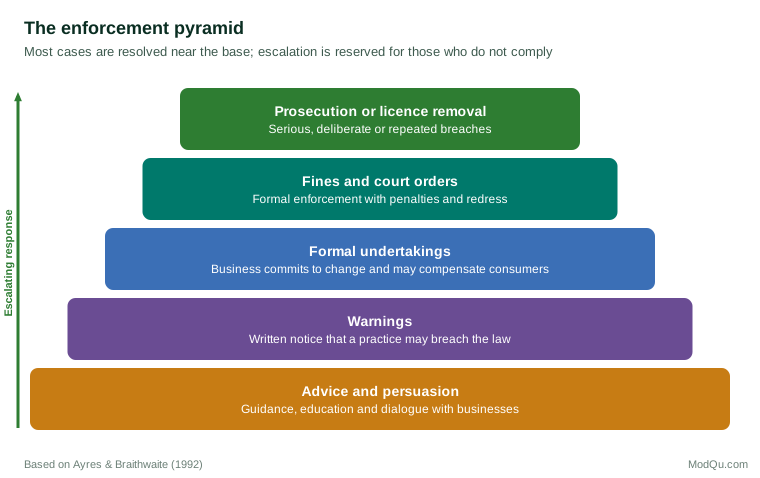
Regulators have a range of responses, from advice and warnings to formal enforcement. Ayres and Braithwaite (1992) proposed that regulators should use an "enforcement pyramid": most matters are handled at the base through persuasion and advice, with escalation to warnings, civil penalties and, at the top, criminal prosecution or loss of licence for those who do not respond. The credible threat of escalation encourages cooperation at the lower levels.
Outcomes of formal enforcement can include orders to stop a practice, corrective advertising, refunds or compensation to consumers, and financial penalties. In 2016, Volkswagen agreed to settlements with United States authorities requiring it to spend up to 14.7 billion dollars to buy back or modify diesel vehicles and compensate owners, after investigations found that it had cheated emissions tests and deceived consumers with claims about "clean diesel" (FTC, 2016).
Hodges (2015) argues that enforcement works best when it is combined with approaches that encourage businesses to build ethical cultures, since deterrence alone does not explain how most businesses behave. Armstrong (2008) notes that consumer protection and competition policy interact: well-informed consumers who can compare offers make markets more competitive, while practices that confuse consumers can weaken competition.
Lessons for businesses
Regulatory investigations offer lessons for businesses that want to avoid becoming the subject of one. They show that regulators look at the overall impression a practice creates, not only at the small print. They show that complaint data, cancellation rates and internal documents are often decisive evidence, so businesses should monitor these themselves. And they show that design choices online are treated as seriously as statements in advertising.
A business that investigates its own practices from the consumer's point of view, for example by testing its sales journey, reviewing complaints for patterns and asking whether its pricing would be understood by an ordinary customer, can find and fix problems before a regulator does.
A short example
The following hypothetical case illustrates a typical investigation. A regulator notices a rise in complaints about a subscription meal service: customers say they signed up for a one-off discounted box and were then charged monthly. The regulator reviews the sign-up pages and finds that the subscription terms appear only in grey text below the payment button. Test sign-ups confirm that no reminder is sent before the first full charge, and cancellation requires a telephone call during limited hours. Using its powers, the regulator obtains the company's data, which show that a high share of customers cancel after the first charge and that internal emails discussed the effect of the page design on cancellations. The company agrees to redesign its sign-up and cancellation process, refund affected customers and accept monitoring, under the threat of formal proceedings.
Conclusion
Consumer protection investigations turn individual complaints into evidence about how businesses treat their customers. Regulators combine complaint analysis, test purchases, consumer research, business data and internal documents to establish what consumers were told, how they were likely to understand it and what harm resulted. Their choice of response, from advice to prosecution, depends on the seriousness of the harm and the business's willingness to change. For businesses, the most useful lesson is that the same evidence is available to them first.
References
Armstrong, M. (2008). Interactions between competition and consumer policy. Competition Policy International, 4(1), 97–147.
Ayres, I., & Braithwaite, J. (1992). Responsive regulation: Transcending the deregulation debate. Oxford University Press.
Bar-Gill, O. (2012). Seduction by contract: Law, economics, and psychology in consumer markets. Oxford University Press.
Consumer Protection from Unfair Trading Regulations 2008, SI 2008/1277 (UK).
Digital Markets, Competition and Consumers Act 2024, c. 13 (UK).
Directive 2005/29/EC of the European Parliament and of the Council of 11 May 2005 concerning unfair business-to-consumer commercial practices in the internal market. (2005). Official Journal of the European Union, L 149, 22–39.
Federal Trade Commission. (2024). Consumer Sentinel Network data book 2023.
Federal Trade Commission. (2016, June 28). Volkswagen to spend up to $14.7 billion to settle allegations of cheating emissions tests and deceiving customers on 2.0 liter diesel vehicles [Press release].
Hodges, C. (2015). Law and corporate behaviour: Integrating theories of regulation, enforcement, compliance and ethics. Hart Publishing.
Mathur, A., Acar, G., Friedman, M. J., Lucherini, E., Mayer, J., Chetty, M., & Narayanan, A. (2019). Dark patterns at scale: Findings from a crawl of 11K shopping websites. Proceedings of the ACM on Human-Computer Interaction, 3(CSCW), Article 81. https://doi.org/10.1145/3359183
Organisation for Economic Co-operation and Development. (2022). Dark commercial patterns (OECD Digital Economy Papers No. 336). OECD Publishing. https://doi.org/10.1787/44f5e846-en
Regulation (EU) 2017/2394 of the European Parliament and of the Council of 12 December 2017 on cooperation between national authorities responsible for the enforcement of consumer protection laws. (2017). Official Journal of the European Union, L 345, 1–26.
Sparrow, M. K. (2000). The regulatory craft: Controlling risks, solving problems, and managing compliance. Brookings Institution Press.