
Share your view of organic food
Tell us how often you buy organic food, why you buy it and how much more you would pay. Your answers are combined with other people's and reported only as totals.
Start the organic food surveyAbout 5 minutes. No account needed. You can stop at any time.
What organic means
Organic farming is a system of food production based on standards that, among other things:
- restrict synthetic pesticides and fertilizers;
- prohibit genetically modified organisms;
- emphasize crop rotation, soil health and natural pest control;
- set animal welfare rules, such as access to outdoor space and limits on routine antibiotic use;
- restrict many additives in processed organic food.
The exact rules differ between countries. Organic does not mean that no pesticides at all are used: some substances of natural origin, and a small number of others, are permitted under organic standards.
The Codex Alimentarius, the international food standards body run by the FAO and WHO, has guidelines for organically produced food. Many countries have their own legal standards and official logos, such as the European Union's organic logo or the USDA Organic seal in the United States. IFOAM – Organics International is a global umbrella body for the organic movement.
How certification works
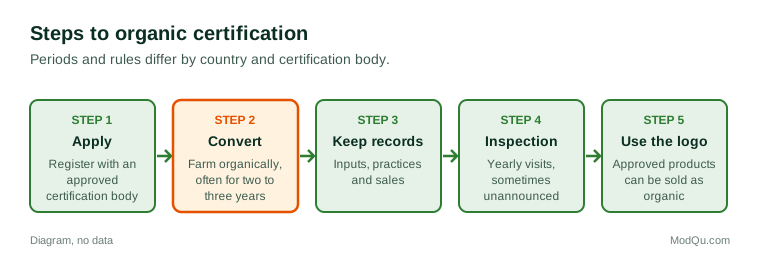
In most countries with organic rules, products can only be sold as organic if they are certified. Certification usually involves:
- a farm or producer applying to an approved certification body;
- a conversion period, often two to three years, during which land is farmed organically before products can be sold as organic;
- records of inputs, sales and practices;
- annual inspections, sometimes with unannounced visits and testing;
- the right to use an organic logo on approved products.
In many countries, small farmers find certification costly. Participatory guarantee systems, where farmers, buyers and local groups check each other, are used in some places as a lower-cost alternative for local markets.
Why people buy organic food
People give a mix of reasons:
- Health: a belief that organic food is healthier or has fewer pesticide residues.
- Environment: support for farming that aims to protect soil, water and wildlife.
- Animal welfare: higher welfare standards for livestock.
- Taste: some people believe organic food tastes better.
- Children: parents often buy organic food for babies and young children in particular.
- Trust: a preference for food produced under clear standards.
- Supporting farmers, especially small and local ones.
Example
A parent buys organic milk, apples and baby food but not organic pasta or tinned goods. They say they focus on what their toddler eats most and on fruit they do not peel, because they cannot afford to buy everything organic.
Price premium
Organic food usually costs more than conventional food. Reasons include lower yields on some farms, more labour, certification costs, smaller-scale processing and distribution, and strong demand. The premium varies widely by product, shop, country and season.
Example (hypothetical figures)
A shopper compares a weekly basket of milk, eggs, apples, carrots, bread and chicken. The conventional basket costs 32, in local currency, and the organic basket costs 44. The premium is 12, or 37.5%. They decide to buy organic eggs and apples only, which adds 3 to their usual bill.
Many shoppers buy some organic products rather than all. Common first choices are fruit and vegetables, dairy, eggs and baby food. Price is the most common reason people give for not buying organic more often.
What the evidence says
Research on organic food covers several questions, and results are mixed:
- Pesticide residues: studies generally find lower synthetic pesticide residues in organic produce. Food safety authorities state that residues in conventional food are typically within legal limits.
- Nutrition: some reviews have found modest differences in certain nutrients; others have found little difference. Overall, whether organic food leads to better health outcomes is not settled.
- Environment: organic farming often supports more biodiversity on the farm and can improve soil quality, but because yields can be lower, it may need more land to produce the same amount of food. Results depend on the crop and the system.
- Animal welfare: organic standards set higher minimum welfare requirements than many conventional systems, though other welfare labels exist too.
Because the evidence is mixed, people tend to weigh the reasons that matter most to them.
Trust and labels
Shoppers can be confused by labels that sound similar to organic but mean something different, such as "natural", "farm fresh", "free range" or "eco". Only products meeting legal organic standards may use the organic term in countries that regulate it. Trust can be damaged by cases of fraud, such as conventional grain sold as organic, which authorities in several countries have investigated.
Example
At a market, a stall sells vegetables labelled "grown without chemicals" but not certified organic. The farmer explains they cannot afford certification but follow organic methods. Some shoppers trust the farmer because they know them; others prefer a certified product from a supermarket.
Where people buy organic food
Organic food is sold in supermarkets, specialist organic shops, farmers' markets, box schemes that deliver weekly produce, online shops and directly from farms. In some countries, organic sections are now common in mainstream supermarkets; in others, organic food is mainly found in cities and specialist outlets.
What people disagree about
People disagree about whether organic food is worth the extra cost, whether it is better for health, whether organic farming could feed the world, and whether other approaches, such as integrated pest management or regenerative farming, offer similar benefits. There is also debate about whether governments should support farmers who convert to organic methods.
Questions that food brands, farms, grocers and policy groups want answered include how often people buy organic food, why they buy it, which products they choose, and how much more they are willing to pay.
Key terms
- OrganicProduced under certified standards that restrict synthetic inputs and set welfare rules.
- Certification bodyAn approved organization that inspects and certifies producers.
- Conversion periodThe time land must be farmed organically before products can be sold as organic.
- Pesticide residueTraces of pesticides left on or in food.
- Price premiumThe extra amount paid for a product compared with a standard version.
- Crop rotationGrowing different crops on the same land in turn to protect soil.
- Box schemeA regular delivery of produce, often organic, from a farm or supplier.
- Participatory guarantee systemLocal checking of organic practice by farmers, buyers and others.
Full glossary: sustainable agriculture terms on EditingTests.com.
Organic food vocabulary test
How well do you know the language of this topic? Try 8 quick questions. Your score is shown straight away and is not saved.
What the organic food survey asks
This survey is part of ModQu's Food and Drink survey. The organic food part takes about five minutes and covers:
- How often you buy organic food.
- Which organic products you buy most.
- Why you buy organic food, or why you do not.
- How much more you would pay for organic, and for which foods.
- Which organic labels you recognize and trust.
- Where you buy organic food.
After that you can choose to continue with other short parts of the Food and Drink survey, such as eating habits or coffee, tea and beverages, or stop.
Ready to take part?
Your answers help show what people really think and do. Results are only ever reported as totals; no one can see your individual answers.
Start the surveyQuestions about this survey
Who can take part?
Adults.
Do I have to give my name?
No. You may be asked for your age group, region and similar details so results can be broken down, but not your name. ModQu never asks for passwords, card numbers or account numbers.
How are the results used?
Answers are combined into totals and percentages and published in ModQu reports. Individual answers are never shown.
Is the vocabulary test part of the survey?
No. It is optional and separate, and your score is not stored.
Is organic the same as local?
No. Organic food can be imported from far away, and local food may not be organic. Some shoppers look for both.
Does food from my own garden count as organic?
The survey asks about certified organic food you buy. You can mention home-grown food separately.
Does the survey say whether organic food is healthier?
No. It asks about your views and buying habits. The evidence is described on this page.
Can I answer if I never buy organic food?
Yes. Your reasons are an important part of the results.