
Share how you flavour your food
Tell us which sauces and spices you use, whether you make your own and what new flavours you have tried. Your answers are combined with other people's and reported only as totals.
Start the spices, sauces and condiments surveyAbout 5 minutes. No account needed. You can stop at any time.
What the category covers
This topic covers the many products people use to add flavour to food:
- Dried spices: whole or ground seeds, bark, roots and fruits such as pepper, cumin, cinnamon, turmeric, chilli and cardamom.
- Herbs: fresh or dried leaves such as coriander, basil, parsley, mint and oregano.
- Spice blends: mixtures such as curry powders, garam masala, five-spice, za'atar, berbere and ras el hanout.
- Cooking sauces and pastes: tomato sauces, curry pastes, chilli pastes, stir-fry sauces and marinades.
- Condiments: products added at the table, such as ketchup, mustard, mayonnaise, chutney, hot sauce, vinegar and soy sauce.
- Fermented seasonings: soy sauce, fish sauce, miso, gochujang and similar products.
- Salt, sugar and stock products.
What counts as an everyday staple in one kitchen may be unusual in another. A household's spice shelf often reflects its family background, the local cuisine and the dishes it has adopted from elsewhere.
How people use them
People use flavourings in different ways:
- Cooking from tradition, using blends and techniques learned from family.
- Following recipes that list exact spices and amounts.
- Using ready-made sauces to make a meal quickly.
- Adding at the table to suit personal taste, such as hot sauce or soy sauce.
- Marinating meat, fish or vegetables before cooking.
Example
A family cooks rice and lentils most days. The grandmother toasts whole cumin seeds and mustard seeds in oil before adding other ingredients, a technique she learned as a child. The teenage grandchild adds a bottled chilli sauce at the table, which the grandmother says hides the flavour.
Bought or home-made
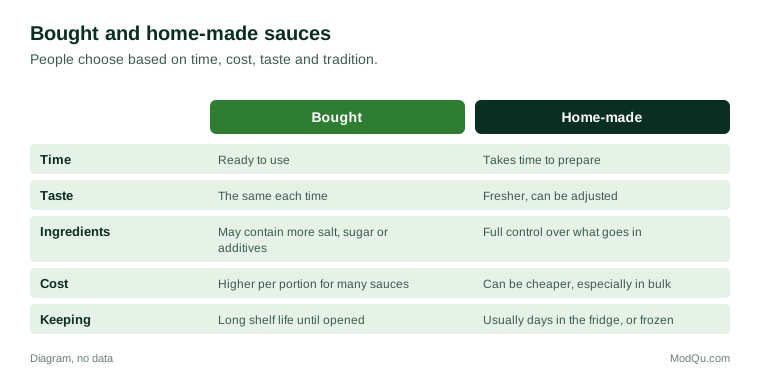
Many sauces and blends can be bought ready-made or prepared at home. People choose based on time, cost, taste, skill and tradition.
Reasons for buying ready-made include convenience, consistent taste and not having all the separate ingredients. Reasons for making at home include fresher flavour, control over salt, sugar and oil, avoiding additives, lower cost when ingredients are bought in bulk, and family tradition.
Example (hypothetical figures)
A cook compares a jar of tomato pasta sauce costing 3 for 500 grams, in local currency, with a home-made version. Two tins of tomatoes, an onion, garlic, oil and dried herbs cost about 2.20 and make about 900 grams. The home-made sauce costs about 0.24 per 100 grams, compared with 0.60 for the jar, but takes 30 minutes to make.
Trying new flavours
Interest in food from other cultures has grown in many places, helped by migration, travel, restaurants, television and online videos. Many people say they have tried cooking a new cuisine at home in recent years. Common routes include buying a ready-made paste or kit, following an online recipe, or learning from a friend or neighbour.
Shops respond by stocking wider ranges, and specialist grocers serving migrant communities often become places where others find new ingredients. Some products that were once specialities in one region, such as chilli sauces, fermented pastes or spice blends, are now sold widely around the world.
Example
A person who enjoyed a dish at a local Ethiopian restaurant buys a bag of berbere spice blend from a specialist shop and finds a recipe online. The first attempt is too hot, so they halve the amount next time. The blend becomes a regular part of their cooking for lentil stews.
Storage and freshness
Dried spices do not usually spoil quickly, but they lose flavour and aroma over time, especially when ground. Whole spices keep their flavour longer than ground ones. Light, heat, air and moisture speed up the loss, so spices are usually stored in closed containers away from the stove.
Many sauces and condiments need to be refrigerated once opened, and labels give instructions. Home-made sauces, especially those with fresh herbs, garlic in oil, or no preservatives, usually last only a few days in the fridge unless frozen. Food safety agencies advise care with home-made garlic or herbs in oil, which can carry a rare but serious risk of botulism if stored at room temperature.
Labels, salt and allergens
Shoppers reading labels on sauces and condiments often look at:
- salt content, which can be high in soy sauce, stock and many table sauces;
- sugar, which is often high in ketchup, sweet chilli sauce and barbecue sauce;
- allergens, such as mustard, sesame, celery, soy, peanuts, wheat, fish and shellfish, which many countries require to be clearly shown;
- additives and preservatives;
- chilli heat ratings on some products;
- certification, such as halal, kosher, vegetarian or organic.
Spices can also be subject to adulteration, where cheaper materials are added to bulk them up or improve colour. Food safety authorities in many countries test spices and issue recalls when problems are found. Buying from known sources is one way shoppers try to reduce this risk.
Spending and choices
Spending on flavourings is usually a small part of a food budget, but people often have strong loyalty to particular sauces and brands from childhood or from their home country. Price, availability, pack size, heat level and familiarity all affect choices. People who have moved country often look for familiar products from home and may pay more for imported versions.
What people disagree about
People disagree about whether ready-made sauces are a useful shortcut or a poor substitute for cooking, how authentic a dish needs to be, how much heat is "too much", and whether adapting another culture's dishes is a sign of interest or a loss of authenticity. Health debates focus on salt and sugar in sauces.
Questions that food brands, grocers and food safety bodies want answered include which sauces and spices people use most, whether they make their own, what new cuisines they have tried at home and how they choose products.
Key terms
- SpiceA dried seed, root, bark or fruit used to flavour food.
- HerbThe leaves of a plant used fresh or dried for flavour.
- CondimentA sauce or seasoning added to food, often at the table.
- Spice blendA mixture of several spices, such as curry powder or garam masala.
- MarinadeA seasoned liquid in which food is soaked before cooking.
- Fermented seasoningA flavouring made by fermentation, such as soy sauce or miso.
- AllergenA substance that can cause an allergic reaction.
- AdulterationAdding cheaper or unsafe material to a food product.
Full glossary: food science terms on EditingTests.com.
Spices, sauces and condiments vocabulary test
How well do you know the language of this topic? Try 8 quick questions. Your score is shown straight away and is not saved.
What the spices, sauces and condiments survey asks
This survey is part of ModQu's Food and Drink survey. The spices, sauces and condiments part takes about five minutes and covers:
- Which sauces, condiments and spices you use most often.
- Whether you make your own sauces or spice blends.
- Which new cuisines you have tried cooking at home recently.
- How you choose between brands and products.
- Whether you check labels for salt, sugar or allergens.
- Where you buy spices and specialist ingredients.
After that you can choose to continue with other short parts of the Food and Drink survey, such as eating habits or coffee, tea and beverages, or stop.
Ready to take part?
Your answers help show what people really think and do. Results are only ever reported as totals; no one can see your individual answers.
Start the surveyQuestions about this survey
Who can take part?
Adults who cook.
Do I have to give my name?
No. You may be asked for your age group, region and similar details so results can be broken down, but not your name. ModQu never asks for passwords, card numbers or account numbers.
How are the results used?
Answers are combined into totals and percentages and published in ModQu reports. Individual answers are never shown.
Is the vocabulary test part of the survey?
No. It is optional and separate, and your score is not stored.
Do herbs from my garden count?
Yes. The survey asks about all flavourings you use, including fresh herbs you grow.
Does the survey ask about brands?
It may ask what type of product you buy and why, but results are reported by type, not to promote brands.
Can I answer if I rarely cook?
Yes. Questions about table sauces and condiments apply to everyone.