
Share your experience of car sharing
Tell us whether you have used car sharing, whether you would pay a monthly fee instead of owning a car and what stops you giving up your car. Your answers are combined with other people's and reported only as totals.
Start the car sharing and subscriptions surveyAbout 5 minutes. No account needed. You can stop at any time.
What this topic covers
This topic covers ways of using a car without the traditional model of buying and owning one:
- Car sharing or car clubs, where members book cars parked around a city by the hour or minute;
- Peer-to-peer car sharing, where private owners rent out their cars to others through a platform;
- Car subscriptions, where a monthly fee covers a car, insurance, maintenance and sometimes the ability to swap cars;
- Traditional car rental, used here mainly for comparison;
- Leasing, a long-term contract that is close to ownership.
Ride-hailing and taxis are covered in a separate topic.
The main models
Car sharing and subscriptions come in several forms:
- Round-trip car sharing: cars have a home parking space and must be returned there. Common in many European and North American cities.
- One-way or free-floating car sharing: cars can be picked up and left anywhere within a zone. Popular in dense cities.
- Peer-to-peer sharing: owners list their cars on a platform, which handles bookings, payment and insurance.
- Neighbourhood and community schemes: small co-operatives or residents sharing a few cars, sometimes electric.
- Workplace and residential schemes: cars available to employees or residents of a building.
- Car subscriptions from manufacturers, dealers or specialist companies, with terms from one month to a year or more.
Who uses them and why
Users of car sharing tend to live in cities with good public transport, where a car is useful sometimes but not every day. Their reasons include:
- Cost: avoiding the fixed costs of ownership;
- Convenience: no need to deal with parking permits, servicing or insurance;
- Occasional needs: shopping trips, visits outside the city, moving items;
- Trying electric cars without committing to buy one;
- Environmental concern: using a car less and owning fewer cars overall.
Car subscriptions appeal to people who want a car every day but value flexibility, such as people on temporary job contracts, newcomers to a country without a credit history, or those who want to try a car before buying.
Example
A couple living in a city apartment sell their second car, which they used only at weekends. They join a car club with a station two streets away and book a car about three times a month for shopping and visits to family. They say planning ahead took some getting used to, but they no longer pay for parking or insurance on a car that sat unused.
How costs compare with owning a car
Owning a car has fixed costs, such as depreciation, insurance, registration, parking and servicing, which are paid whether the car is used or not. Car sharing turns most of these into costs paid only when the car is used. For people who drive little, sharing can be much cheaper; for people who drive a lot, owning usually costs less per kilometre.
Example (hypothetical figures)
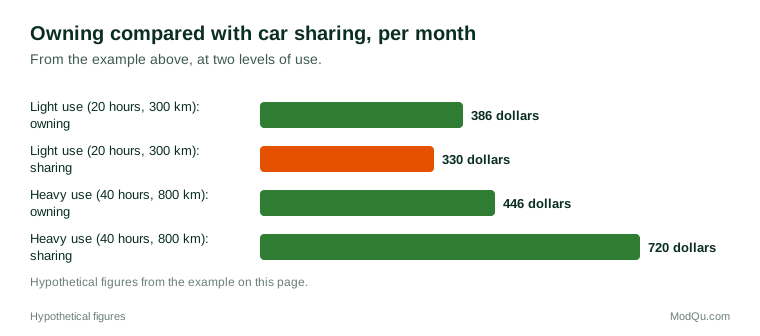
Owning a small car costs a household 350 dollars a month in fixed costs plus 0.12 dollars per kilometre in fuel and wear. Car sharing costs 12 dollars an hour plus 0.30 dollars per kilometre. If they use a car for 20 hours and 300 kilometres a month, ownership costs 386 dollars and car sharing 330 dollars. At 40 hours and 800 kilometres, ownership costs 446 dollars and sharing 720 dollars.
Figure 1 compares the costs in that example. The break-even point depends on local prices, how often people drive and how far.
Car subscriptions
A car subscription usually includes in one monthly payment:
- the use of a car;
- insurance;
- maintenance and servicing;
- road tax or registration;
- breakdown cover.
People compare subscriptions with leasing and buying. Subscriptions usually cost more per month than leasing the same car, but offer shorter commitments, simpler paperwork and the ability to cancel or swap. Common concerns include mileage limits, charges for damage at the end, and the total cost over several years.
What stops people giving up their car
Many people say they would consider sharing but keep their own car. Common reasons include:
- Availability: worrying that a shared car will not be free when needed;
- Distance: no car-sharing station or zone nearby, especially outside city centres and in rural areas;
- Children: car seats and school runs;
- Work needs: carrying tools or driving every day;
- Spontaneity: wanting a car instantly;
- Habit and identity: enjoying owning a car or seeing it as part of independence;
- Cleanliness and condition of shared cars;
- Distrust of app-based services and charges for damage or late returns.
Example
A parent of two young children tries car sharing for a month while their car is being repaired. Fitting and removing two child seats every trip and booking ahead for school runs prove difficult. They decide to keep owning a car, but they no longer plan to buy a second one.
Insurance, damage and trust
Shared cars raise questions about responsibility. Users often worry about being charged for damage they did not cause. Most services ask users to report and photograph damage before driving. Peer-to-peer platforms provide insurance during rentals, but owners and renters sometimes find the cover and claims process confusing. Reviews and ratings are used to build trust between owners and renters.
Trends and debates
Trends include more electric vehicles in car-sharing fleets, car-sharing spaces in new housing developments, manufacturers offering subscriptions, and integration with public transport apps. Some car-sharing services have closed or reduced coverage because of costs, showing that the business is difficult. Debates include whether car sharing reduces car ownership and traffic or adds trips that would have been made by transit, how cities should allocate parking for shared cars, and whether subscriptions are good value.
Questions that businesses want answered here include who uses car sharing, how often, why, what they would pay and what would make them give up owning a car.
Key terms
- Car sharingShort-term use of cars, booked by the hour or minute, usually through an app.
- Car clubA membership-based car-sharing service, a term used in some countries.
- Free-floating car sharingCar sharing where cars can be picked up and left anywhere within a zone.
- Peer-to-peer car sharingPrivate owners renting out their cars through a platform.
- Car subscriptionA monthly fee covering a car, insurance and maintenance, with short commitments.
- LeasingA long-term contract to use a car for a set period and mileage.
- DepreciationThe loss in a car's value over time.
- Fixed costsCosts paid regardless of how much a car is used, such as insurance and parking.
Full glossary: ride sharing platforms terms on EditingTests.com.
Car sharing and subscriptions vocabulary test
How well do you know the language of this topic? Try 8 quick questions. Your score is shown straight away and is not saved.
What the car sharing and subscriptions survey asks
This survey is part of ModQu's Cars and Getting Around survey. The car sharing and subscriptions part takes about five minutes and covers:
- Whether you have used a car-sharing service or car club, and how often.
- Whether you have rented a car from a private owner through an app.
- Whether you would pay a monthly subscription instead of owning a car, and how much.
- What you use shared cars for.
- What stops you giving up your own car, or why you gave it up.
- How you feel about damage charges, cleanliness and availability.
After that you can choose to continue with other short parts of the Cars and Getting Around survey, such as buying a car or electric vehicles, or stop.
Ready to take part?
Your answers help show what people really think and do. Results are only ever reported as totals; no one can see your individual answers.
Start the surveyQuestions about this survey
Who can take part?
Adults.
Do I have to give my name?
No. You may be asked for your age group, region and similar details so results can be broken down, but not your name. ModQu never asks for passwords, card numbers or account numbers.
How are the results used?
Answers are combined into totals and percentages and published in ModQu reports. Individual answers are never shown.
Is the vocabulary test part of the survey?
No. It is optional and separate, and your score is not stored.
Do I need my own insurance to use car sharing?
Most car-sharing services include basic insurance in the price, often with an excess that users pay if there is damage. Some offer extra cover to reduce the excess.
Can car sharing replace owning a car?
For people who drive occasionally and live near a car-sharing service, it often can. For people who drive daily, long distances or with young children, owning is usually more practical.