
Share your experience of buy now, pay later
Tell us whether you use instalment plans, what for, and how they have worked for you. Your answers are combined with other people's and reported only as totals.
Start the buy now, pay later surveyAbout 5 minutes. No account needed. You can stop at any time.
What buy now, pay later means
Buy now, pay later (often shortened to BNPL) is a way of paying for something in instalments instead of all at once. At the online checkout, or at the till in some shops, the shopper chooses an instalment option. The provider pays the shop straight away, and the shopper pays the provider back over a few weeks or months.
The most common form splits a purchase into four equal payments: one at the time of purchase and three more every two weeks. Other plans spread larger purchases, such as furniture, electronics or travel, over six, twelve or more months. Some of these longer plans charge interest; the short plans usually do not, as long as every payment is made on time.
Instalment buying is not new. Shops have offered lay-away, hire purchase and store credit for a very long time. What changed is that the plans became quick to set up online, are offered at the moment of purchase, and are often run by specialist providers rather than banks.
How a typical plan works
The steps are usually simple, which is part of the appeal:
- Choosing the option: the shopper selects the instalment plan at checkout instead of paying by card in full.
- A quick check: the provider asks for basic details and makes a decision within seconds. Some providers run a soft credit check that does not affect the person's credit score; others run fuller checks for larger amounts.
- The first payment: often a quarter of the price, taken from a debit or credit card.
- The remaining payments: taken automatically from the same card on set dates.
- Reminders and an app: many providers send reminders and let people see their plans in an app.
Example (hypothetical figures)
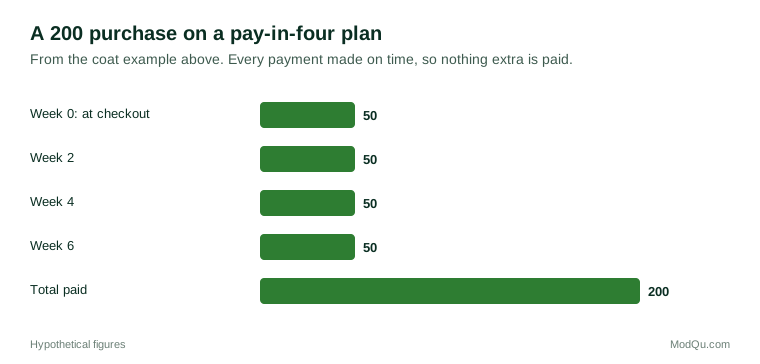
A shopper buys a winter coat for 200 in their local currency and chooses a four-part plan. They pay 50 at checkout, then 50 every two weeks for six weeks. Because every payment is taken on time, the coat costs 200 in total, the same as paying in full.
The figure below shows how the same 200 purchase is paid off under a four-part plan.
Why shoppers use instalment plans
People give a range of reasons for choosing to pay in instalments:
- Spreading costs to fit pay dates, especially for larger purchases.
- Avoiding credit card interest on purchases they could not pay off in one month.
- No credit card: younger shoppers and people with little credit history may not have one.
- Convenience: the option is offered at checkout with very little effort.
- Trying items first: some shoppers buy several sizes, return what does not fit, and only pay for what they keep.
Retailers offer these plans because they can increase sales and the size of the average basket. In return, the shop pays the provider a fee on each sale.
The costs and the risks
For the shopper, a short plan paid on time often costs nothing extra. The costs appear when things do not go to plan:
- Late fees when a payment fails, which can add a noticeable amount to a small purchase.
- Interest on longer plans, which can be as high as credit card rates.
- Effects on credit: in some countries, missed payments are reported to credit bureaus, and in some, on-time payments are also reported.
- Debt collection if payments stay unpaid.
- Stacking: having several plans with different providers at the same time makes it hard to keep track of what is due and when.
Example
A student uses instalment plans for headphones, a phone case and a pair of trainers in the same month, with two different providers. The payments fall on different days. When their part-time pay arrives late, two payments fail at once and they are charged two late fees. They now keep a list of every plan and its dates.
Because each plan is small, people can underestimate how much they owe in total. This is one of the main concerns raised by consumer groups and regulators.
How rules differ by country
When instalment plans first spread, many were not covered by the rules that apply to credit cards and loans, because they charged no interest. That has been changing. Several countries have introduced or proposed rules that require affordability checks, clear information about fees, and fair treatment of people who fall behind. Others treat the plans like other forms of consumer credit.
The details vary a great deal. In some places, providers must check a person's income before lending; in others, a basic identity check is enough. Some require late fees to be capped. Reporting to credit bureaus also differs. Anyone using a plan should check the terms and the rules where they live, because what applies in one country may not apply in another.
Who uses buy now, pay later
Research in several countries suggests that younger adults use instalment plans more than older adults, and that use is common for clothing, electronics and beauty products. Larger plans are also used for furniture, home improvements, travel and medical or dental bills in some markets.
People who use instalment plans are not all in the same position. Some have plenty of money and use the plans for convenience or to keep cash in a savings account. Others use them because they are short of money until their next pay. Survey questions often try to separate these groups, because the risks are very different.
Example
Two people buy the same television on a twelve-month plan. One could have paid in full but chose the plan because it was interest-free and kept their savings untouched. The other chose it because they could not afford the full price. The plan is the same; the risk of missing payments is not.
Buy now, pay later compared with other ways to pay
Instalment plans sit between paying in full and borrowing on a credit card:
- Debit card or cash: the money leaves straight away, with no risk of debt.
- Buy now, pay later: a fixed set of payments, often with no interest, but fees if a payment is missed.
- Credit card: a flexible limit, free if the balance is paid in full each month, but interest on anything carried over.
- Store credit or personal loan: usually for larger amounts, with interest and a set term.
Some banks and card issuers now let customers turn a card purchase into instalments after the fact, which blurs the line between these options.
What people disagree about
Opinions on instalment plans are divided. Supporters say they are a cheaper and clearer form of credit than credit cards, give shoppers more control, and are useful for people without a card. Critics say they encourage people to spend more than they planned, make it easy to build up several small debts, and target younger shoppers.
Questions that businesses want answered include how often people use instalment plans, for which products, whether they would have bought without one, how many plans they hold at once, whether they have missed a payment, and how they would react to stricter checks.
```faq Is buy now, pay later a loan? | It is a form of credit: you receive the item now and repay the provider later, even if no interest is charged. Can using these plans affect my credit score? | It depends on the provider and the country. Some report missed payments, some report all payments, and some report none.
Key terms
- Buy now, pay laterPaying for a purchase in a set number of instalments, often with no interest if paid on time.
- InstalmentOne of several payments that together pay off a purchase.
- Pay-in-fourA common plan that splits a purchase into four equal payments over about six weeks.
- Soft credit checkA check of credit information that does not affect a person's credit score.
- Late feeA charge added when a scheduled payment is not made on time.
- Affordability checkAn assessment of whether a borrower can repay without hardship.
- Merchant feeWhat a shop pays the provider for each sale made with the plan.
- StackingHolding several instalment plans at the same time.
Full glossary: consumer credit terms on EditingTests.com.
Buy now, pay later vocabulary test
How well do you know the language of this topic? Try 8 quick questions. Your score is shown straight away and is not saved.
What the buy now, pay later survey asks
This survey is part of ModQu's Money and Banking survey. The buy now, pay later part takes about five minutes and covers:
- Whether you have used buy now, pay later in the last 12 months, and how often.
- What you bought with it and how much it cost.
- Why you chose an instalment plan instead of paying another way.
- How many plans you have had at the same time.
- Whether you have missed a payment or paid a late fee.
- How you feel about stricter checks before people can use these plans.
After that you can choose to continue with other short parts of the Money and Banking survey, such as everyday banking or digital payments and wallets, or stop.
Ready to take part?
Your answers help show what people really think and do. Results are only ever reported as totals; no one can see your individual answers.
Start the surveyQuestions about this survey
Who can take part?
Adults who shop online or in stores.
Do I have to give my name?
No. You may be asked for your age group, region and similar details so results can be broken down, but not your name. ModQu never asks for passwords, card numbers or account numbers.
How are the results used?
Answers are combined into totals and percentages and published in ModQu reports. Individual answers are never shown.
Is the vocabulary test part of the survey?
No. It is optional and separate, and your score is not stored.