
Share your experience of anime, comics and manga
Tell us what you read and watch, in which formats, and how much you spend in a month. Your answers are combined with other people's and reported only as totals.
Start the anime, comics and manga surveyAbout 5 minutes. No account needed. You can stop at any time.
What this topic covers
This topic covers stories told in pictures, in print and on screen:
- Comics: stories told in sequences of drawn panels, published as comic books, graphic novels, newspaper strips and collected editions. Comic traditions exist in many countries, including the United States, France and Belgium, Italy, Argentina and elsewhere.
- Manga: comics from Japan, usually read from right to left, often published first in magazines or online in chapters and then collected in volumes.
- Manhwa and manhua: comics from Korea and China. Many Korean comics are published as webtoons, made to be read by scrolling down on a phone.
- Webcomics: comics published online, often for free, by independent artists.
- Anime: animation from Japan, including television series, films and online series, many of them based on manga.
- Animated adaptations of comics from other countries.
It looks at what people read and watch, how they do it, what they spend, and how they take part in fan communities.
Who reads and watches
Comics, manga and anime are enjoyed by children, teenagers and adults. Some people follow one long series for years; others read graphic novels occasionally, like any other book. Interest has grown around the world as streaming services have made anime easier to watch and phone apps have made manga and webtoons easy to read.
People's reasons include:
- long, involving stories with characters they care about;
- art styles they enjoy;
- genres not common in their local television or books, such as sports manga, school stories or particular kinds of fantasy;
- sharing with friends and online communities;
- learning about another culture or language;
- nostalgia for series they followed as children.
Genres and audiences
Manga and anime are often grouped by their main audience: titles aimed at boys, girls, young men, young women and children. These labels describe the original magazine or audience, not who actually reads them. Genres cover almost every subject, including:
- action and adventure;
- fantasy and science fiction;
- romance and comedy;
- sports;
- horror and mystery;
- slice of life, about ordinary daily experiences;
- historical stories;
- non-fiction and educational comics.
Western comics are often associated with superheroes, but they also include crime, humour, memoir, journalism and literary graphic novels.
Formats and how people read
People read and watch in many formats:
- Printed volumes and graphic novels bought from bookshops, comic shops and supermarkets.
- Single issues of comic books, published monthly in some countries.
- Digital comics and manga apps, where chapters can be read for free, unlocked with coins or included in a subscription.
- Vertical-scroll webtoons on phones, often released one episode a week.
- Library loans of printed and digital volumes.
- Anime on streaming services, television, cinemas and video-sharing sites.
Example
A university student reads a weekly webtoon on the bus each morning. The first episodes were free, and the newest episodes can be read early by spending coins. They usually wait a week for episodes to become free, but during the final chapters of the story they pay to read ahead because they cannot wait.
Spending and collecting
Spending varies widely. Some people only read free chapters and watch anime included with a streaming subscription they already have. Others spend a large share of their leisure budget on volumes, special editions, figures, posters, clothing and event tickets. Collecting a complete series in print, sometimes dozens of volumes, is a common goal for fans.
Example (hypothetical figures)
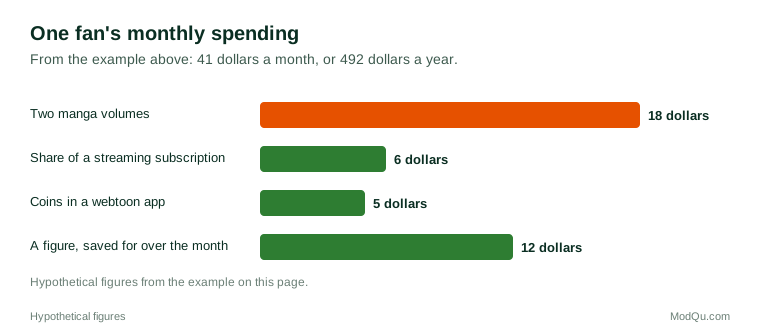
A fan's monthly spending is: two manga volumes at 9 dollars each (18 dollars), a streaming subscription share of 6 dollars, 5 dollars of coins in a webtoon app, and a 12-dollar figure saved for over the month. That comes to 41 dollars a month, or 492 dollars a year. Manga volumes are 18 of the 41 dollars, about 44%.
Figure 1 shows the spending from the example.
Questions about spending often ask what people buy, how they decide between print and digital, and whether they buy merchandise.
Fan communities and events
Fans take part in a wide range of activities:
- Conventions that bring together artists, publishers, shops, screenings, talks and cosplay, ranging from small local events to very large international ones.
- Cosplay: dressing as characters, often with costumes made by hand.
- Fan art and fan fiction shared online.
- Clubs and online forums where people discuss and recommend titles.
- Creating their own comics, sometimes self-published or posted online.
Example
A teenager who loves an anime series decides to make a costume of a favourite character for a convention in their city. They spend two months making it from second-hand clothes and craft foam, share progress photos in an online group and meet other fans of the series at the event.
Translation, availability and piracy
Many fans read and watch titles in translation. Official translations can take months or years to appear, and some titles are never published in a reader's language. This has led to:
- Simulcasts, where anime episodes are streamed with subtitles in many countries soon after airing in Japan.
- Simultaneous digital releases of some manga chapters in several languages.
- Unofficial fan translations and pirate sites, which publishers and creators say take income from the people who make the work.
Fans debate whether piracy is ever acceptable when no legal version exists in their country. Survey research often asks how people access titles and what would make them choose legal options.
Debates and trends
Debates in this area include:
- Age ratings: whether titles are suitable for children, given that comics and animation are not always made for young audiences.
- Working conditions: long hours and pay for manga artists and animators, which have been widely reported.
- Subtitles versus dubbing: whether to watch anime in the original language with subtitles or dubbed into the viewer's language.
- Print or digital: whether digital reading will replace print, as collectors often prefer physical volumes.
- Adaptations: live-action films and series based on comics and anime, which fans often judge harshly.
Questions that businesses want answered here include which formats people use, what they spend, how they discover new titles and how they feel about subscriptions and digital coins.
Key terms
- MangaComics from Japan, usually read from right to left.
- AnimeAnimation from Japan, including series and films.
- WebtoonA digital comic designed to be read by scrolling down on a phone.
- Graphic novelA long comic story published as a book.
- VolumeA collected book of several manga or comic chapters.
- CosplayDressing up as a character from a comic, game, anime or film.
- SimulcastStreaming an episode in other countries at nearly the same time it airs at home.
- DubbingReplacing the original voices with voices in another language.
Full glossary: animation production terms on EditingTests.com.
Anime, comics and manga vocabulary test
How well do you know the language of this topic? Try 8 quick questions. Your score is shown straight away and is not saved.
What the anime, comics and manga survey asks
This survey is part of ModQu's Media and Entertainment survey. The anime, comics and manga part takes about five minutes and covers:
- Whether you read comics, manga, manhwa or webcomics, and which kinds.
- Whether you watch anime, and how: streaming, television or cinema.
- Which formats you use: print, digital apps, webtoons or library loans.
- How much you spend on them in a month, including merchandise.
- Whether you take part in fan activities, such as conventions or cosplay.
- How you find new titles, and how you feel about subtitles and dubbing.
After that you can choose to continue with other short parts of the Media and Entertainment survey, such as streaming tv and video or music and podcasts, or stop.
Ready to take part?
Your answers help show what people really think and do. Results are only ever reported as totals; no one can see your individual answers.
Start the surveyQuestions about this survey
Who can take part?
Adults and teens aged 16 and over.
Do I have to give my name?
No. You may be asked for your age group, region and similar details so results can be broken down, but not your name. ModQu never asks for passwords, card numbers or account numbers.
How are the results used?
Answers are combined into totals and percentages and published in ModQu reports. Individual answers are never shown.
Is the vocabulary test part of the survey?
No. It is optional and separate, and your score is not stored.