
Share your reading habits
Tell us which magazines and newsletters you read, in what format, and whether you pay for any. Your answers are combined with other people's and reported only as totals.
Start the magazines and newsletters surveyAbout 5 minutes. No account needed. You can stop at any time.
What this topic covers
This topic covers two kinds of regular publication:
- Magazines: weekly, monthly or quarterly publications on news, current affairs, lifestyle, hobbies, homes, food, travel, science, business, sport, fashion, health and many other subjects. They are read in print, on websites, in apps and through digital magazine services that offer many titles for one fee.
- Newsletters: regular emails, or posts on a newsletter platform, from journalists, independent writers, experts, community groups, charities, schools, local governments and businesses.
It also covers how these are paid for, how people find them, and how they manage the amount of reading that arrives.
Print magazines today
Print magazines have become fewer, and many have reduced how often they publish or moved online. Those that remain often focus on subjects where readers value a physical copy:
- special interests and hobbies, such as woodworking, gardening, cars, crafts or fishing;
- design, food and travel, where photography matters;
- long-form journalism and culture;
- children's magazines;
- community, regional and association magazines, often sent to members.
People who still read print often describe it as a break from screens. Magazines are also read in waiting rooms, on flights and in libraries, which many public libraries supply in print and through digital lending apps.
Example
A retired teacher subscribes to two print magazines, one on gardening and one on Canadian history. They keep a stack beside a reading chair and read each issue cover to cover over a few weeks. When one magazine moves to digital only, they let the subscription lapse because they do not want to read it on a tablet.
Digital magazines
Many magazines publish online, with articles free to read up to a limit and a subscription for full access. Some offer a digital replica of the print edition in an app. Digital magazine services let readers browse hundreds of titles for a monthly fee, and some libraries offer similar access free with a card.
Digital reading suits people who travel, want to search past issues, or prefer not to collect paper. Others find reading long articles on a phone tiring and say they skim more and remember less.
Newsletters
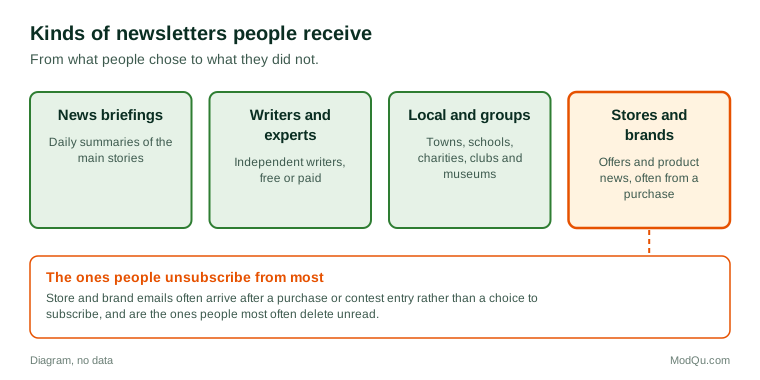
Email newsletters have grown into a major way people get information. Common kinds include:
- news briefings that summarize the day's stories;
- independent writers and journalists who publish directly to readers, free or paid;
- expert newsletters on investing, technology, health, parenting or other subjects;
- local newsletters about a town, neighbourhood or school;
- organization newsletters from charities, museums, clubs and places of worship;
- brand newsletters from stores and companies, with offers and product news.
People like newsletters because they arrive in a place they already check, can be read at any time, and often come from a writer they trust. They dislike them when there are too many, when they are mostly sales messages, or when unsubscribing is difficult.
Example
A worker who commutes by train reads three newsletters each morning: a national news briefing, a local newsletter about city hall and a weekly one from a gardening writer. They also receive about twenty emails a week from stores, which they rarely open and delete in batches every few days.
Paying for magazines and newsletters
People pay for reading in several ways:
- print subscriptions, often with a lower price for the first year;
- digital subscriptions to one magazine;
- bundles of print and digital access;
- digital magazine services covering many titles;
- paid newsletters, usually monthly or yearly, sometimes with a free version and extra content for paying readers;
- memberships that include a magazine, such as those from associations and museums.
Reasons people pay include trusting the writer, valuing in-depth coverage, supporting independent journalism and getting content they cannot find elsewhere. Reasons people do not pay include the amount of free reading available, cost, and the number of separate subscriptions adding up.
Example (hypothetical figures)
A reader pays for three newsletters at $5, $7 and $8 a month, and one magazine at $30 a year. The newsletters cost $240 a year, so with the magazine they spend $270. When they review their spending, they find they read only the $7 newsletter closely and cancel the other two, saving $156 a year.
Signing up and unsubscribing
People sign up for newsletters in many ways: when buying something online, entering a contest, joining a loyalty program, creating an account, or choosing a newsletter on purpose. Many people end up on more lists than they meant to join.
In Canada, Canada's Anti-Spam Legislation (CASL) requires organizations to have consent before sending commercial emails, to identify themselves, and to include a working unsubscribe link. Many people still find their inboxes full of promotional emails and use filters, separate email addresses for shopping, or the unsubscribe link to cut down.
Questions businesses want answered here include how many newsletters people receive, how many they actually open, why they unsubscribe, and what makes them keep reading.
Advertising and sponsored content
Most magazines and many newsletters carry advertising. In magazines, ads are often a large share of the pages, and some readers enjoy them as part of the experience, especially in fashion, design and travel titles. Newsletters may include a sponsor's message at the top or a short ad between sections.
Sponsored content, sometimes called branded content or advertorial, is written to look like an ordinary article but is paid for by an advertiser. Readers often find it hard to tell apart from editorial content, and publications use labels such as "sponsored" or "paid partnership". Survey research on reading often asks whether people notice these labels and whether sponsored content changes how much they trust a publication.
Example
A reader enjoys a newsletter about personal finance. When the writer begins including a sponsored section from a credit card company every week, the reader starts to wonder whether the writer's own advice is still independent, and begins checking other sources before acting on tips.
What people disagree about
Opinion is divided on whether print magazines will survive, whether paid newsletters are good value compared with a newspaper subscription, whether independent writers are more or less trustworthy than established publications, and how many promotional emails are acceptable. Some people see newsletters as a welcome alternative to social media feeds; others see them as more clutter in an already full inbox.
Key terms
- SubscriptionA regular payment for ongoing access to a publication.
- IssueOne edition of a magazine.
- NewsletterA regular email or post sent to people who signed up.
- Paid newsletterA newsletter that charges readers for some or all content.
- UnsubscribeTo stop receiving a newsletter or mailing list.
- Open rateThe share of recipients who open an email.
- Digital replicaAn on-screen copy of a magazine's print edition.
- CASLCanada's Anti-Spam Legislation on commercial electronic messages.
Full glossary: digital publishing terms on EditingTests.com.
Magazines and newsletters vocabulary test
How well do you know the language of this topic? Try 8 quick questions. Your score is shown straight away and is not saved.
What the magazines and newsletters survey asks
This survey is part of ModQu's Media and Entertainment survey. The magazines and newsletters part takes about five minutes and covers:
- Whether you read any magazines, which kinds, and in print or digital form.
- Which email newsletters you subscribe to, and how many you open regularly.
- Whether you pay for any magazines or newsletters, and how much.
- How you found the newsletters you read most.
- Why you have unsubscribed from newsletters, if you have.
- How you feel about the number of emails you receive.
After that you can choose to continue with other short parts of the Media and Entertainment survey, such as streaming tv and video or music and podcasts, or stop.
Ready to take part?
Your answers help show what people really think and do. Results are only ever reported as totals; no one can see your individual answers.
Start the surveyQuestions about this survey
Who can take part?
Adults.
Do I have to give my name?
No. You may be asked for your age group, region and similar details so results can be broken down, but not your name. ModQu never asks for passwords, card numbers or account numbers.
How are the results used?
Answers are combined into totals and percentages and published in ModQu reports. Individual answers are never shown.
Is the vocabulary test part of the survey?
No. It is optional and separate, and your score is not stored.
Do newsletters from stores count?
Yes. The survey asks separately about newsletters from writers and news outlets and those from stores and companies.