
Share your experience of music and podcasts
Tell us how you listen to music and podcasts, what you pay for and what you spend on live music. Your answers are combined with other people's and reported only as totals.
Start the music and podcasts surveyAbout 5 minutes. No account needed. You can stop at any time.
What this topic covers
This topic covers recorded music, podcasts and other audio, and the ways people get them:
- Music streaming services, free with ads or paid by subscription.
- Radio, on air and online, including public, commercial and campus stations.
- Owned music: downloads, CDs and vinyl records.
- Video platforms used for music, where many people listen as well as watch.
- Podcasts: series of spoken episodes on almost any subject, usually free to listen to.
- Audiobooks, which overlap with podcasts but are covered mainly on the books and reading page.
- Live music: concerts, festivals and local shows.
How people listen to music
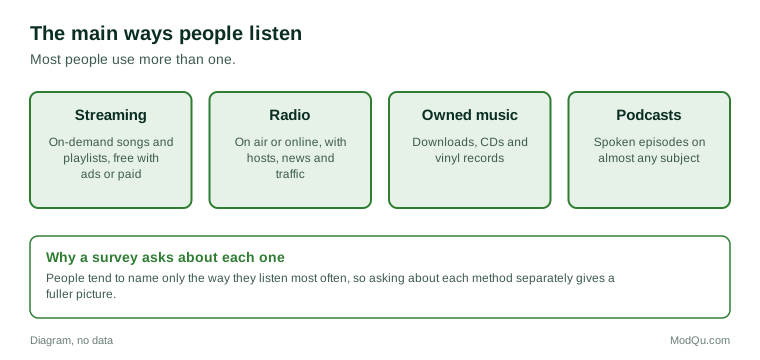
Most people use more than one way of listening. A typical week might include a streaming app on a phone with earbuds, radio in the car, a smart speaker in the kitchen and music videos on a television. Common patterns include:
- Streaming on demand, choosing songs, albums and playlists.
- Playlists and mixes made by the service, which choose songs based on past listening.
- Radio, valued for local news, traffic, hosts and the feeling of a shared station.
- Physical formats, especially vinyl, which has had a revival among collectors and younger listeners.
- Background listening while working, studying or exercising.
Age and habit shape these choices. Many older listeners still rely on radio and owned music, while younger listeners are more likely to stream almost everything. Many people who stream also buy vinyl or merchandise to support artists they like.
Example
A commuter listens to a morning radio show in the car for traffic and weather, streams playlists through earbuds at the gym, and plays vinyl records at home on weekends. Asked how they listen to music, they first say "on my phone", then remember the other two.
The example shows why a survey asks about several listening methods separately: people tend to name the most recent or most frequent one first.
Free versus paid
Music streaming services usually offer a free plan with ads and limits, such as shuffle-only play on phones, and a paid plan with no ads, offline listening and higher sound quality. Family and student plans lower the price per person.
Reasons people pay include:
- avoiding ads;
- downloading music for travel or areas with poor coverage;
- choosing exact songs rather than shuffle;
- sharing a family plan.
Reasons people stay on free plans include cost, not listening enough to justify a fee, and using video platforms or radio instead.
Example (hypothetical figures)
Four adults in one home each pay $11.99 a month for separate music plans, a total of $47.96. A family plan costs $19.99 a month for up to six people. Switching saves them $27.97 a month, or $335.64 a year.
How artists are paid
Many listeners are unsure how much artists earn from streaming. Payments are usually shared among record labels, publishers, songwriters and performers, and each stream earns a very small amount. Artists often make more from live shows, merchandise and direct sales. Some listeners say this affects how they spend, for example by buying from artists directly or going to more shows.
In Canada, rules on Canadian content (often called CanCon) require radio stations to play a set share of Canadian music. How similar expectations should apply to streaming services has been part of the debate over the Online Streaming Act.
Podcasts
A podcast is a series of audio episodes, usually free, that listeners can follow in an app and download. Podcasts cover almost every subject: news, true crime, comedy, history, sports, business, health, education and personal stories. Many have a video version as well.
People listen to podcasts:
- while commuting, walking or doing chores;
- to learn about a subject in depth;
- for company, especially with hosts they feel they know;
- to fall asleep.
Podcasts are funded through ads read by the hosts, sponsorships, listener donations, paid membership for bonus episodes, and networks or companies that produce shows. Many people do not know whether a podcast is independent or made by a large company.
Example
A retired accountant starts listening to a history podcast on walks. Within a year they follow twelve shows but listen regularly to only three. They join one show's paid membership to hear bonus episodes and support the host.
Finding new music and shows
People discover new music and podcasts in many ways:
- recommendations from friends and family;
- playlists and suggestions inside apps;
- short videos on social media, where a song can become popular quickly;
- radio and DJs;
- television, film and game soundtracks;
- guests on other podcasts.
Questions businesses want answered include how people found the last new artist or podcast they liked, how much they rely on app suggestions, and whether they feel they hear enough new music.
Live music and spending
Live music is one of the main things people spend on in this area. Spending includes tickets, travel, food and drinks, and merchandise. Ticket buying has become a frequent source of frustration: high prices for popular shows, fees added late in checkout, prices that change with demand, and tickets resold for much more than face value. Some provinces, including Ontario and Quebec, have rules on ticket resale and on showing the full price.
Smaller venues and local shows are also part of the picture. Many people attend free outdoor concerts, bar shows and community events that cost little or nothing.
Example
Two friends try to buy tickets for a popular tour the minute sales open. They wait in an online queue for an hour, and by the time they reach the front the remaining seats cost far more than they planned. They skip the tour and spend the money on four shows by local bands over the summer.
What people disagree about
Opinion is divided on whether streaming is fair to artists, whether paid plans are worth it, whether algorithms narrow what people hear, whether vinyl sounds better, whether ticket resale should be capped, and whether streaming services should have to promote Canadian music.
Key terms
- StreamingListening to audio delivered over the internet as it plays.
- PlaylistA list of songs grouped to play in order or shuffled.
- Offline listeningDownloading music or episodes to hear without a connection.
- PodcastA series of spoken audio episodes that listeners can follow.
- EpisodeA single instalment of a podcast or series.
- CanConCanadian content rules for broadcasting.
- RoyaltyA payment to a rights holder each time their work is used.
- Resale ticketA ticket sold again by someone other than the original seller.
Full glossary: music publishing terms on EditingTests.com.
Music and podcasts vocabulary test
How well do you know the language of this topic? Try 8 quick questions. Your score is shown straight away and is not saved.
What the music and podcasts survey asks
This survey is part of ModQu's Media and Entertainment survey. The music and podcasts part takes about five minutes and covers:
- How you mostly listen to music: streaming, radio, owned music or video platforms.
- Whether you pay for a music service, which plan, and why.
- How many podcasts you follow and which kinds you listen to most.
- How you found the last new artist or podcast you liked.
- How much you spent on concerts and live music this year.
- What frustrates you about buying tickets.
After that you can choose to continue with other short parts of the Media and Entertainment survey, such as streaming tv and video or news and information, or stop.
Ready to take part?
Your answers help show what people really think and do. Results are only ever reported as totals; no one can see your individual answers.
Start the surveyQuestions about this survey
Who can take part?
Adults who listen to music or podcasts.
Do I have to give my name?
No. You may be asked for your age group, region and similar details so results can be broken down, but not your name. ModQu never asks for passwords, card numbers or account numbers.
How are the results used?
Answers are combined into totals and percentages and published in ModQu reports. Individual answers are never shown.
Is the vocabulary test part of the survey?
No. It is optional and separate, and your score is not stored.
Do I need to listen to podcasts to take part?
No. You can answer the music questions and skip those that do not apply to you.