
Share your experience of streaming
Tell us which streaming services you pay for, what you have cancelled and whether you would accept ads for a lower price. Your answers are combined with other people's and reported only as totals.
Start the streaming tv and video surveyAbout 5 minutes. No account needed. You can stop at any time.
What this topic covers
Streaming means watching video delivered over the internet as it plays, rather than from a broadcast signal, a cable box or a disc. This topic covers:
- Subscription video services that charge a monthly or yearly fee for a library of shows and films.
- Ad-supported plans, which cost less or nothing in return for advertising.
- Free streaming services funded by ads, including channels that run like traditional TV.
- Rental and purchase of individual films and episodes.
- Public broadcasters' streaming apps, such as CBC Gem in Canada.
- Video-sharing platforms where individuals and creators post videos.
- Sports and live event streaming.
Traditional cable and satellite television are covered on the television and broadcast page.
How people choose services
Few households subscribe to every service, so people choose. Common reasons for picking a service include:
- a particular show or film they want to watch, often a new season of a series;
- live sports, which tie many viewers to a specific service;
- children's programming;
- the size and range of the library;
- price, including whether a cheaper ad-supported plan is available;
- bundles with mobile, internet or other subscriptions;
- what the rest of the household wants.
Recommendations from friends, social media and reviews play a large part in what people decide to watch, and so in which service they sign up for.
Example
A household pays for two streaming services all year. When a popular drama releases its final season on a third service, they subscribe for one month, watch the season over two weekends, and cancel before the next billing date.
Cancelling and coming back
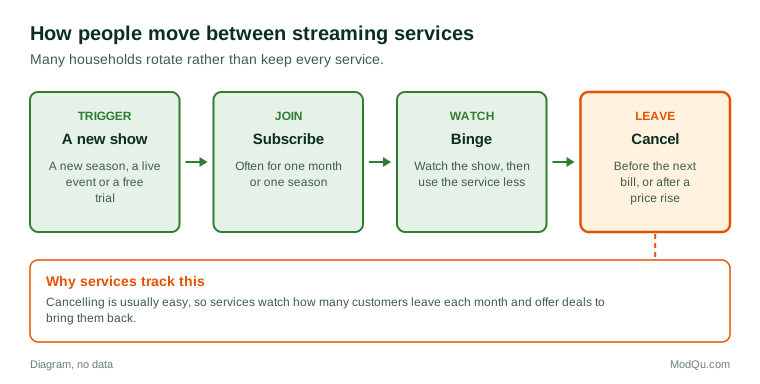
Cancelling a streaming service is usually easy, so many people move between services. This is often called churn by the companies. Common patterns include:
- rotating: keeping one or two services and switching others on and off by season;
- subscribing for one show, then cancelling;
- pausing a subscription where the service allows it;
- returning when a new season or a live event comes out;
- cancelling after a price rise, then coming back later.
Free trials, discounted first months and bundled offers encourage people to join, while price increases and the removal of shows encourage them to leave.
Example (hypothetical figures)
A viewer keeps four services at $17, $15, $12 and $10 a month, a total of $54. They decide to keep only the two they use most all year ($17 and $12) and take each of the other two for three months a year. Their yearly cost drops from $648 to $348 plus $75 for the rotated months, a total of $423.
Ads and price tiers
Most large services now offer more than one plan:
- a lower-priced plan with ads;
- a standard plan without ads;
- a premium plan with higher picture quality, more screens at once or downloads.
Whether people accept ads depends on how much they save, how many ads there are, and how much they watch. Some viewers barely notice ads; others find them a reason to pay more. Some households choose different plans for different services, paying to remove ads on the one they watch most and accepting ads on the rest. Free ad-supported streaming services, which run shows on a schedule like traditional channels, have also grown, especially among people trying to cut costs.
Password sharing and household rules
Many people have shared a streaming login with family or friends who live elsewhere. Several services now limit sharing to one household, and some charge extra to add a member who lives somewhere else. People's reactions vary: some pay the extra fee, some sign up for their own account, and some cancel.
Example
Two adult siblings in different provinces have shared one account for years. When the service starts charging to add a person outside the household, the sibling who pays adds the other as an extra member. They split the cost between them.
Cord-cutting
Cord-cutting means cancelling cable or satellite television and relying on streaming instead. Some people cut the cord to save money; others because they rarely watch live television. Some "cord-nevers", often younger adults, have never paid for cable at all.
Cutting the cord is not always cheaper. Paying for several streaming services, plus a fast enough internet connection, can cost as much as a cable package. Live sports and local news are the most common reasons people keep cable, or come back to it.
How people watch
Streaming has also changed viewing habits:
- binge-watching several episodes or a whole season at once;
- watching on phones and tablets, as well as on smart TVs;
- second-screening, using a phone while watching TV;
- watching alone on separate devices in the same home;
- shorter attention: skipping intros, watching at higher speed, or leaving shows unfinished.
Families sometimes struggle with choice itself. Scrolling through several apps to find something to watch is a common complaint, and some people say they spend more time choosing than watching.
Example
A couple sits down after work to watch a film. They spend twenty minutes moving between three apps, reading descriptions and watching trailers. In the end they rewatch a comedy they have seen before, because it is the one thing they both agree on.
Questions that businesses want answered here include which devices people watch on, how they find something to watch, how often they finish a series, and whether they would pay more for a service that made choosing easier.
What people disagree about
Opinion is divided on several questions: whether there are now too many services, whether prices have risen too far, whether sharing a password with family should be allowed, whether ads are a fair trade for a lower price, and whether streaming services should have to fund or show Canadian content. Under the Online Streaming Act passed in 2023, Canada's broadcasting rules were extended to online streaming services, and the details of what services must contribute have been the subject of ongoing CRTC proceedings.
Key terms
- StreamingWatching video delivered over the internet as it plays.
- Subscription video on demandA service that charges a regular fee for a library of video.
- Ad-supported planA cheaper or free plan that includes advertising.
- ChurnCustomers cancelling a service, often to rejoin later.
- Cord-cuttingCancelling cable or satellite TV in favour of streaming.
- Binge-watchingWatching many episodes of a show in one sitting.
- Simultaneous streamsThe number of screens that can watch on one account at once.
- Free trialA period of free use before paid billing starts.
Full glossary: video streaming platforms terms on EditingTests.com.
Streaming TV and video vocabulary test
How well do you know the language of this topic? Try 8 quick questions. Your score is shown straight away and is not saved.
What the streaming tv and video survey asks
This survey is part of ModQu's Media and Entertainment survey. The streaming tv and video part takes about five minutes and covers:
- Which streaming services you pay for, and on which plans.
- How much you spend on streaming each month.
- Whether you have cancelled or rejoined a service in the last six months, and why.
- Whether you would accept ads for a lower price.
- Whether you share an account with anyone outside your home.
- Whether you still pay for cable or satellite TV, and whether you plan to cancel.
After that you can choose to continue with other short parts of the Media and Entertainment survey, such as music and podcasts or news and information, or stop.
Ready to take part?
Your answers help show what people really think and do. Results are only ever reported as totals; no one can see your individual answers.
Start the surveyQuestions about this survey
Who can take part?
Adults who watch TV or video.
Do I have to give my name?
No. You may be asked for your age group, region and similar details so results can be broken down, but not your name. ModQu never asks for passwords, card numbers or account numbers.
How are the results used?
Answers are combined into totals and percentages and published in ModQu reports. Individual answers are never shown.
Is the vocabulary test part of the survey?
No. It is optional and separate, and your score is not stored.
Does this survey cover free video sites too?
Yes. It asks about paid services, free ad-supported services and video-sharing platforms.