
Share your experience of watching games
Tell us whether you watch esports or game streams, where you watch and whether you have paid or donated to a streamer. Your answers are combined with other people's and reported only as totals.
Start the esports and game streaming surveyAbout 5 minutes. No account needed. You can stop at any time.
What this topic covers
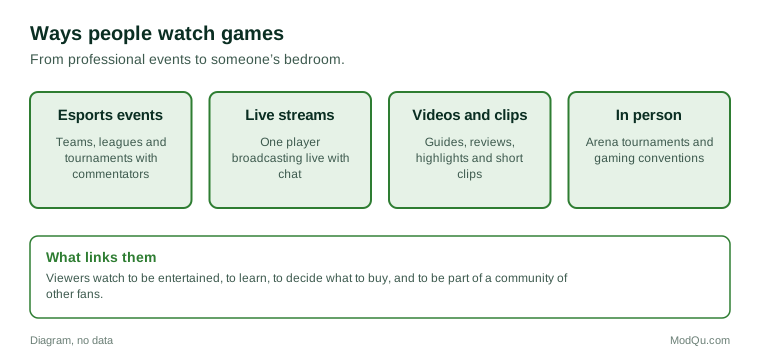
This topic covers watching video games played by others:
- Esports: organized competitive gaming, with professional players, teams, leagues and tournaments.
- Live game streaming: individuals broadcasting their own play live, often with a camera and commentary, while viewers chat.
- Recorded gaming videos: walkthroughs, reviews, highlights, guides and entertainment videos posted on video platforms.
- Speedrunning: players completing games as fast as possible, often streamed and sometimes at charity events.
- Watching at events: tournaments held in arenas and convention centres, and gaming conventions.
Playing games yourself is covered on the video games page.
What esports are
Esports are competitions in video games, played by individuals or teams. Popular kinds of games include:
- team strategy games, where two teams control characters on a map;
- first-person shooters;
- fighting games;
- sports games based on soccer, hockey, basketball and other sports;
- card and strategy games;
- racing games.
Professional esports often follow the pattern of traditional sports: teams with sponsors, coaches and analysts, regular-season leagues, playoffs and international championships. Major events are broadcast with commentators, analysis desks and replays. Colleges and universities in Canada and the United States run varsity and club esports teams, and some offer scholarships.
Example
A hockey fan who had never played the game in question goes with a friend to watch an esports tournament in an arena. They are surprised by the crowd, the commentary and the tension in the final round. By the end of the evening, they understand enough to cheer for one team, and they follow the league's playoffs on a streaming platform afterwards.
Why people watch others play
Viewers give many reasons for watching:
- entertainment: a funny or skilful streamer can be as entertaining as a television host;
- learning: picking up tactics to improve their own play;
- deciding whether to buy a game by watching someone else play it first;
- community: chatting with other viewers and feeling part of a regular group;
- background company while working, studying or doing chores;
- competition: following teams and players as with any sport;
- watching games they cannot play, because of cost, time, skill or disability.
Many viewers follow a small number of streamers closely and feel they know them, even though they have never met.
Example
A man with a hand injury that makes holding a controller painful still follows the strategy game he used to play. He watches the same streamer three evenings a week, chats with other regular viewers, and says the stream has replaced the online matches he used to play with friends.
Streaming platforms and formats
Game streaming takes place mainly on a few large live-streaming and video platforms. Common formats include:
- long live streams, sometimes lasting many hours;
- co-streaming, where a streamer watches and comments on an official esports broadcast;
- "just chatting" streams where gaming streamers talk to their audience without playing;
- highlights and clips cut from longer streams and shared on short-video apps;
- charity streams that raise money for causes, sometimes running for a full day or more.
Live chat is a central part of the experience. Viewers ask questions, react to play and talk with each other. Moderators, often volunteers, remove abusive messages and enforce the channel's rules.
How streamers and teams earn money
Streamers and esports organizations earn money in several ways:
- subscriptions, where viewers pay a monthly amount to support a channel and get perks such as special emotes;
- donations and tips, often shown on screen with a message;
- platform currencies that viewers buy and give to streamers;
- ads shown during streams;
- sponsorships from companies that make gaming equipment, drinks and other products;
- merchandise;
- prize money and salaries for professional players.
Only a small share of streamers earn a living from streaming. Many stream as a hobby, with small audiences of friends and regular viewers, and some stream to build skills they hope to use in other media work.
Example (hypothetical figures)
A viewer subscribes to two streamers at $6.99 a month each and gives $5 tips about four times a year. Over a year the subscriptions cost $167.76 and the tips $20, a total of $187.76. When asked how much they spend on gaming, they mention only the games they bought and forget the streaming spending.
Questions businesses want answered include how many people watch game streams, how much they spend supporting streamers, which sponsors they remember, and how watching affects which games they buy.
Young viewers and concerns
Many viewers of game streams are teenagers and young adults. Parents and others raise concerns about:
- time spent watching, often late at night;
- spending on subscriptions, tips and platform currency;
- language and behaviour of some streamers;
- gambling-style content, such as streams promoting betting sites or loot boxes;
- contact with strangers in chat and private messages;
- harassment, particularly of women and minority streamers.
Platforms set minimum ages and content rules, and offer tools for blocking and reporting. Some have banned or restricted streams that promote unregulated gambling.
Example
A parent notices a $40 charge for platform currency on their card. Their 14-year-old explains they gave it to a streamer during a charity stream. The parent and teen agree on a monthly limit, and the teen sets up a gift card so spending cannot go over it.
Esports and betting
Betting on esports results has grown, including in Canada since single-event sports betting became legal in 2021 and provinces began licensing online betting. Some people see this as a normal part of competitive sport; others worry about young fans, match-fixing and advertising of betting during broadcasts.
What people disagree about
Opinion is divided on whether esports are "real" sports, whether schools should have esports teams, whether watching others play is a good use of time, how platforms should handle harmful streamers, whether betting on esports should be advertised, and whether streaming is a realistic career. These views often differ sharply between people who watch and people who do not.
Key terms
- EsportsOrganized competitive video gaming.
- Live streamA video broadcast shown as it happens.
- StreamerA person who broadcasts their gameplay or commentary live.
- SubscriptionA monthly payment to support a channel, usually with perks.
- EmoteA small image used in chat, often unlocked by subscribing.
- Co-streamingA streamer broadcasting an official event with their own commentary.
- ModeratorA person who enforces a channel's chat rules.
- SpeedrunCompleting a game as fast as possible.
Full glossary: esport operations terms on EditingTests.com.
Esports and game streaming vocabulary test
How well do you know the language of this topic? Try 8 quick questions. Your score is shown straight away and is not saved.
What the esports and game streaming survey asks
This survey is part of ModQu's Media and Entertainment survey. The esports and game streaming part takes about five minutes and covers:
- Whether you watch esports, live game streams or gaming videos, and how often.
- Which platforms you use to watch.
- Why you watch, and which kinds of games or streamers you follow.
- Whether you have subscribed, tipped or donated to a streamer, and how much.
- Whether you have attended an esports event or gaming convention.
- Whether watching has affected which games you buy or play.
After that you can choose to continue with other short parts of the Media and Entertainment survey, such as streaming tv and video or music and podcasts, or stop.
Ready to take part?
Your answers help show what people really think and do. Results are only ever reported as totals; no one can see your individual answers.
Start the surveyQuestions about this survey
Who can take part?
People aged 16 and over.
Do I have to give my name?
No. You may be asked for your age group, region and similar details so results can be broken down, but not your name. ModQu never asks for passwords, card numbers or account numbers.
How are the results used?
Answers are combined into totals and percentages and published in ModQu reports. Individual answers are never shown.
Is the vocabulary test part of the survey?
No. It is optional and separate, and your score is not stored.
Do I need to play games to take part?
No. Many people watch esports and game streams without playing the games themselves.