
Share your experience of television
Tell us how you watch TV, whether you pay for cable or satellite and what you still watch live. Your answers are combined with other people's and reported only as totals.
Start the television and broadcast surveyAbout 5 minutes. No account needed. You can stop at any time.
What this topic covers
This topic covers television that is broadcast or scheduled, rather than chosen from a streaming library:
- Over-the-air television, received free with an antenna.
- Cable television, delivered through a cable or fibre connection by a television provider.
- Satellite television, received with a dish, common in rural areas.
- IPTV, television delivered over the internet by a provider, often with a set-top box.
- Live streaming of broadcast channels through a provider's app.
- Specialty channels for sports, news, children's programming, films and other subjects.
Streaming services and on-demand viewing are covered on the streaming TV and video page.
Ways of receiving television
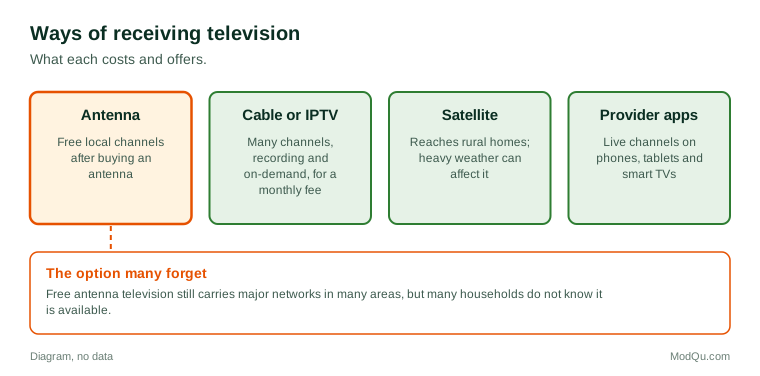
Each method has its own trade-offs:
- Antenna TV is free after the cost of an antenna and gives local channels in high definition, but the number of channels depends on how close the home is to transmitters. In Canada, many urban households can receive major networks this way.
- Cable and IPTV offer many channels, recording, and on-demand libraries, but come with monthly fees and equipment rental.
- Satellite reaches homes that have no cable, though signals can be affected by heavy weather.
- Provider apps let subscribers watch on phones, tablets and smart TVs, at home or away.
Many people do not know that free antenna television is still available. Questions businesses and broadcasters want answered include how many households use an antenna and how many would if they knew.
Example
A couple living in a city cancels their cable package to save money. A friend suggests an antenna. They buy one for about the price of one month of cable, mount it near a window and receive more than a dozen local channels, including the networks they watch for news and hockey.
What cable and satellite packages include
Television packages are usually built in layers:
- a basic package with local stations and some required channels;
- theme packs of channels grouped by subject, such as sports, news, films or children's channels;
- premium channels sold separately;
- recording through a personal video recorder (PVR) or a cloud recording service;
- on-demand shows and films included or for rent.
In Canada, the CRTC requires providers to offer a small basic package at a low price, with the option to add channels individually or in small packs. Many customers are not aware of this option.
Example (hypothetical figures)
A household pays $95 a month for a television package with about 100 channels, plus $12 a month to rent two receivers. They review their viewing and find they watch eight channels regularly. A basic package with three added theme packs costs $55 a month. Switching saves them $40 a month, or $480 a year, while still renting the receivers.
Why people keep or cancel
People keep cable or satellite for reasons such as:
- live sports, especially hockey, football, basketball, baseball and soccer;
- news channels and local news;
- ease of use: one remote and a channel guide;
- habit, especially among older viewers;
- bundles with internet and home phone that make cancelling one service complicated.
People cancel for reasons such as cost, watching mostly streaming, rarely watching live TV, frustration with price increases, and moving to a new home.
Example
A retired man has had cable for forty years. His daughter suggests he cancel and use streaming apps. He tries for a month but finds switching between apps confusing and misses his news channel. He goes back to a smaller cable package and keeps one streaming service for films.
What people still watch live
Even in households that stream most of their viewing, some programming is still mostly watched live:
- sports, where results matter as they happen;
- news, especially during elections, emergencies and major events;
- weather, during storms and wildfires;
- award shows, finales and other big events;
- morning shows and talk shows;
- game shows and reality competitions watched as they air.
Example
A family that streams almost everything turns on live television only twice that year: during a wildfire near their town, to follow road closures and evacuation updates, and for the final game of a hockey playoff series. Asked how often they watch live TV, they first say "never", then remember both.
Watching live is also social. People text friends during a game, comment on social media during an awards show, or gather to watch a final together. Questions that broadcasters and advertisers want answered include which programs people watch live, on which devices, and whether they skip ads when they record.
Canadian television and public broadcasting
Canadian broadcasters are required by the CRTC to show a share of Canadian programming and to support Canadian production. CBC/Radio-Canada, the national public broadcaster, offers television, radio and online services in English and French, and in some Indigenous languages. Private networks, provincial educational broadcasters, community channels and the Aboriginal Peoples Television Network (APTN) are also part of the system.
Many people are unsure which channels are public and which are private, or how they are funded. Views on public funding for broadcasting differ widely and are a regular topic of public debate.
Advertising on television
Television advertising remains a large business, especially during live sports and big events. Viewers who record shows often skip ads, while live viewers see them. People's views on TV ads range from finding them useful or entertaining to avoiding them entirely. Some advertisers now buy ads across both television and streaming, and measure viewing on both. For viewers, this can mean seeing the same ad on a live hockey broadcast in the evening and again on a streaming app the next morning.
What people disagree about
Opinion is divided on whether cable is still worth paying for, whether sports should be available without a full package, how much public money should go to broadcasting, whether streaming services should follow the same rules as broadcasters, and whether live television has a future. These views often differ by age, location and how much sport a person watches.
Key terms
- Over-the-airTelevision received free with an antenna.
- Cable televisionTV delivered through a cable or fibre connection by a provider.
- IPTVTelevision delivered over the internet by a provider.
- PVRA personal video recorder that records shows to watch later.
- Basic packageThe smallest television package a provider offers.
- Theme packA group of channels sold together by subject.
- Specialty channelA channel focused on one subject, such as sports or news.
- Cord-cuttingCancelling cable or satellite TV in favour of streaming or antenna.
Full glossary: television broadcasting terms on EditingTests.com.
Television and broadcast vocabulary test
How well do you know the language of this topic? Try 8 quick questions. Your score is shown straight away and is not saved.
What the television and broadcast survey asks
This survey is part of ModQu's Media and Entertainment survey. The television and broadcast part takes about five minutes and covers:
- How you receive television at home: antenna, cable, satellite, IPTV or streaming only.
- Whether you pay for a TV package, what it includes and what it costs.
- Which programs you still watch live, and on which devices.
- How satisfied you are with your TV provider.
- Whether you plan to cancel or change your TV service, and why.
- How you feel about ads on television.
After that you can choose to continue with other short parts of the Media and Entertainment survey, such as streaming tv and video or music and podcasts, or stop.
Ready to take part?
Your answers help show what people really think and do. Results are only ever reported as totals; no one can see your individual answers.
Start the surveyQuestions about this survey
Who can take part?
Adults.
Do I have to give my name?
No. You may be asked for your age group, region and similar details so results can be broken down, but not your name. ModQu never asks for passwords, card numbers or account numbers.
How are the results used?
Answers are combined into totals and percentages and published in ModQu reports. Individual answers are never shown.
Is the vocabulary test part of the survey?
No. It is optional and separate, and your score is not stored.
Can I take part if I do not have a TV?
Yes. Many people watch television programs on phones, tablets or computers, and the survey asks about all of these.