
Share how you get your news
Tell us where you get news, which sources you trust and whether you pay for any. Your answers are combined with other people's and reported only as totals.
Start the news and information surveyAbout 5 minutes. No account needed. You can stop at any time.
What this topic covers
This topic is about news and current affairs: reports on what is happening locally, nationally and around the world. It covers:
- Where people get news: television, radio, newspapers, news websites and apps, social media, video platforms, podcasts, newsletters and conversations with others.
- What kinds of news they follow: local, national, international, politics, business, sport, weather, health and entertainment.
- Trust: which sources people believe and why.
- Paying for news: subscriptions, donations and memberships.
- Misinformation: false or misleading information and how people deal with it.
- News avoidance: people choosing to read or watch less news.
Where people get news
Most people use a mix of sources, and the mix depends a lot on age. Common patterns include:
- Television news, especially evening and local news, still important for many older adults.
- Radio, often in the car or in the morning, including public radio such as CBC Radio.
- Newspapers, in print or online.
- News apps and websites, sometimes reached through alerts on a phone.
- Search engines, where people look up a story after hearing about it.
- Social media and video platforms, where news appears among posts from friends, creators and organizations.
- Podcasts and newsletters, often for in-depth coverage of one subject.
- Word of mouth: family, friends, co-workers and group chats.
Many people now come across news rather than go looking for it. A headline appears in a feed or a friend shares a link, and the person reads it without visiting the news outlet's own site or app.
Example
A young adult says they "don't follow the news", but in one day they see a story about a wildfire in a short video, read a summary of a court decision in a group chat, and get a weather warning on their phone. Asked where they got news yesterday, they first answer "nowhere", then list all three.
Local news
Local news covers city councils, school boards, courts, local businesses, community events, crime and weather. Many Canadian communities have lost a local newspaper or radio newsroom in the past two decades, and some areas are described as news deserts, with little or no regular local coverage. In some places, new digital outlets, non-profit newsrooms and community radio have filled part of the gap.
People often say they value local news highly, yet fewer pay for it than say they value it. Questions that public bodies, publishers and funders want answered include where people find local information now and what they miss when a local outlet closes.
How people decide what to trust
Trust in news varies by source and by person. People give many reasons for trusting a source:
- it has a long history and reputation;
- it corrects its mistakes in public;
- it names its reporters and sources;
- it seems to share their values or does not seem to take sides;
- friends and family trust it;
- it has been right before.
People also distrust sources for many reasons, including perceived bias, ownership, errors they remember, sensational headlines and too much opinion mixed with reporting. Trust in "the news media" in general is often lower than trust in the specific outlets people actually use.
Example
Two neighbours watch the same evening newscast about a new housing policy. One thinks the report favoured the government; the other thinks it was too critical. Both trust the same weather forecast from that station without a second thought.
Misinformation and checking
Misinformation is false or misleading information shared without an intent to deceive. Disinformation is false information spread on purpose. Both can spread quickly online, particularly during elections, health emergencies and disasters.
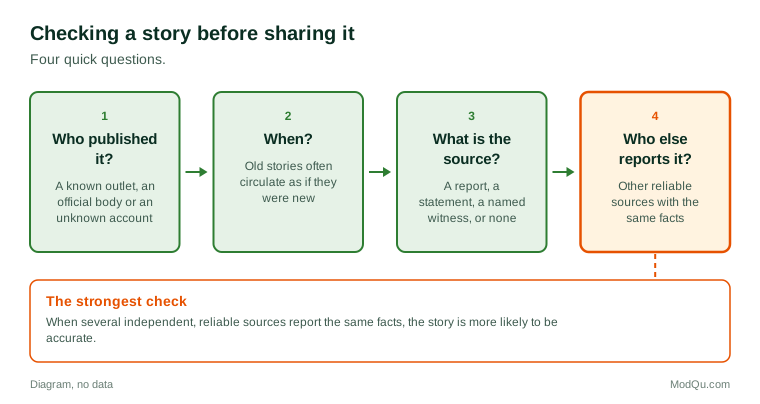
Ways people check information include:
- looking for the same story in other sources;
- checking who published it and when;
- reading past the headline;
- looking at the original source, such as a report or official statement;
- using fact-checking websites;
- being careful with images and video that could be edited or generated.
Many people say they are confident they can spot false news but less confident that others can. Surveys often explore this gap.
Paying for news
News is funded through a mix of advertising, subscriptions, donations, public funding and grants. Many news websites use a paywall that limits free articles. Reasons people pay include supporting journalism, getting full access to a trusted source, and avoiding ads. Reasons people do not pay include the amount of free news available, cost, and not wanting another subscription.
Example (hypothetical figures)
A reader hits the article limit on a regional newspaper's site several times a month. An introductory offer is $1 a week for a year, then $4 a week. In the first year the subscription costs $52; at the regular price, it would cost $208 a year. They subscribe and set a reminder to decide again before the price changes.
In Canada, public policy has also played a role. The federal government introduced tax credits for qualifying news organizations and their digital subscribers, and the Online News Act of 2023 requires some large online platforms to compensate news outlets. In response, one large social media company stopped showing news links in Canada, which changed where some Canadians see news.
Avoiding the news
A growing number of people say they sometimes avoid the news. Reasons include feeling overwhelmed, finding it depressing, distrust, and a sense that there is nothing they can do about the events reported. Some people limit news to certain times of day or turn off alerts. Others stop following certain topics, such as politics or war, while still checking weather and local information. For publishers and public bodies, news avoidance raises a practical question: how to reach people with important information, such as emergency alerts or public health notices, when they have chosen to tune out.
What people disagree about
Opinion is divided on whether news outlets are biased, whether public broadcasters should receive government funding, whether online platforms should pay for news, how social media companies should handle false information, and whether news should be free. These are the kinds of views that change with events, which is why repeated surveys are useful.
Key terms
- MisinformationFalse or misleading information shared without intent to deceive.
- DisinformationFalse information spread on purpose.
- PaywallA limit on free articles before a subscription is needed.
- Fact-checkingChecking whether claims in a story are true.
- EditorialAn article giving a publication's opinion.
- News desertA community with little or no regular local news.
- Public broadcasterA broadcaster funded wholly or partly by public money.
- CorrectionA published notice fixing an error in an earlier report.
Full glossary: news production terms on EditingTests.com.
News and information vocabulary test
How well do you know the language of this topic? Try 8 quick questions. Your score is shown straight away and is not saved.
What the news and information survey asks
This survey is part of ModQu's Media and Entertainment survey. The news and information part takes about five minutes and covers:
- Where you got news yesterday, and your main source of news.
- Which kinds of news you follow most, including local news.
- Which news sources you trust most and least, and why.
- Whether you pay for any news subscription, or would.
- How you check information you are unsure about.
- Whether you sometimes avoid the news, and why.
After that you can choose to continue with other short parts of the Media and Entertainment survey, such as streaming tv and video or music and podcasts, or stop.
Ready to take part?
Your answers help show what people really think and do. Results are only ever reported as totals; no one can see your individual answers.
Start the surveyQuestions about this survey
Who can take part?
Adults.
Do I have to give my name?
No. You may be asked for your age group, region and similar details so results can be broken down, but not your name. ModQu never asks for passwords, card numbers or account numbers.
How are the results used?
Answers are combined into totals and percentages and published in ModQu reports. Individual answers are never shown.
Is the vocabulary test part of the survey?
No. It is optional and separate, and your score is not stored.
Will I be asked about my political views?
Some questions ask which issues matter to you, but you can skip any question you prefer not to answer.