
Research · Literature and evidence
Evaluating Source Credibility in the Digital Age
How to judge whether a source can be trusted, covering authority, purpose, evidence, currency and corroboration, with the lateral reading technique used by professional fact-checkers.
Every piece of research depends on the sources behind it. A conclusion built on a misleading report, an out-of-date statistic or a vendor's sales material can be wrong however carefully the rest of the work is done. Evaluating source credibility means deciding how far a source deserves to be believed before relying on it. This article sets out the main questions to ask and a practical technique for asking them quickly.
What credibility means
Research on persuasion has long treated credibility as a judgement made by the audience, not a fixed property of the source. Hovland and Weiss (1951) found that the same message was judged more fair and persuasive when attributed to a source seen as trustworthy than when attributed to one seen as untrustworthy. Pornpitakpan (2004), reviewing five decades of studies, found that perceived expertise and trustworthiness consistently shape how much people believe what they read. The difficulty is that perceived credibility and actual reliability are not the same thing. A polished website or a confident tone can create an impression of authority that the evidence does not support (Metzger, 2007).
Five questions to ask
A practical evaluation asks five questions, summarised below.
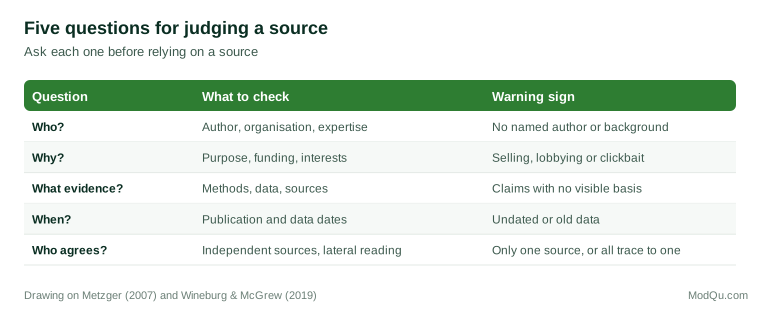
Who produced it? Identify the author and the organisation. Do they have relevant expertise? Are they named, and can their background be checked?
Why was it produced? Consider the purpose. A report produced to inform differs from one produced to sell, lobby or attract attention. Funding matters: Lundh et al. (2017) found that drug and device studies sponsored by manufacturers more often reported favourable results and conclusions than studies with other sponsors. A conflict of interest does not make a source wrong, but it is a reason to look harder.
What is the evidence? Look for a clear description of methods, data and sources. Does the document explain how its figures were produced, from what sample and when? Claims without visible evidence should carry little weight.
Is it current? Check the date of publication and the date of the data. A statistic from ten years ago may describe a market that no longer exists.
Does it agree with other sources? Corroboration is the strongest test. If independent sources with different methods reach similar conclusions, confidence rises. If a claim appears in only one place, or every version traces back to the same original, caution is warranted.
Reading laterally
Traditional checklists encourage readers to examine a source closely on its own terms: its layout, its "about" page, its references. Wineburg and McGrew (2019) compared how historians, university students and professional fact-checkers evaluated unfamiliar websites. The fact-checkers were faster and more accurate. Instead of reading a site from top to bottom, they quickly left it and opened new browser tabs to see what other sources said about the organisation behind it. This lateral reading revealed, for example, that a professional-looking site was run by a lobbying group, something that reading the site itself did not show.
The lesson is that credibility is often best judged from outside the source. A minute spent searching for the organisation's name, its funding and what independent commentators say about it can be worth more than a careful reading of the source itself.
Why care is needed
Unreliable information is not rare, and it spreads easily. Vosoughi et al. (2018) analysed the spread of true and false news stories on Twitter and found that false stories spread farther, faster and more broadly than true ones, largely because people shared them. Pennycook and Rand (2019) found that people who reasoned more carefully were better at telling true headlines from false ones, regardless of whether the headlines suited their political views. This suggests that simply pausing to think, and applying a few deliberate checks, improves judgement.
Applying the checks in research
In research and business work, credibility checks should be routine and recorded:
- Prefer original sources to summaries, and trace statistics back to where they were first produced.
- Record who produced each key source, when and why, so that others can judge it too.
- Treat a single uncorroborated source as provisional, and say so in the report.
- Be most careful with sources that confirm what you already expected, since they are the least likely to be questioned.
Conclusion
Judging credibility is not about finding perfect sources, since none exist. It is about knowing how much weight each source can bear. Asking who produced it, why, on what evidence, how recently and whether others agree, and checking those answers from outside the source, protects research from building on weak foundations.
References
Hovland, C. I., & Weiss, W. (1951). The influence of source credibility on communication effectiveness. Public Opinion Quarterly, 15(4), 635–650. https://doi.org/10.1086/266350
Lundh, A., Lexchin, J., Mintzes, B., Schroll, J. B., & Bero, L. (2017). Industry sponsorship and research outcome. Cochrane Database of Systematic Reviews, (2), Article MR000033. https://doi.org/10.1002/14651858.MR000033.pub3
Metzger, M. J. (2007). Making sense of credibility on the Web: Models for evaluating online information and recommendations for future research. Journal of the American Society for Information Science and Technology, 58(13), 2078–2091. https://doi.org/10.1002/asi.20672
Pennycook, G., & Rand, D. G. (2019). Lazy, not biased: Susceptibility to partisan fake news is better explained by lack of reasoning than by motivated reasoning. Cognition, 188, 39–50. https://doi.org/10.1016/j.cognition.2018.06.011
Pornpitakpan, C. (2004). The persuasiveness of source credibility: A critical review of five decades' evidence. Journal of Applied Social Psychology, 34(2), 243–281. https://doi.org/10.1111/j.1559-1816.2004.tb02547.x
Vosoughi, S., Roy, D., & Aral, S. (2018). The spread of true and false news online. Science, 359(6380), 1146–1151. https://doi.org/10.1126/science.aap9559
Wineburg, S., & McGrew, S. (2019). Lateral reading and the nature of expertise: Reading less and learning more when evaluating digital information. Teachers College Record, 121(11), 1–40. https://doi.org/10.1177/016146811912101102