
Research · Literature and evidence
Scoping Reviews and Rapid Evidence Assessments
How scoping reviews and rapid evidence assessments differ from full systematic reviews, when to use each, the stages of a scoping review, the shortcuts used in rapid reviews and their risks, and how to report both.
Full systematic reviews are the most thorough way to synthesise evidence, but they are not always the right tool. They typically take many months, and they work best for focused questions about the effects of interventions. Sometimes the need is different: to map what research exists on a broad topic, or to give decision-makers the best available evidence within weeks. Scoping reviews and rapid evidence assessments were developed for these needs. This article explains what each involves, how they differ from systematic reviews and from each other, and how to carry them out without losing the rigour that makes reviews worth trusting.
The family of reviews
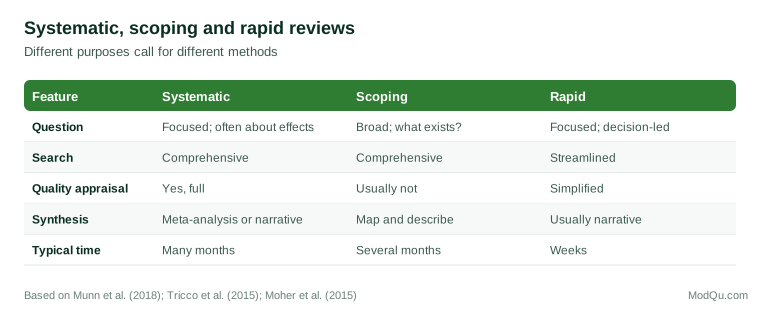
Grant and Booth (2009) identified fourteen types of review, and Moher et al. (2015) described systematic, rapid, scoping, realist and other reviews as members of a single family, sharing the aim of synthesising evidence but differing in purpose and method. Choosing the right member of the family depends on the question, the time available and how the review will be used. The table below compares the three most commonly used types.
Scoping reviews
Purpose
A scoping review maps the extent, range and nature of research on a topic. It asks what is known, how it has been studied and where the gaps are, rather than what the answer to a precise question is. Arksey and O'Malley (2005) described four common reasons for conducting a scoping review: to examine the extent, range and nature of research activity; to decide whether a full systematic review is worthwhile; to summarise and disseminate research findings; and to identify gaps in the existing literature.
Munn et al. (2018) set out when a scoping review is more appropriate than a systematic review. Scoping reviews suit questions such as what kinds of evidence exist on a topic, how concepts have been defined, how research has been conducted, and what the key characteristics of a field are. Systematic reviews suit questions about the feasibility, appropriateness, meaningfulness or effectiveness of a particular practice, where an answer can inform decisions directly.
The framework
Arksey and O'Malley (2005) proposed a five-stage framework, with an optional sixth stage, shown below.
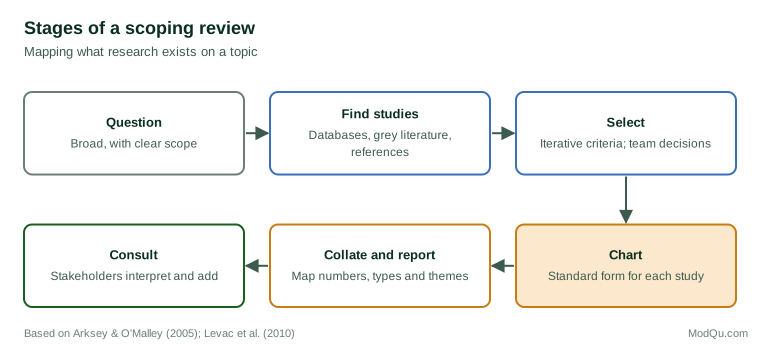
- Identify the research question. The question is broad, but it should still define the concept, the population and the context of interest.
- Identify relevant studies. Searches cover databases, reference lists, grey literature and relevant organisations.
- Select studies. Inclusion criteria are applied, often refined as the reviewers become familiar with the literature.
- Chart the data. Key information from each study is recorded in a standard form, such as authors, year, location, population, methods and main findings.
- Collate, summarise and report. Results are presented as a descriptive overview, often with tables and charts showing the volume and types of research, and a narrative summary of themes.
- Consultation (optional). Stakeholders are consulted to add insights, suggest further sources and help interpret findings.
Levac et al. (2010) refined the framework. They recommended combining a broad question with a clearly articulated scope, using an iterative team approach to selecting studies, piloting the data charting form, including a qualitative thematic analysis in addition to the descriptive summary, considering the implications of findings for policy and practice, and treating consultation as an essential rather than optional stage.
Searching for a scoping review
Because scoping reviews cover broad topics, searches can return very large numbers of records. Booth et al. (2016) recommended developing the search iteratively: starting with a few known relevant studies, examining the terms used in their titles, abstracts and index entries, and building these into the search strategy. Testing whether the search finds the known studies gives a simple check of its sensitivity. Scoping reviews also rely heavily on grey literature, because much of the activity in a field, such as practice reports, programme evaluations and policy documents, never appears in journals. Searching the websites of relevant organisations and asking experts for sources are often as productive as database searches.
Evidence maps
Many scoping reviews present their results as an evidence map or gap map: a grid in which one dimension lists interventions or topics and the other lists outcomes or populations, with each cell showing how many studies exist. Empty or sparse cells show where research is lacking; crowded cells show where a systematic review might now be feasible. Maps are a quick way for funders and decision-makers to see the shape of a field, but they show only the quantity of research, not its quality.
Standards and reporting
Early scoping reviews varied widely in method. Pham et al. (2014) conducted a scoping review of scoping reviews and found inconsistency in how they were defined, conducted and reported. Colquhoun et al. (2014) called for greater clarity and proposed a definition: a scoping review is a form of knowledge synthesis that addresses an exploratory question aimed at mapping key concepts, types of evidence and gaps in research, by systematically searching, selecting and synthesising existing knowledge.
Peters et al. (2015) developed guidance for the Joanna Briggs Institute, recommending a protocol, the PCC framework (population, concept and context) to define the question, and a systematic and transparent approach to searching and charting. Khalil et al. (2016) emphasised that scoping reviews should follow the same rigour in searching and selection as systematic reviews, even though their aims are different. Tricco et al. (2018) published the PRISMA extension for scoping reviews (PRISMA-ScR), a checklist of items that scoping reviews should report.
Assessing quality
Scoping reviews do not usually assess the quality or risk of bias of included studies, because their aim is to map evidence rather than to weigh it. This is both a strength and a limitation. It allows a broad overview of a field, but it means that a scoping review cannot say whether the evidence on any question is strong. Readers should not treat the volume of studies found on a topic as a measure of how well established a finding is.
Rapid evidence assessments
Purpose
Decision-makers often need evidence quickly: to respond to an emerging problem, inform a policy deadline or decide on a business investment. A rapid review, often called a rapid evidence assessment, uses the methods of a systematic review but simplifies or omits some steps to produce results in a shorter time, often weeks rather than months.
Ganann et al. (2010) reviewed rapid review methods and found that they varied widely in how they shortened the process, and that there was little evidence about how much the shortcuts affected conclusions. Khangura et al. (2012) described the development of an evidence summary service designed to answer questions from health system decision-makers within weeks, built on close collaboration with the people asking the questions.
Common shortcuts
Tricco et al. (2015) conducted a scoping review of rapid review methods and identified the most common ways in which rapid reviews streamline the process:
- Narrowing the question, for example by focusing on a single intervention or outcome;
- Limiting the search to fewer databases, a shorter date range or one language;
- Using a single reviewer for screening or data extraction, sometimes with a second reviewer checking a sample;
- Omitting or simplifying quality assessment;
- Limiting synthesis to a narrative summary;
- Relying on existing systematic reviews where available, rather than primary studies.
Garritty et al. (2021) set out guidance from the Cochrane Rapid Reviews Methods Group. Their recommendations include involving the people who will use the review in setting the question, publishing or registering a protocol, searching at least two major databases and grey literature, using two reviewers to screen at least a sample of records, and assessing risk of bias with a validated tool, even in simplified form.
Using existing systematic reviews
One of the most effective ways to speed up a review is to build on systematic reviews that already exist. If a recent, high-quality systematic review addresses the question, a rapid review can summarise it and search only for studies published since its search date. If several reviews exist, an overview of reviews can compare their findings. The Cochrane Handbook sets out methods for overviews, including assessing the quality of the included reviews and handling overlap when the same primary studies appear in several reviews (Higgins et al., 2019). The risk is that existing reviews may be out of date, may use different definitions or may themselves be of poor quality, so they should be appraised rather than accepted.
Social science evidence
Petticrew and Roberts (2006) noted that social science questions often involve complex interventions, varied outcomes and evidence from many study designs, including qualitative research. This makes both scoping and rapid reviews especially useful in social and business research, where a strict focus on randomised trials would exclude most of the relevant evidence. It also makes clear reporting of how different kinds of evidence were combined particularly important.
Rapid reviews in social policy and management
Rapid evidence assessments are widely used in public policy. Thomas et al. (2013) reviewed their use in social policy and argued that they could provide useful, timely evidence if their methods and limitations were stated clearly, but warned against treating them as equivalent to full systematic reviews. In management, Barends et al. (2017) published guidelines for rapid evidence assessments that ask focused questions, search systematically, assess the methodological quality of studies and report the level of trustworthiness of the findings, adapted to the kinds of evidence common in organisational research.
Risks
The shortcuts of rapid reviews carry risks. Searching fewer sources may miss relevant studies; using one reviewer increases the chance of errors in selection and extraction; skipping quality assessment means weak studies may be given too much weight. Schünemann and Moja (2015) argued that rapid reviews should remain systematic in their essentials, and that the label "rapid" should not become an excuse for poor methods. Varker et al. (2015) emphasised that rapid evidence assessments must report exactly which steps were shortened, so that users can judge the risk.
Choosing between review types
The choice depends on the question and the decision it will inform:
- Is the question broad and exploratory? A scoping review is likely to fit.
- Is the question focused and is there time for full rigour? A systematic review is preferable.
- Is a decision needed soon, and is some loss of thoroughness acceptable? A rapid review may be appropriate.
Munn et al. (2018) noted that a scoping review is sometimes conducted first to establish whether there is enough evidence to justify a systematic review. Similarly, a rapid review may be followed by a full systematic review when time allows. Gough et al. (2017) emphasised that all review types should be guided by the needs of their users and should state their methods clearly.
Time and resources should be discussed openly with the people who will use the review. A decision-maker may prefer a rapid review in four weeks to a systematic review in nine months, once the trade-offs are explained; another may need the greater certainty of a full review because the decision is costly or hard to reverse. Writing down the agreed question, scope, timetable and methods in a short protocol, even for a rapid or scoping review, protects against later disagreements and against the scope drifting as the work proceeds. It also allows the review to be repeated or updated later on the same basis.
Reporting
Whatever the type, a review should report its question, search strategy, inclusion criteria, selection process, methods for charting or extracting data, approach to quality assessment, synthesis and limitations. For scoping reviews, PRISMA-ScR provides a checklist (Tricco et al., 2018). For rapid reviews, reporting should state clearly which steps of a systematic review were shortened or omitted, and the likely consequences. The PRISMA 2020 statement for systematic reviews also provides a useful framework for reporting rapid reviews (Page et al., 2021).
Applied examples
Two hypothetical examples show how the types differ in practice.
A market research firm is asked to advise a client on research into consumer trust in online marketplaces. The firm does not know how much research exists or how trust has been measured. It conducts a scoping review, charting 120 studies by country, method, definition of trust and outcome. The map shows that most studies use surveys of buyers in a few countries, that sellers' perspectives are rarely studied, and that definitions of trust vary widely. The review does not say which factors increase trust most, but it identifies where new research would add most value and which measures have been used.
A retailer needs to decide within a month whether to introduce self-checkout in small stores. Its research team carries out a rapid evidence assessment, searching two databases and industry sources for studies of self-checkout effects on sales, waiting times and shrinkage. One reviewer screens all records and a second checks a sample. A simplified quality assessment rates each study. The review finds moderate evidence that self-checkout reduces waiting times and limited, conflicting evidence on shrinkage. The team reports these findings with a clear statement of the shortcuts taken, and recommends a pilot in a few stores to collect local evidence on shrinkage.
Conclusion
Scoping reviews and rapid evidence assessments extend the family of evidence synthesis beyond the full systematic review. Scoping reviews map the extent and nature of research on broad topics and identify gaps. Rapid reviews provide timely evidence for decisions by streamlining systematic methods. Both can be rigorous if they follow established frameworks, keep their essential systematic features and report their methods and limitations openly. Choosing the right type, and being honest about what it can and cannot show, is what makes a review useful.
References
Arksey, H., & O'Malley, L. (2005). Scoping studies: Towards a methodological framework. International Journal of Social Research Methodology, 8(1), 19–32. https://doi.org/10.1080/1364557032000119616
Barends, E., Rousseau, D. M., & Briner, R. B. (Eds.). (2017). CEBMa guideline for rapid evidence assessments in management and organizations (Version 1.0). Center for Evidence Based Management.
Booth, A., Sutton, A., & Papaioannou, D. (2016). Systematic approaches to a successful literature review (2nd ed.). SAGE.
Colquhoun, H. L., Levac, D., O'Brien, K. K., Straus, S., Tricco, A. C., Perrier, L., Kastner, M., & Moher, D. (2014). Scoping reviews: Time for clarity in definition, methods, and reporting. Journal of Clinical Epidemiology, 67(12), 1291–1294. https://doi.org/10.1016/j.jclinepi.2014.03.013
Ganann, R., Ciliska, D., & Thomas, H. (2010). Expediting systematic reviews: Methods and implications of rapid reviews. Implementation Science, 5, Article 56. https://doi.org/10.1186/1748-5908-5-56
Garritty, C., Gartlehner, G., Nussbaumer-Streit, B., King, V. J., Hamel, C., Kamel, C., Affengruber, L., & Stevens, A. (2021). Cochrane Rapid Reviews Methods Group offers evidence-informed guidance to conduct rapid reviews. Journal of Clinical Epidemiology, 130, 13–22. https://doi.org/10.1016/j.jclinepi.2020.10.007
Gough, D., Oliver, S., & Thomas, J. (Eds.). (2017). An introduction to systematic reviews (2nd ed.). SAGE.
Grant, M. J., & Booth, A. (2009). A typology of reviews: An analysis of 14 review types and associated methodologies. Health Information & Libraries Journal, 26(2), 91–108. https://doi.org/10.1111/j.1471-1842.2009.00848.x
Higgins, J. P. T., Thomas, J., Chandler, J., Cumpston, M., Li, T., Page, M. J., & Welch, V. A. (Eds.). (2019). Cochrane handbook for systematic reviews of interventions (2nd ed.). Wiley. https://doi.org/10.1002/9781119536604
Khalil, H., Peters, M., Godfrey, C. M., McInerney, P., Soares, C. B., & Parker, D. (2016). An evidence-based approach to scoping reviews. Worldviews on Evidence-Based Nursing, 13(2), 118–123. https://doi.org/10.1111/wvn.12144
Khangura, S., Konnyu, K., Cushman, R., Grimshaw, J., & Moher, D. (2012). Evidence summaries: The evolution of a rapid review approach. Systematic Reviews, 1, Article 10. https://doi.org/10.1186/2046-4053-1-10
Levac, D., Colquhoun, H., & O'Brien, K. K. (2010). Scoping studies: Advancing the methodology. Implementation Science, 5, Article 69. https://doi.org/10.1186/1748-5908-5-69
Moher, D., Stewart, L., & Shekelle, P. (2015). All in the family: Systematic reviews, rapid reviews, scoping reviews, realist reviews, and more. Systematic Reviews, 4, Article 183. https://doi.org/10.1186/s13643-015-0163-7
Munn, Z., Peters, M. D. J., Stern, C., Tufanaru, C., McArthur, A., & Aromataris, E. (2018). Systematic review or scoping review? Guidance for authors when choosing between a systematic or scoping review approach. BMC Medical Research Methodology, 18, Article 143. https://doi.org/10.1186/s12874-018-0611-x
Page, M. J., McKenzie, J. E., Bossuyt, P. M., Boutron, I., Hoffmann, T. C., Mulrow, C. D., Shamseer, L., Tetzlaff, J. M., Akl, E. A., Brennan, S. E., Chou, R., Glanville, J., Grimshaw, J. M., Hróbjartsson, A., Lalu, M. M., Li, T., Loder, E. W., Mayo-Wilson, E., McDonald, S., … Moher, D. (2021). The PRISMA 2020 statement: An updated guideline for reporting systematic reviews. BMJ, 372, Article n71. https://doi.org/10.1136/bmj.n71
Peters, M. D. J., Godfrey, C. M., Khalil, H., McInerney, P., Parker, D., & Soares, C. B. (2015). Guidance for conducting systematic scoping reviews. International Journal of Evidence-Based Healthcare, 13(3), 141–146. https://doi.org/10.1097/XEB.0000000000000050
Petticrew, M., & Roberts, H. (2006). Systematic reviews in the social sciences: A practical guide. Blackwell. https://doi.org/10.1002/9780470754887
Pham, M. T., Rajić, A., Greig, J. D., Sargeant, J. M., Papadopoulos, A., & McEwen, S. A. (2014). A scoping review of scoping reviews: Advancing the approach and enhancing the consistency. Research Synthesis Methods, 5(4), 371–385. https://doi.org/10.1002/jrsm.1123
Schünemann, H. J., & Moja, L. (2015). Reviews: Rapid! Rapid! Rapid! …and systematic. Systematic Reviews, 4, Article 4. https://doi.org/10.1186/2046-4053-4-4
Thomas, J., Newman, M., & Oliver, S. (2013). Rapid evidence assessments of research to inform social policy: Taking stock and moving forward. Evidence & Policy, 9(1), 5–27. https://doi.org/10.1332/174426413X662572
Tricco, A. C., Antony, J., Zarin, W., Strifler, L., Ghassemi, M., Ivory, J., Perrier, L., Hutton, B., Moher, D., & Straus, S. E. (2015). A scoping review of rapid review methods. BMC Medicine, 13, Article 224. https://doi.org/10.1186/s12916-015-0465-6
Tricco, A. C., Lillie, E., Zarin, W., O'Brien, K. K., Colquhoun, H., Levac, D., Moher, D., Peters, M. D. J., Horsley, T., Weeks, L., Hempel, S., Akl, E. A., Chang, C., McGowan, J., Stewart, L., Hartling, L., Aldcroft, A., Wilson, M. G., Garritty, C., … Straus, S. E. (2018). PRISMA extension for scoping reviews (PRISMA-ScR): Checklist and explanation. Annals of Internal Medicine, 169(7), 467–473. https://doi.org/10.7326/M18-0850
Varker, T., Forbes, D., Dell, L., Weston, A., Merlin, T., Hodson, S., & O'Donnell, M. (2015). Rapid evidence assessment: Increasing the transparency of an emerging methodology. Journal of Evaluation in Clinical Practice, 21(6), 1199–1204. https://doi.org/10.1111/jep.12405