
Share your experience of listening to radio
Tell us how often you listen to the radio, where you listen and which kind of station you prefer. Your answers are combined with other people's and reported only as totals.
Start the radio surveyAbout 5 minutes. No account needed. You can stop at any time.
What this topic covers
Radio means audio programmes broadcast by stations to the public, either over the air or online. It includes music, news, talk, sport, religious programming, drama and community broadcasting. This topic covers:
- how often people listen and for how long;
- where they listen: at home, in the car, at work, on a phone;
- which devices they use;
- which formats and stations they prefer;
- how they feel about advertising and presenters;
- how radio fits alongside streaming music and podcasts.
Radio matters in different ways in different places. In many countries it is the main source of news for people in rural areas, people without internet access and people who cannot read. In others it is mainly something people listen to in the car.
How people listen
Radio reaches people through several technologies:
- AM and FM analogue broadcasting, received by most car radios and portable sets.
- Shortwave, which travels long distances and is still used for international broadcasting and in remote areas.
- Digital radio, such as DAB and DAB+ in Europe, Australia and parts of Asia, HD Radio in the United States, and other standards elsewhere. Digital radio can offer more stations and clearer sound where it is available.
- Online streaming through station websites and apps, radio aggregator apps and smart speakers.
- Television services, which carry some radio stations.
- Mobile phones with built-in FM receivers, still common on many low-cost phones.
Where people listen
The place people listen most often varies by country and by age. Common places include:
- In the car: for many listeners the most common place, especially on commutes.
- At home: in the kitchen, in the morning, or as background while doing chores.
- At work: in shops, workshops, taxis, salons and offices.
- On the move: through earphones on a phone.
- In shared spaces: market stalls, buses and community centres, where one radio serves many people.
Example
A taxi driver keeps the radio on for most of a twelve-hour shift. They listen to a talk station for news and traffic in the morning, switch to music stations in the afternoon and turn the volume down when passengers want quiet. They say radio keeps them company and tells them about road closures before their navigation app does.
Kinds of station and format
Stations usually follow a format, a consistent style that tells listeners what to expect. Common formats include:
- Music formats, such as contemporary hits, classic hits, rock, country, classical, jazz, religious music or local and regional music;
- News and talk, with news bulletins, interviews, phone-ins and discussion;
- Sport, with live commentary and discussion;
- Public service radio, run by public broadcasters, often mixing news, culture, education and music;
- Community radio, run by and for a local community or group, often by volunteers;
- Religious radio;
- International broadcasters, which broadcast to other countries in several languages.
Many listeners have one or two favourite stations and change station rarely. Presenters, especially breakfast or morning presenters, are often the main reason people choose a station.
How radio is funded
Radio stations are funded in different ways, and this affects what they broadcast:
- Commercial radio earns money from advertising and sponsorship.
- Public service radio is funded by government, a licence fee or a mix, with rules to serve the whole public. Examples include national public broadcasters in many countries.
- Community radio relies on grants, donations, local sponsorship and volunteers.
- Listener-supported radio asks listeners for regular donations.
People's views of advertising on radio vary. Some find it repetitive; others say local adverts tell them about shops and events nearby.
Radio and emergencies
Radio plays an important part in emergencies. Battery-powered and wind-up radios work during power cuts and when mobile networks fail. Many countries designate broadcasters to provide warnings and information during storms, floods, earthquakes and other disasters. Emergency planning guidance in many places recommends that households keep a battery-powered radio.
Example
During a storm that cuts power and mobile signal for two days, a family uses a battery radio to hear where emergency shelters are open and when roads will reopen. Before this, they had not listened to radio at home for years. They now keep spare batteries with the radio.
Radio compared with streaming and podcasts
Music streaming apps and podcasts compete with radio for listening time. Listeners compare them in several ways:
- Choice: streaming lets people choose exactly what to hear; radio chooses for them, which some people prefer.
- Live content: radio offers live news, traffic, sport and conversation, and a sense of shared listening.
- Discovery: some people find new music through radio presenters; others through streaming recommendations.
- Cost: broadcast radio is free once you have a receiver; streaming may require a subscription or come with adverts; online listening uses mobile data.
- Local content: radio offers local news, weather and events.
Many people use all three. A common pattern is radio in the car and in the morning, streaming for personal music, and podcasts for particular interests. Radio stations also publish their shows as podcasts and on demand.
Example (hypothetical figures)
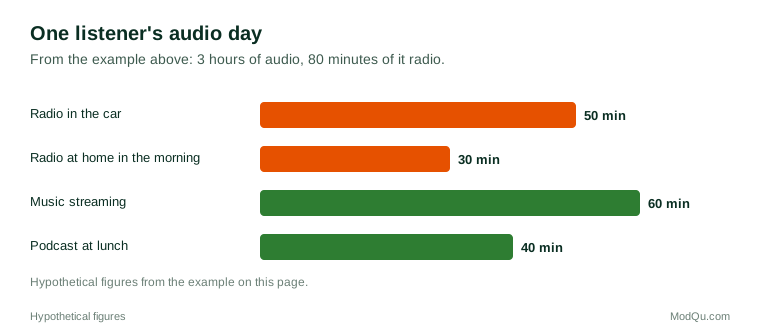
A listener records a typical weekday. They listen to the radio for 50 minutes in the car and 30 minutes at home in the morning, stream music for 60 minutes at the gym and in the evening, and listen to a podcast for 40 minutes at lunch. That is 3 hours of audio a day, of which 80 minutes, or about 44%, is radio.
Figure 1 shows the listening day from the example.
Trends and debates
Trends and debates in radio include:
- Switching from analogue to digital: some countries have switched off or plan to reduce FM broadcasting, which raises concerns for listeners with older radios.
- Radio in cars: whether new cars keep AM and FM receivers as dashboards become more like phones.
- Smart speakers, which have brought radio back into some homes.
- Local news: the decline of local journalism in some countries, and the role of local radio.
- Younger listeners: whether people who grow up with streaming will listen to radio.
Questions that businesses want answered here include how often people listen to radio, where and on which device, which formats they prefer, and how radio compares with streaming and podcasts in their daily routine.
Key terms
- AM and FMThe two main forms of analogue radio broadcasting.
- DABDigital Audio Broadcasting, a digital radio standard used in many countries.
- FormatThe consistent style of a station, such as hits, news and talk, or classical.
- Public service broadcasterA broadcaster funded publicly with a duty to serve the whole population.
- Community radioNon-profit radio run by and for a local community or group.
- Phone-inA programme in which listeners call in to speak on air.
- StreamingListening to a station or audio over the internet as it plays.
- ReachThe number or share of people who listen to a station at least once in a period.
Full glossary: radio broadcasting terms on EditingTests.com.
Radio vocabulary test
How well do you know the language of this topic? Try 8 quick questions. Your score is shown straight away and is not saved.
What the radio survey asks
This survey is part of ModQu's Media and Entertainment survey. The radio part takes about five minutes and covers:
- How often you listen to the radio, and for how long on a typical day.
- Where you listen: in the car, at home, at work or on the move.
- Which devices you use: car radio, home radio, phone, smart speaker or online.
- Which kind of station you prefer, and why.
- How radio fits with music streaming and podcasts in your day.
- Whether you rely on radio for news or in emergencies.
After that you can choose to continue with other short parts of the Media and Entertainment survey, such as streaming tv and video or music and podcasts, or stop.
Ready to take part?
Your answers help show what people really think and do. Results are only ever reported as totals; no one can see your individual answers.
Start the surveyQuestions about this survey
Who can take part?
Adults.
Do I have to give my name?
No. You may be asked for your age group, region and similar details so results can be broken down, but not your name. ModQu never asks for passwords, card numbers or account numbers.
How are the results used?
Answers are combined into totals and percentages and published in ModQu reports. Individual answers are never shown.
Is the vocabulary test part of the survey?
No. It is optional and separate, and your score is not stored.