
Share your experience of audiobooks
Tell us whether you listen to audiobooks, where you get them and how you pay for them. Your answers are combined with other people's and reported only as totals.
Start the audiobooks surveyAbout 5 minutes. No account needed. You can stop at any time.
What this topic covers
An audiobook is a recording of a book read aloud, usually in full. Audiobooks were once sold on cassettes and CDs, mainly for people with visual impairments or long car journeys. Today most are downloaded or streamed on phones, and they have become a common way to enjoy books.
This topic covers:
- who listens to audiobooks, how often and when;
- what kinds of books people listen to;
- where they get audiobooks, from apps and shops to public libraries;
- how they pay: single purchases, credits, subscriptions or free;
- what they value in narration and production;
- how listening fits with reading print and e-books.
Audiobooks are related to podcasts and radio drama but differ in that they are a reading of a complete book, or an adaptation of one.
Who listens and when
Audiobook listeners come from all age groups. Many say listening lets them "read" more books than they otherwise could, because they can listen while doing something else. Common listening times include:
- driving and commuting;
- housework, cooking and gardening;
- walking, running and going to the gym;
- falling asleep;
- long journeys and flights.
Audiobooks are also important for people who find print hard to read, including people with visual impairments, dyslexia or other reading difficulties, and people learning a new language who want to hear pronunciation. Many countries have national library services or organizations that provide accessible audiobooks free for people with print disabilities.
Example
A truck driver who spends long days on the road used to listen to music and talk radio. A colleague suggests audiobooks, and they start with a thriller. A year later they have finished more than thirty books, mostly crime and history, and say they had not read that many books since school.
What people listen to
Popular genres for audiobooks include:
- crime, thrillers and mysteries;
- fantasy and science fiction, including long series;
- memoirs and biographies, especially when read by the author;
- self-help and personal development;
- history and popular science;
- romance;
- children's books, often used on family car journeys;
- classics, which are often available free because they are out of copyright.
Some audiobooks are full-cast productions with several actors, music and sound effects. Others are read by a single narrator. A small but growing number are original audio titles written to be heard first.
Where people get audiobooks
The main sources are:
- Audiobook apps and stores, where titles can be bought, borrowed with credits or streamed as part of a subscription.
- General streaming and music apps that now include audiobooks in some countries.
- Public libraries, which lend digital audiobooks through apps, usually free with a library card, with a limited number of copies and waiting lists for popular titles.
- Free collections of classic books read by volunteers.
- CDs, still used by some listeners, especially in cars and by older adults.
Example
A student cannot afford a subscription, so they borrow audiobooks from their public library's app. Popular new titles have a waiting list of several weeks, so they place holds on several books at once and listen to older titles while they wait.
How people pay
Audiobooks can be paid for in several ways, and the choice affects how many books people listen to and how much they spend.
- Single purchase: buying each title at its own price. New audiobooks can cost more than the printed book because of the cost of recording.
- Credit membership: a monthly fee that gives one or more credits, each exchanged for a title the listener keeps.
- All-you-can-listen subscription: a monthly fee for unlimited listening from a catalogue, which may not include every title.
- Hours-based plans: a monthly fee for a set number of listening hours.
- Free: library lending and free classics.
Example (hypothetical figures)
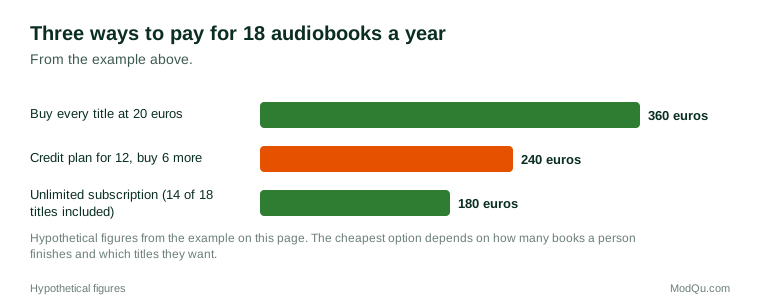
A listener finishes 18 audiobooks a year. Buying each at an average of 20 euros would cost 360 euros. A credit plan at 10 euros a month with one credit a month costs 120 euros for 12 books, and buying the other 6 at 20 euros adds 120 euros, a total of 240 euros. An unlimited subscription at 15 euros a month costs 180 euros, but only 14 of the 18 books they want are in its catalogue.
Figure 1 compares the three options in that example. The cheapest choice depends on how many books a person finishes and whether the titles they want are included.
What makes a good audiobook
Listeners often say the narrator matters as much as the book. Common points include:
- a clear, pleasant voice and a pace that suits the story;
- different voices for characters, without overacting;
- correct pronunciation of names, places and foreign words;
- good sound quality with no background noise;
- the author reading their own memoir, which many listeners value.
Listening speed is another feature people use. Most apps let listeners speed up or slow down narration. Some listen at faster speeds to finish books sooner; others prefer normal speed for fiction.
A poor narrator is one of the most common reasons people stop listening to an audiobook.
Listening compared with reading
People often ask whether listening to a book "counts" as reading. Many listeners say it does, and that they remember and enjoy books as much as in print. Others find they remember less when listening while doing something else, or prefer to read difficult non-fiction on paper. Some people combine formats, switching between an e-book and its audiobook depending on where they are.
Audiobooks can also help children's reading and vocabulary, especially when children follow a printed copy while listening.
Debates and trends
Several debates and trends shape audiobooks:
- Prices and subscriptions: whether unlimited subscriptions pay authors and narrators fairly.
- Library access: the price and lending terms libraries pay for digital audiobooks, which are often higher than for print.
- Synthetic voices: computer-generated narration, which makes it cheaper to produce audiobooks of more titles but worries narrators and some listeners.
- Accessibility: making more books available in audio for people with print disabilities, supported in many countries by the Marrakesh Treaty, an international agreement on accessible formats.
- Languages: many audiobooks are only available in a few major languages.
Questions that businesses want answered here include how often people listen, where they get audiobooks, which payment model they prefer and whether they would accept computer-generated narration.
Key terms
- AudiobookA recording of a book read aloud.
- NarratorThe person who reads an audiobook aloud.
- UnabridgedA complete recording of the whole book.
- AbridgedA shortened version of the book, with some parts removed.
- CreditA unit included in some memberships that can be exchanged for one title.
- Full-cast productionAn audiobook performed by several actors, often with music and sound effects.
- Synthetic narrationNarration produced by computer-generated voices instead of a human reader.
- Print disabilityA condition, such as low vision or dyslexia, that makes reading printed text difficult.
Full glossary: digital audio terms on EditingTests.com.
Audiobooks vocabulary test
How well do you know the language of this topic? Try 8 quick questions. Your score is shown straight away and is not saved.
What the audiobooks survey asks
This survey is part of ModQu's Media and Entertainment survey. The audiobooks part takes about five minutes and covers:
- Whether you have listened to an audiobook in the last year, and how many.
- When and where you usually listen.
- Where you get audiobooks: apps, stores, libraries or free collections.
- How you pay: single purchases, credits, a subscription or free.
- What matters most to you in narration, and whether you would listen to computer-generated voices.
- How audiobooks fit with your reading of print books and e-books.
After that you can choose to continue with other short parts of the Media and Entertainment survey, such as streaming tv and video or music and podcasts, or stop.
Ready to take part?
Your answers help show what people really think and do. Results are only ever reported as totals; no one can see your individual answers.
Start the surveyQuestions about this survey
Who can take part?
Adults.
Do I have to give my name?
No. You may be asked for your age group, region and similar details so results can be broken down, but not your name. ModQu never asks for passwords, card numbers or account numbers.
How are the results used?
Answers are combined into totals and percentages and published in ModQu reports. Individual answers are never shown.
Is the vocabulary test part of the survey?
No. It is optional and separate, and your score is not stored.