
Share your views on young people's chances
Tell us how good young people's chances are where you live, what holds them back and whether you think they will be better off than their parents. Your answers are combined with other people's and reported only as totals.
Start the youth and opportunity surveyAbout 5 minutes. No account needed. You can stop at any time.
What this topic covers
"Youth" usually means people aged roughly 15 to 24, though many surveys and governments extend it to 29 or even 35, because the move into stable work, housing and family life now often takes longer. "Opportunity" means the real chances people have to get an education, find decent work, earn a living, have a home and take part in society.
This topic covers how adults of all ages see young people's chances, including:
- education and training after school;
- finding a first job and building a career;
- the cost of housing and leaving home;
- the role of family background and where people grow up;
- health and well-being, including mental health;
- whether young people today will be better off than their parents.
The world has a very young population in some regions and an ageing population in others. In parts of Africa, South Asia and the Middle East a large share of people are under 25, and creating enough jobs for them is a central issue. In much of Europe and East Asia, young people are a shrinking share of the population, and debates focus on housing costs, pensions and fairness between generations.
Education and training
Education is the most common route to better opportunities. Over recent decades, the share of young people finishing secondary school and going on to college or university has risen in most countries. But more education has not always led to better jobs. In some places graduates face high unemployment or work in jobs that do not need a degree.
Paths after school include:
- University or college degrees, which may involve tuition fees and student debt in some countries, or be free or low-cost in others.
- Vocational and technical training, such as trade schools and apprenticeships that combine work and study.
- Starting work directly, often in entry-level or informal jobs.
- Gap years, volunteering or military service, which is required in some countries.
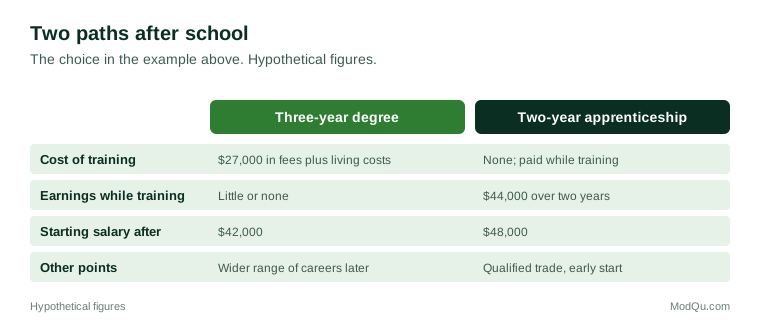
Example (hypothetical figures)
A young person weighs two options. A three-year degree costs $9,000 a year in fees, so $27,000 in total, plus living costs, and would likely lead to a starting salary of $42,000. A two-year paid apprenticeship as an electrician pays $22,000 a year while training, so $44,000 over two years, with a qualified salary of $48,000 afterwards. She chooses the apprenticeship, though her parents had hoped she would go to university.
Getting a first job
Many young people find the first job hardest to get. Employers often ask for experience, and young people cannot get experience without a job. Youth unemployment rates are higher than adult rates in most countries, often two or three times as high.
Other common problems include:
- short-term, part-time or zero-hours contracts that give little security;
- unpaid internships, which favour those whose families can support them;
- informal work without contracts, common in many lower- and middle-income countries;
- discrimination based on age, gender, ethnicity, disability or where someone lives.
Young people who are not in employment, education or training (often shortened to NEET) are a particular concern for governments, because long periods out of work early in life can affect earnings and health for years.
Family background and place
Where someone is born and who their parents are still shape opportunity strongly. Children from families with more money and education tend to do better at school, go further in education and earn more, even when abilities are similar. The phrase "social mobility" describes how easily people can move into a different income or class than their parents.
Place matters too. Young people in cities often have more jobs and courses nearby but higher housing costs. Those in rural areas or small towns may need to move away for education or work, which can weaken local communities. Within cities, some neighbourhoods have much weaker schools and fewer jobs than others.
Example
Two cousins finish school the same year. One lives in a capital city and finds a paid internship through a friend of her father's. The other lives in a farming region two hundred kilometres away, where the nearest college is an hour by bus. He works at the family shop for two years before moving to the city to study, by which time his cousin has a permanent job.
Housing and leaving home
In many countries young adults are leaving home later than their parents did. High rents and house prices, insecure jobs and student debt are common reasons. In some cultures living with parents into one's late twenties or after marriage is normal and expected; in others it is seen as a sign of difficulty. Surveys often ask young people whether they want to leave home and what stops them.
Health and well-being
Young people's mental health has become a major topic. Many surveys report concerns about anxiety, stress and loneliness among young people, and services in many countries have long waiting lists. Causes people point to include pressure at school, money worries, social media, and uncertainty about the future, including climate change. Others warn that greater willingness to talk about mental health may also affect how often problems are reported.
Will young people be better off than their parents?
For much of the twentieth century in many countries, each generation was richer, healthier and better educated than the one before. Many people now doubt that this will continue, especially in higher-income countries, where housing costs and slower wage growth have hit younger generations. In some fast-growing economies, by contrast, many young people already live very different, often more comfortable lives than their parents did.
Example
A grandmother who left school at fourteen and worked in a factory says her granddaughter, now at university, has "every chance I never had". The granddaughter agrees she has more education and freedom, but says she cannot imagine ever buying a home like the one her grandmother bought at twenty-five.
What people disagree about
People disagree about whether young people today have it harder or easier than past generations; whether more should go to university or into trades; whether governments should spend more on youth jobs, training and housing; whether young people themselves need to work harder; and how fair it is that older generations hold most wealth and property. Answers often differ between age groups, which is why surveys on this topic ask adults of all ages.
Questions that governments, foundations, employers and community organizations want answered include how people rate young people's chances locally, what they see as the main barriers, and which kinds of support they think would help most.
Key terms
- Youth unemploymentThe share of young people who want work and are looking for it but have no job.
- NEETNot in employment, education or training.
- ApprenticeshipPaid work combined with training for a trade or skill.
- Social mobilityHow easily people can move into a different income or class from their parents.
- InternshipA short period of work experience, sometimes unpaid.
- Zero-hours contractA job contract with no guaranteed minimum hours.
- Student debtMoney borrowed to pay for education, repaid after study.
- Intergenerational fairnessWhether costs and benefits are shared fairly between generations.
Full glossary: social services administration terms on EditingTests.com.
Youth and opportunity vocabulary test
How well do you know the language of this topic? Try 8 quick questions. Your score is shown straight away and is not saved.
What the youth and opportunity survey asks
This survey is part of ModQu's Communities and Society survey. The youth and opportunity part takes about five minutes and covers:
- How good you think young people's chances are where you live, for education, jobs and housing.
- What you see as the main things holding young people back.
- Whether you think today's young people will be better off than their parents.
- Which kinds of support would help most: training, jobs, housing, mental health or other.
- If you are young yourself, your own plans and the barriers you face.
After that you can choose to continue with other short parts of the Communities and Society survey, such as neighbourhoods and community life or loneliness and social connection, or stop.
Ready to take part?
Your answers help show what people really think and do. Results are only ever reported as totals; no one can see your individual answers.
Start the surveyQuestions about this survey
Who can take part?
Adults.
Do I have to give my name?
No. You may be asked for your age group, region and similar details so results can be broken down, but not your name. ModQu never asks for passwords, card numbers or account numbers.
How are the results used?
Answers are combined into totals and percentages and published in ModQu reports. Individual answers are never shown.
Is the vocabulary test part of the survey?
No. It is optional and separate, and your score is not stored.