
Share your experience of accessibility
Tell us which barriers you or people close to you face, and which places get accessibility right. Your answers are combined with other people's and reported only as totals.
Start the accessibility and disability surveyAbout 5 minutes. No account needed. You can stop at any time.
Disability and accessibility
A disability is a long-term or recurring condition that, together with barriers in the environment, limits a person's daily activities. Disabilities can be physical, sensory, cognitive, intellectual, mental health related, learning related or a combination. Some are visible, such as using a wheelchair, and many are not, such as chronic pain, hearing loss, autism, epilepsy or depression. Some are present from birth; many are acquired through illness, injury or ageing.
Accessibility means designing places, products, services, information and jobs so that people with disabilities can use them fully and independently. Good accessibility helps many other people too, such as parents with strollers, older adults, travellers with luggage and people with a temporary injury.
Statistics Canada measures disability through the Canadian Survey on Disability, which asks about difficulties with daily activities and how often they limit people. The survey's results show that disability is common and becomes more common with age.
The social model of disability
Two ways of thinking about disability are often contrasted:
- The medical model sees disability as a problem in the person's body or mind, to be treated or cured.
- The social model sees disability as created mainly by barriers in society: stairs with no ramp, videos with no captions, forms that cannot be read by a screen reader, or attitudes that exclude.
Most disability organizations and modern accessibility laws draw on the social model, while recognizing that health care and treatment also matter. Under the social model, removing barriers is the main way to make society more accessible.
Kinds of barriers
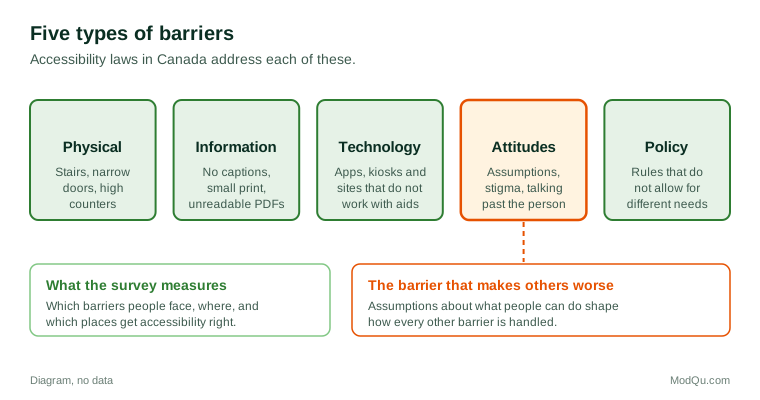
Accessibility laws and researchers group barriers into a few types:
- Physical and architectural: stairs, narrow doors, high counters, lack of accessible washrooms, and snow and ice on sidewalks.
- Information and communication: small print, no captions or sign language interpretation, documents that screen readers cannot read, and complicated language.
- Technology: websites, apps, kiosks and self-checkouts that cannot be used with assistive technology.
- Attitudinal: assumptions about what people with disabilities can do, staff who speak to a companion rather than the person, and stigma.
- Policy and practice: rules that do not allow for different needs, such as a ban on all animals that does not allow for service animals.
- Transportation: inaccessible vehicles, stations and booking systems.
Example
A man who uses a wheelchair arrives for a dinner reservation at a restaurant listed online as accessible. The entrance has a ramp, but the washroom is down a flight of stairs. He calls ahead the next time he books anywhere, and now chooses restaurants that list exactly which areas are step-free.
Accessibility laws in Canada
Canada has several layers of law on disability and accessibility:
- The Canadian Charter of Rights and Freedoms protects equality rights, including for people with mental or physical disabilities.
- Human rights laws, federal and provincial, prohibit discrimination based on disability in jobs, housing and services, and include a duty to accommodate.
- The Accessible Canada Act (2019) aims for a barrier-free Canada by 2040 in areas under federal responsibility, such as banking, telecommunications, federal transportation and the federal government.
- Provincial accessibility laws, such as the Accessibility for Ontarians with Disabilities Act (2005), and laws in Manitoba, Nova Scotia, British Columbia and other provinces, set standards for organizations.
Canada has also ratified the United Nations Convention on the Rights of Persons with Disabilities. In the United States, the Americans with Disabilities Act (1990) is the main federal law. This page describes laws in general and is not legal advice.
Accessibility at work
At work, the duty to accommodate means employers must adjust jobs and workplaces for employees with disabilities up to the point of undue hardship, a high legal standard. Accommodations vary widely:
- flexible hours or remote work;
- assistive technology such as screen readers, magnifiers or speech-to-text software;
- adjusted duties or a gradual return to work after illness;
- an accessible workstation or parking space;
- quiet space, written instructions or more frequent breaks.
Example
An office worker with a hearing loss finds team meetings hard to follow, especially video calls with several people speaking. After they ask, their employer turns on live captions for all calls and agrees that key decisions will be followed up in writing. Several colleagues without hearing loss say they find the captions useful too.
Many people with disabilities say they hesitate to ask for accommodation because they worry about stigma or about being seen as less capable. Questions that employers and governments want answered include which barriers people face at work, whether they ask for accommodation, and how employers respond.
Accessibility online
As more services move online, digital accessibility has become as important as ramps and elevators. Accessible websites and apps work with screen readers, can be used with a keyboard only, have enough colour contrast, provide text alternatives for images, caption videos and use clear language. The Web Content Accessibility Guidelines (WCAG), published by the World Wide Web Consortium, are the standard most laws refer to.
Example
A woman who is blind uses a screen reader on her phone. She can bank online without help, but her pharmacy's refill app has unlabelled buttons that her screen reader announces only as "button". She calls the pharmacy each month instead, and says it is the one errand she still cannot do on her own.
Getting it right
People with disabilities often point to simple things that make a large difference: staff who ask "How can I help?" rather than assume, clear information about accessibility before a visit, automatic doors that work, seating in long lines, quiet hours in stores, and involving people with disabilities in planning. The disability rights phrase "Nothing about us without us" expresses the principle that people with disabilities should take part in decisions that affect them.
What people disagree about
Debates include how fast accessibility standards should be enforced, who should pay for changes to older buildings, whether self-service technology is leaving people behind, how well disability benefits cover the extra costs of living with a disability, and how to balance accessibility with other priorities such as heritage buildings. Surveys on this topic need to be accessible themselves, and must ask about disability respectfully and voluntarily.
Key terms
- AccessibilityDesigning places, services and information so people with disabilities can use them fully.
- BarrierAnything that stops a person with a disability from taking full part.
- Duty to accommodateAn employer's or provider's legal duty to adjust for a person's disability.
- Undue hardshipThe legal limit to the duty to accommodate, a high standard to meet.
- Assistive technologyDevices or software that help people with disabilities, such as screen readers.
- Screen readerSoftware that reads text on a screen aloud or in braille.
- Social model of disabilityThe view that disability is created mainly by barriers in society.
- WCAGThe Web Content Accessibility Guidelines, the main standard for accessible websites.
Full glossary: disability services administration terms on EditingTests.com.
Accessibility and disability vocabulary test
How well do you know the language of this topic? Try 8 quick questions. Your score is shown straight away and is not saved.
What the accessibility and disability survey asks
This survey is part of ModQu's Communities and Society survey. The accessibility and disability part takes about five minutes and covers:
- Whether you have a disability or long-term condition (always optional).
- Which barriers you face most often, in public places, online and at work.
- Whether you have asked for an accommodation, and how it went.
- Which businesses and services do accessibility well, and why.
- How you find out whether a place or service is accessible before you go.
- What change would make the biggest difference to you.
After that you can choose to continue with other short parts of the Communities and Society survey, such as neighbourhoods and community life or loneliness and social connection, or stop.
Ready to take part?
Your answers help show what people really think and do. Results are only ever reported as totals; no one can see your individual answers.
Start the surveyQuestions about this survey
Who can take part?
Adults, including people with disabilities.
Do I have to give my name?
No. You may be asked for your age group, region and similar details so results can be broken down, but not your name. ModQu never asks for passwords, card numbers or account numbers.
How are the results used?
Answers are combined into totals and percentages and published in ModQu reports. Individual answers are never shown.
Is the vocabulary test part of the survey?
No. It is optional and separate, and your score is not stored.