
Share your views on the future
Tell us how you feel about the future, what worries you and what gives you hope. Your answers are combined with other people's and reported only as totals.
Start the generations and the future surveyAbout 5 minutes. No account needed. You can stop at any time.
What a generation is
A generation, in the sense used in surveys and the media, is a group of people born in the same span of years who grew up during the same events and changes. Commonly used labels include:
- The Silent Generation, born roughly 1928 to 1945.
- Baby boomers, born roughly 1946 to 1964, after the Second World War.
- Generation X, born roughly 1965 to 1980.
- Millennials (Generation Y), born roughly 1981 to 1996.
- Generation Z, born roughly 1997 to 2012.
- Generation Alpha, born from roughly 2013 onward.
The exact years differ between sources, and the labels were mostly coined by writers and marketers rather than by researchers. In Canada, the baby boom is often dated to 1946 to 1965.
Age, period and cohort
When people of different ages hold different views, there are three possible reasons, which researchers try to separate:
- Age effects: views change as people grow older, whatever generation they belong to.
- Period effects: events, such as a recession or a pandemic, affect everyone at the same time.
- Cohort effects: people born at the same time share experiences that shape them for life.
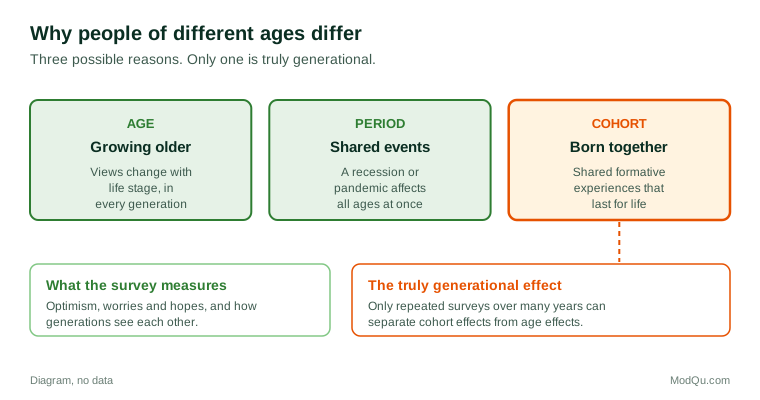
A survey taken once cannot tell these apart, because age and generation are the same thing in a single year. Repeating surveys over many years makes it possible to see whether young people today think differently from young people in the past. This is why some differences that look generational turn out to be about age.
Example
A survey finds that people in their twenties are more likely than people in their sixties to say they move often and rent their home. That alone does not show a generational difference, since young people have always moved more. Comparing with surveys from the 1990s shows whether people in their twenties then rented and moved as much as they do now.
Optimism about the future
Surveys often ask people whether they think the next generation will be better or worse off than their parents, and whether things in their country are heading in the right direction. They also ask about people's own lives: whether they expect to be better off in five years.
Personal and national optimism often differ. Many people are hopeful about their own future while worried about their country or the world. Answers also depend on the area asked about: people may feel positive about technology and health, and negative about housing or the environment.
Example
A 30-year-old nurse says they expect their own life to improve over the next five years because they have just finished their training and found a permanent job. Asked whether their generation will be better off than their parents', they say no, because their parents bought a house at the same age and they do not expect to.
Common worries and hopes
Worries people mention in surveys of this kind include housing costs, the cost of living, climate change, jobs and the economy, health care, political division, conflict and war, technology, and the world children and grandchildren will grow up in. Hopes include advances in health and medicine, new technology, younger people's openness and energy, community, and personal goals such as family and work.
Worries and hopes vary by age, region, income and life stage. Parents of young children, for example, often think about the future in terms of their children's prospects.
Housing, work and the generational gap
Housing is one of the most discussed differences between generations in Canada. People who bought homes decades ago have often seen their value rise a great deal, while many younger adults face high prices and rents and buy later, if at all. Work has also changed: more contract and gig work, more frequent job changes, and fewer workplace pensions with guaranteed payments than in the past.
These differences shape how people answer questions about the future. Someone who owns a home and has a pension may feel secure even when worried about the country, while a renter on short contracts may feel uncertain whatever their personal plans. Surveys often ask about housing and work alongside optimism so that these links can be seen.
How generations see each other
Each generation tends to have views about the others, and some of those views turn into stereotypes: older people seen as resistant to change, younger people seen as entitled or glued to their phones. Similar complaints about "young people today" have been made for centuries.
At the same time, there are real differences in circumstances. People who entered the job market in a recession, who face high housing costs, or who grew up with smartphones have had different experiences from those who did not.
Example
A grandmother and her granddaughter disagree about whether young people work hard enough. When they talk it through, the grandmother learns that her granddaughter works two part-time jobs while studying, and the granddaughter learns that her grandmother left school at 16 to support her family. They agree that each had it hard in different ways.
Using generational labels with care
Generational labels are useful shorthand, but they can mislead. Differences within a generation, for example by income, region, gender or culture, are often larger than the differences between generations. Researchers warn against treating a whole generation as if it thinks and acts alike, and against mistaking age effects for generational ones. Good surveys report results by age group and other factors, and are cautious about drawing broad conclusions.
What people disagree about
Debates include whether younger generations really face a harder start in life than their parents did, how to share costs between generations through pensions, health care and housing policy, whether generational labels help or harm understanding, and whether people today are more or less optimistic than in the past. Questions that governments, foundations and the media want answered include what people of different ages expect, fear and hope, and how those views change over time.
Key terms
- GenerationA group of people born in the same span of years who share formative experiences.
- CohortA group of people who share an experience in the same period, such as being born in the same years.
- Age effectA difference in views that comes from being older or younger, whatever the generation.
- Period effectA change that affects people of all ages at the same time.
- Cohort effectA difference that stays with a group born at the same time throughout life.
- Baby boomerA person born in the high-birth years after the Second World War, roughly 1946 to 1964.
- Intergenerational mobilityHow much people's circumstances differ from their parents'.
- StereotypeA fixed, oversimplified idea about a group of people.
Full glossary: public policy terms on EditingTests.com.
Generations and the future vocabulary test
How well do you know the language of this topic? Try 8 quick questions. Your score is shown straight away and is not saved.
What the generations and the future survey asks
This survey is part of ModQu's Communities and Society survey. The generations and the future part takes about five minutes and covers:
- Whether you think young people today will be better off than their parents.
- How you expect your own life to change over the next five years.
- What worries you most about the future, from a list and in your own words.
- What gives you hope.
- How you think other generations see yours, and how you see them.
- Which issues you think need the most attention for future generations.
After that you can choose to continue with other short parts of the Communities and Society survey, such as neighbourhoods and community life or loneliness and social connection, or stop.
Ready to take part?
Your answers help show what people really think and do. Results are only ever reported as totals; no one can see your individual answers.
Start the surveyQuestions about this survey
Who can take part?
Adults of all ages.
Do I have to give my name?
No. You may be asked for your age group, region and similar details so results can be broken down, but not your name. ModQu never asks for passwords, card numbers or account numbers.
How are the results used?
Answers are combined into totals and percentages and published in ModQu reports. Individual answers are never shown.
Is the vocabulary test part of the survey?
No. It is optional and separate, and your score is not stored.