
Share how much you trust others
Tell us how many neighbours you know, whether you think most people can be trusted and when you would help or ask for help. Your answers are combined with other people's and reported only as totals.
Start the trust in neighbours and strangers surveyAbout 5 minutes. No account needed. You can stop at any time.
What social trust means
Social trust is the belief that other people will generally act fairly, honestly and without causing harm. Researchers often separate three kinds:
- Particular trust: trust in people we know well, such as family and close friends.
- Neighbourhood trust: trust in people who live nearby, whom we may know only by sight.
- Generalized trust: trust in people in general, including strangers.
Trust in institutions, such as courts, police or government, is related but different. A person can trust their neighbours and distrust their government, or the other way around.
How trust is measured
One of the best-known survey questions on this topic has been asked for decades in many countries: "Generally speaking, would you say that most people can be trusted, or that you need to be very careful in dealing with people?" Large international surveys have found that the share who say most people can be trusted varies widely between countries, from well under a fifth in some to well over half in others, with the Nordic countries usually near the top.
Researchers also use more concrete questions, because people may answer an abstract question differently from how they act:
- How many of your neighbours do you know by name?
- Would you leave a spare key with a neighbour?
- If you lost a wallet with cash in it, how likely is it to be returned?
- Would you lend a neighbour something, such as a tool or some sugar?
- Would you ask a stranger to watch your bag while you go to the toilet?
Some studies go further and test behaviour directly, for example by "losing" wallets in public places and counting how many are returned.
Knowing your neighbours
How well people know their neighbours depends on how long they have lived in a place, the kind of housing, whether they have children or pets, and local customs. People in rural areas and small towns, and people who own their homes and have lived there a long time, often know more neighbours. People in large apartment buildings, renters who move often and people who work long hours often know fewer.
Example (hypothetical figures)
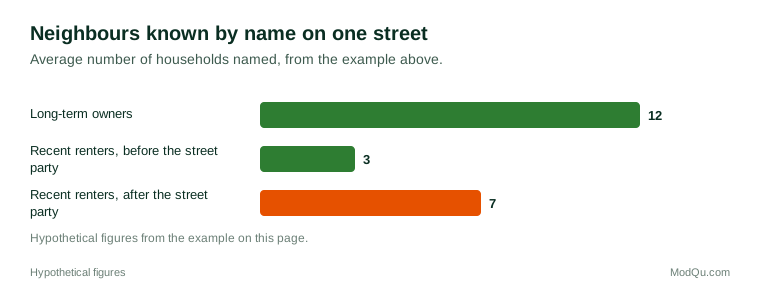
A survey of one street of 30 homes asks each household how many neighbours they know by name. Long-term owners name an average of 12 households. Renters who arrived in the last two years name an average of 3. After the street holds its first summer party, a repeat survey finds the renters now name an average of 7.
Small things build familiarity: greeting people, chatting in shared spaces, children playing together, walking dogs, community events and local shops where people meet. Shared problems, such as a storm or a power cut, often bring neighbours into contact for the first time.
Why trust differs between places
Researchers have suggested many reasons for differences in trust between countries and communities:
- Fair and honest institutions: where courts, police and officials are seen as fair and not corrupt, people tend to trust each other more.
- Inequality: places with large gaps between rich and poor tend to report lower trust.
- Safety and crime: high crime, or fear of crime, lowers trust.
- Stability: people who stay in one place longer build more ties.
- Shared experience: community groups, clubs and public spaces bring people together.
- History: conflict, war or long periods of repression can leave low trust that lasts for generations.
People disagree about the effect of diversity on trust. Some studies have found lower trust in neighbourhoods with rapid population change; others find that the effect is small or disappears when income and stability are taken into account, and that contact between groups over time can build trust.
Who trusts more
Within a country, trust tends to be higher among people with more education, higher incomes, good health and secure jobs. People who have been victims of crime or fraud, or who feel they have been treated unfairly, tend to trust less. Older people in some countries report more trust in neighbours than young people do, partly because they have lived in one place longer.
Example
A woman who has lived in the same building for thirty years leaves her spare key with two neighbours and takes in parcels for half the floor. Her grandson, who rents a flat in a big city and moves every year or two, has never spoken to his neighbours and has his parcels sent to a locker at a station.
Why trust matters
Social trust affects daily life in many ways:
- Helping each other: people who trust their neighbours are more likely to lend things, check on older residents and watch each other's homes.
- Safety: neighbours who know each other often notice when something is wrong.
- Health and well-being: knowing and trusting people nearby is linked with lower loneliness.
- Economic life: trust makes trade easier, because people need fewer checks and contracts.
- Emergencies: after disasters, neighbours are often the first to help, before official services arrive.
Low trust has costs: people spend more on locks, fences and security, avoid public spaces, and may be less willing to take part in community life.
Example
After a severe storm cuts power for four days, residents of one street share a generator, cook food from their freezers together and check on two older people who live alone. Before the storm, most of them had only waved to each other. A year later they still have a group chat and hold a street meal every summer.
Trust online and with strangers
Daily life increasingly involves trusting strangers through apps and websites: buying second-hand goods, staying in someone's home, sharing a car ride or hiring someone for a small job. Ratings, reviews and identity checks are designed to make this easier. At the same time, scams, fake profiles and fraud have made many people more cautious online.
What people disagree about
People disagree about whether trust is falling, whether it can be rebuilt by local projects, how much it depends on government and fairness, and whether being cautious with strangers is sensible or a sign of a weakening society. Many say they trust "people around here" but worry about society in general.
Questions that governments, foundations, community organizations and media want answered include how many neighbours people know, how much they trust others, what would make them more willing to help or ask for help, and how trust differs between areas.
Key terms
- Social trustThe belief that other people will generally act fairly and honestly.
- Generalized trustTrust in people in general, including strangers.
- Particular trustTrust in people one knows well, such as family and friends.
- Social capitalThe networks, trust and shared norms that help people work together.
- ReciprocityHelping others with the expectation that help will be returned when needed.
- Social cohesionHow well people in a community get along and feel they belong together.
- Institutional trustTrust in organizations such as courts, police and government.
- Lost-wallet testA field study that measures honesty by counting how many "lost" wallets are returned.
Full glossary: community outreach terms on EditingTests.com.
Trust in neighbours and strangers vocabulary test
How well do you know the language of this topic? Try 8 quick questions. Your score is shown straight away and is not saved.
What the trust in neighbours and strangers survey asks
This survey is part of ModQu's Communities and Society survey. The trust in neighbours and strangers part takes about five minutes and covers:
- How many of your neighbours you know by name and how often you talk to them.
- Whether you think most people can be trusted, or that you need to be careful.
- Whether you would lend a neighbour something, leave them a key or ask them for help.
- How likely you think a lost wallet would be returned where you live.
- What has made you trust people more or less in recent years.
After that you can choose to continue with other short parts of the Communities and Society survey, such as neighbourhoods and community life or loneliness and social connection, or stop.
Ready to take part?
Your answers help show what people really think and do. Results are only ever reported as totals; no one can see your individual answers.
Start the surveyQuestions about this survey
Who can take part?
Adults.
Do I have to give my name?
No. You may be asked for your age group, region and similar details so results can be broken down, but not your name. ModQu never asks for passwords, card numbers or account numbers.
How are the results used?
Answers are combined into totals and percentages and published in ModQu reports. Individual answers are never shown.
Is the vocabulary test part of the survey?
No. It is optional and separate, and your score is not stored.