
Share your experience of where you live
Tell us whether you live in a city, town or rural area, whether you would like to move and which services are missing. Your answers are combined with other people's and reported only as totals.
Start the rural and urban life surveyAbout 5 minutes. No account needed. You can stop at any time.
What this topic covers
This topic is about the kind of place people live in and how that shapes daily life. Places are often grouped into:
- Large cities and their suburbs, sometimes called metropolitan areas.
- Small cities and towns, which may serve as a centre for surrounding villages.
- Rural areas: villages, farms and countryside with low population density.
- Remote areas, far from any large town, such as islands, mountains, deserts or the far north.
Countries define "urban" and "rural" differently, using population size, density, distance to a city or the kind of work people do. A place of 5,000 people might count as a town in one country and a village in another. The United Nations reports that the world became more urban than rural for the first time in the late 2000s, and that most future population growth is expected in cities, especially in Africa and Asia.
How daily life differs
Daily life in cities and rural areas often differs in predictable ways, though there are many exceptions.
In cities, people usually have more jobs, schools, hospitals, shops and cultural activities nearby, and better public transport. They often pay more for housing, have less space, and may face more traffic, noise, air pollution and crime. Many people live alone or far from family.
In rural areas, people usually have more space, lower housing costs in many regions, closer contact with nature and often stronger ties with neighbours. They may have to travel long distances for work, hospitals, secondary schools and shopping, and may depend on a car. Jobs may be concentrated in farming, forestry, fishing, mining or tourism.
Towns sit in between, offering some services within reach while keeping a smaller-scale feel.
Example
A family lives in a village of 600 people. The primary school is a ten-minute walk away, but the secondary school is a 45-minute bus ride. The nearest hospital is in a town 60 kilometres away, and the bank branch closed last year. They grow vegetables, know everyone on their street and pay half what their relatives pay for a flat in the capital.
Services that are often missing
Surveys of rural and small-town residents often find gaps in:
- Health care: fewer doctors, longer travel to hospitals and emergency care.
- Public transport: infrequent or no buses or trains, so people without a car are cut off.
- Fast internet and mobile coverage, which affects work, school and access to online services.
- Banks, post offices and shops, as branches close or move to larger towns.
- Child care and schools, especially secondary schools and colleges.
- Jobs, particularly skilled jobs for young people.
City residents report other gaps: affordable housing, green space, safe walking and cycling routes, and quiet. In fast-growing cities in lower-income countries, many people live in areas without reliable water, sanitation, electricity or waste collection.
Why people move
Movement from rural areas to cities has been one of the largest changes of the past two centuries. People move to cities mainly for work, education and services. Young adults are the most likely to move, which leaves some rural areas with ageing populations and fewer people of working age.
People also move the other way, from cities to towns and the countryside, for reasons such as:
- lower housing costs and more space;
- wanting a quieter or safer place to raise children;
- retirement;
- remote work, which lets some people keep a city job while living elsewhere;
- returning to a home region to be near family.
Example (hypothetical figures)
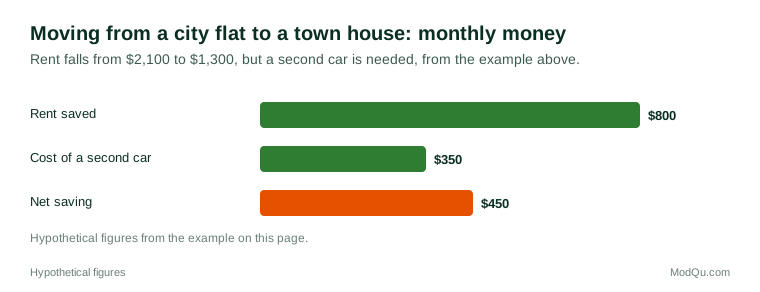
A couple pays $2,100 a month for a two-bedroom flat in a large city. They both work remotely and move to a town two hours away, where a three-bedroom house with a garden costs $1,300 a month to rent. They save $800 a month, or $9,600 a year, but buy a second car that costs them about $350 a month to run. Their net saving is $450 a month, or $5,400 a year.
Belonging and community
Many people say that rural areas and small towns have stronger communities, where people know and help their neighbours. Others find small places close-knit in a way that can feel limiting, with less privacy and less tolerance of difference. Cities offer more anonymity and more variety of people and lifestyles, which some find freeing and others find lonely.
Newcomers to small places sometimes say it takes years to be accepted. Long-standing residents sometimes worry that newcomers, holiday homes and short-term rentals raise house prices and change the character of a place.
Work and the economy
Rural economies have changed a great deal. Farming has become more mechanized, so fewer people work on farms. Mining and factory towns have lost jobs when mines or plants close. Tourism, remote work, renewable energy projects and small businesses have created new jobs in some places but not in others.
Cities concentrate many high-paid jobs, but also many low-paid service jobs, and the gap between rich and poor is often wide. Commuting from towns into cities links the two, sometimes over long distances.
Example
A former mining town loses its main employer. Over ten years many young people leave for the regional city, and the high street has empty shops. A group of residents opens a co-working space with fast internet, and several remote workers and small businesses move in. The population stops falling, though it is older than before.
What people prefer
When asked where they would most like to live, many people in surveys in several countries choose a small town or rural area, even when they live in a city. In practice, work, family, schools and housing costs decide where most people actually live. Preferences also change over a lifetime: many people want a city when young and a quieter place when raising children or retiring.
What people disagree about
People disagree about how much should be spent to keep rural services such as hospitals, schools and bus routes running for small populations; whether new housing should go in cities or in towns and villages; whether governments should encourage people to move to declining regions; and how to balance farming, nature, tourism and new development in the countryside.
Questions that governments, planners, foundations and businesses want answered include where people live and want to live, what they value about their area, which services are missing, and what would make them stay or move.
Key terms
- UrbanizationThe growth in the share of people living in cities and towns.
- Rural areaCountryside, farms and villages with low population density.
- Population densityThe number of people living in a given area, such as per square kilometre.
- CommutingTravelling regularly between home and work.
- DepopulationA falling number of people living in an area.
- SuburbA mainly residential area on the edge of a city.
- Service desertAn area where an essential service, such as a bank or doctor, is far away or absent.
- Counter-urbanizationMovement of people from cities to towns and rural areas.
Full glossary: urban planning terms on EditingTests.com.
Rural and urban life vocabulary test
How well do you know the language of this topic? Try 8 quick questions. Your score is shown straight away and is not saved.
What the rural and urban life survey asks
This survey is part of ModQu's Communities and Society survey. The rural and urban life part takes about five minutes and covers:
- Whether you live in a large city, suburb, small city or town, village or rural area.
- What you like most and least about where you live.
- Which services are missing or hard to reach: health care, transport, internet, shops, banks, schools or jobs.
- Whether you would like to move, and if so to what kind of place.
- What would make you stay or leave.
After that you can choose to continue with other short parts of the Communities and Society survey, such as neighbourhoods and community life or loneliness and social connection, or stop.
Ready to take part?
Your answers help show what people really think and do. Results are only ever reported as totals; no one can see your individual answers.
Start the surveyQuestions about this survey
Who can take part?
Adults.
Do I have to give my name?
No. You may be asked for your age group, region and similar details so results can be broken down, but not your name. ModQu never asks for passwords, card numbers or account numbers.
How are the results used?
Answers are combined into totals and percentages and published in ModQu reports. Individual answers are never shown.
Is the vocabulary test part of the survey?
No. It is optional and separate, and your score is not stored.