
Share your experience of migration
Tell us where you were born, how you stay in touch with family abroad and which community groups you belong to. Your answers are combined with other people's and reported only as totals.
Start the migration and diaspora communities surveyAbout 5 minutes. No account needed. You can stop at any time.
What migration and diaspora mean
Migration is the movement of people from one place to another to live. International migration means crossing a border and staying in another country for a long period, usually a year or more. Internal migration, such as moving from a village to a capital city, is just as common in many countries, but this page is mainly about moving between countries.
A diaspora is a population that lives outside its country or region of origin but keeps a sense of shared identity and links with it. The word was first used for communities that had been scattered from a homeland, and it is now used widely for any group living abroad that keeps cultural, family or economic ties with the place it came from. A diaspora includes people who moved themselves (first generation) and often their children and grandchildren (second and third generations), who may have never lived in the country of origin.
People who move are described in different ways depending on the reason and their legal status:
- Labour or economic migrants move mainly for work or better pay.
- Family migrants join a spouse, parent or child who already lives in the new country.
- International students move to study, and some stay to work afterwards.
- Refugees have fled persecution, war or serious danger and are protected under international law. Asylum seekers are people who have asked for that protection and are waiting for a decision.
- Returning migrants go back to their country of origin after years abroad.
Why people move
Researchers often group the reasons for migration into "push" factors in the place of origin and "pull" factors in the destination. Push factors include unemployment, low wages, conflict, persecution, natural disasters and lack of services. Pull factors include jobs, higher pay, safety, education, family already living there and a shared language.
In practice most moves have several reasons at once, and networks matter a great deal. People tend to move where relatives, friends or neighbours from home have already settled, because those contacts can help with housing, jobs and paperwork. This is why many towns or regions of origin are linked to particular cities abroad.
Example
A nurse trained in a large Asian country takes a contract at a hospital overseas because the pay is several times higher and two former classmates already work there. She plans to stay five years, send money to her parents and then return. Eight years later she has married, bought a flat and applied for citizenship, while still sending money home every month.
The example shows a common pattern: many people expect a move to be temporary, and plans change as their lives develop in the new country.
Settling in a new country
The first years after a move usually bring practical tasks and adjustments:
- getting the right visa or residence permit and keeping it valid;
- finding housing, often with a limited rental history in the new country;
- having qualifications recognized, which can take months and may mean retraining;
- opening a bank account, getting a phone number and registering for health care;
- learning or improving the local language;
- finding schools for children;
- building new friendships while managing homesickness.
Many newcomers work below their skill level at first because employers do not recognize foreign qualifications or experience. Language, local work customs and lack of contacts also play a part. Over time, many people move into jobs closer to their training, though not all do.
Rules differ widely by country. Some countries choose skilled migrants through points systems that score age, education, language and job offers. Others rely more on employer sponsorship or family reunification. Regional arrangements, such as free movement between member states of the European Union, allow citizens to live and work across borders with few formalities.
Staying in touch with home
Contact with family abroad has changed a great deal. Letters and expensive international calls have given way to messaging apps, video calls and social media, so many migrants now speak with relatives every day. This makes it easier to stay part of family life, but some people say it also makes it harder to settle, because their attention is split between two places.
Links with home also include:
- Remittances, the money migrants send to family. For many households in lower-income countries these payments pay for food, school fees, health care and housing.
- Visits, which depend on cost, distance, visa rules and safety.
- Media and news from the country of origin, followed online or through satellite television.
- Investment, such as building a house in the home town or supporting a family business.
- Political ties, such as voting from abroad where the home country allows it.
Example (hypothetical figures)
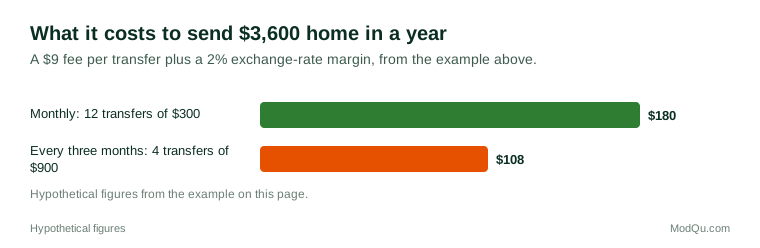
A construction worker sends $300 a month to his mother. A transfer service charges a $9 fee per transfer plus a 2% margin on the exchange rate, so each transfer costs about $15 in total. Over a year he sends $3,600 and pays about $180 in costs, which is 5% of the amount sent. A friend suggests sending $900 every three months instead, which would cut the fixed fees from $108 to $36 a year.
Diaspora communities and groups
Diaspora communities often build their own organizations. These can include:
- cultural associations that hold festivals, dances and national day events;
- places of worship that also serve as social centres;
- language schools for children on weekends;
- hometown associations that raise money for projects in a particular town or village;
- professional networks for doctors, engineers or business owners from the same origin;
- sports clubs and youth groups;
- media in the community's language, such as radio programs, newspapers and online channels.
These groups help newcomers find housing and work, keep traditions alive and give older people a place to meet. For the second generation they can be a link to their parents' culture. Some groups are very active, while others are informal networks of friends and relatives.
Example
A family who moved from East Africa twenty years ago sends their two children to a Saturday language school run by a community association. The children speak the local language with friends and switch to their parents' language at home. Their teenage daughter now volunteers at the association, helping newly arrived families fill in school enrolment forms.
Identity across generations
Identity often changes between generations. First-generation migrants may think of themselves mainly as belonging to their country of origin. Their children, raised and schooled in the new country, often describe a mixed or "hyphenated" identity, for example feeling both Lebanese and Brazilian. By the third generation, the language of origin is often lost, though food, religion, family customs and a sense of heritage may remain.
People answer questions about identity in many ways. Some feel fully at home in both places, some feel they belong fully to neither, and some feel strongly attached to one. Experiences of discrimination, the welcome they received and how often they visit the country of origin can all shape these feelings.
Common challenges
Migrants and diaspora communities report a number of recurring problems:
- Discrimination in hiring, housing or daily life.
- Separation from family, including children or elderly parents left behind.
- Paperwork and legal uncertainty, such as waiting years for a permit decision.
- Exploitation, including high recruitment fees, unpaid wages or unsafe work, which affects some workers on temporary visas.
- Loneliness, especially in the first years and for older migrants who do not speak the local language.
- Caring at a distance, when parents in the home country become ill or frail.
Many also report clear gains: better income, safety, education for their children and new skills. Surveys on migration aim to capture both sides rather than one.
What people disagree about
Migration is a common subject of public debate. People disagree about how many migrants a country should accept, which skills to prioritize, how quickly newcomers should become citizens, and how much they should be expected to adopt local customs. They also disagree about the effects of emigration on the countries people leave, where losing doctors, nurses and engineers can be felt strongly, while remittances and returning migrants bring money and skills back.
Questions that governments, foundations and community organizations want answered include how connected migrants feel to their new country, how often they contact family abroad, what services helped them most, and which community groups they rely on.
Key terms
- DiasporaA population living outside its country or region of origin that keeps links with it.
- RemittanceMoney a migrant sends to family or others in another country.
- RefugeeA person who has fled persecution or danger and is protected under international law.
- Asylum seekerA person who has asked for refugee protection and is waiting for a decision.
- Residence permitOfficial permission to live in a country for a period.
- NaturalizationThe legal process by which a non-citizen becomes a citizen.
- Second generationThe children of migrants, born or raised in the new country.
- Chain migrationMigration that follows earlier migrants from the same family or place.
Full glossary: immigration administration terms on EditingTests.com.
Migration and diaspora communities vocabulary test
How well do you know the language of this topic? Try 8 quick questions. Your score is shown straight away and is not saved.
What the migration and diaspora communities survey asks
This survey is part of ModQu's Communities and Society survey. The migration and diaspora communities part takes about five minutes and covers:
- Whether you were born in another country, and if so when you moved and why.
- Which country or countries you have family links with.
- How often you are in touch with family abroad, and how (calls, video, messages, visits).
- Whether you send money abroad, roughly how often, and what it costs you.
- Which community, cultural, religious or hometown groups you belong to.
- How at home you feel where you live now, and what helped or made it harder.
After that you can choose to continue with other short parts of the Communities and Society survey, such as neighbourhoods and community life or loneliness and social connection, or stop.
Ready to take part?
Your answers help show what people really think and do. Results are only ever reported as totals; no one can see your individual answers.
Start the surveyQuestions about this survey
Who can take part?
Adults.
Do I have to give my name?
No. You may be asked for your age group, region and similar details so results can be broken down, but not your name. ModQu never asks for passwords, card numbers or account numbers.
How are the results used?
Answers are combined into totals and percentages and published in ModQu reports. Individual answers are never shown.
Is the vocabulary test part of the survey?
No. It is optional and separate, and your score is not stored.
Do I need to have moved countries to take this survey?
No. Children and grandchildren of migrants, and people with family abroad, are welcome to answer.
Will you ask about my legal status?
The survey may ask broad questions about how you came, but you can skip any question, and it never asks for document numbers.