
Share your experience of language
Tell us which languages you speak, where you use them and how much they matter to you. Your answers are combined with other people's and reported only as totals.
Start the language and identity surveyAbout 5 minutes. No account needed. You can stop at any time.
What this topic covers
Language is the system of words, sounds, signs and grammar that people use to communicate. Identity is a person's sense of who they are and which groups they belong to. The two are closely linked: the language someone grew up with often carries their family history, religion, humour, songs and ways of thinking, and many people feel that speaking it is part of being who they are.
This topic covers:
- how many languages people speak and how well;
- which language they use at home, at work, with friends and online;
- how important their language is to their sense of self and community;
- how languages are passed on from parents to children, or not;
- attitudes to accents, dialects and minority languages.
Sign languages are full languages with their own grammar and are part of this topic too. Deaf communities in many countries see their national sign language as central to their culture and identity.
Speaking more than one language
Being multilingual is normal in much of the world. In many parts of Africa and South Asia, a person might speak a home language, a regional language used in markets, and a national or former colonial language used in school and government. In parts of Europe, children learn two or more foreign languages at school. In countries where one language dominates, such as some English-speaking countries, many people speak only one.
People speak different languages to different levels. Researchers often separate:
- First language or mother tongue: the language learned first in childhood.
- Second language: a language learned later, often used daily.
- Heritage language: a family language spoken at home by children of migrants, who may understand it well but read or write it less.
- Foreign language: a language studied but not used in daily life.
People also switch between languages in one conversation, which is called code-switching. Bilingual families often do this without thinking, choosing the word or phrase that fits best.
Example
A taxi driver in a West African city speaks a home language with his parents, a widely used regional language with passengers, and French with officials and when reading the news. His children add English at school and use a mix of all four with friends online. Asked which language is "his", he names the home language, though he uses it least each day.
Language at home
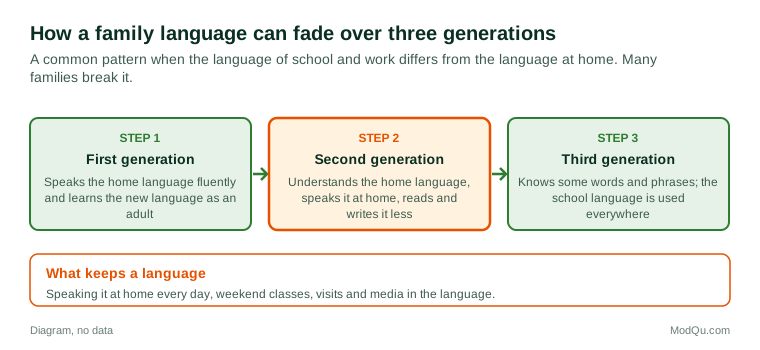
The language used at home is one of the strongest signs of whether a language will be passed on. When parents speak a language with their children every day, the children usually keep it. When the language of school and friends is different, children often answer their parents in the school language, and by adolescence some lose confidence in the home language.
Families make choices about this in different ways:
- One parent, one language: each parent speaks their own language to the child.
- Home language at home: the family language at home, the local language outside.
- Mixed approach: whatever language comes naturally in the moment.
- Shift: parents choose to speak the dominant local language, sometimes because they worry their children will be held back.
Example
A couple who moved abroad speak their own language to each other but switch to the local language with their son so he will "fit in at school". At fourteen he understands his grandparents on video calls but cannot reply in full sentences. He asks to take weekend classes so he can speak with them properly.
Why language matters to identity
People give many reasons why their language is important to them:
- It connects them to parents, grandparents and ancestors.
- It is used in their religion, songs, stories or poetry.
- It marks membership in a community or nation.
- Some ideas, jokes or feelings are hard to express in another language.
- It carries a history of struggle, for example where a language was once banned in schools.
For others, language matters less to identity than religion, place or family. Some people who have lost their family's language still feel strongly part of the community, while others feel that losing it has cut them off. Surveys that ask "How important is your language to you?" usually find a wide range of answers, and the reasons behind them are as useful as the rating.
Accents, dialects and standard languages
Within one language there are many varieties. A dialect is a regional or social variety with its own words, pronunciation and sometimes grammar. An accent is a way of pronouncing a language. Most countries also have a standard variety used in schools, news and official writing.
People are often judged by their accent or dialect. Research in several countries has found that listeners make guesses about a speaker's education, intelligence or friendliness from their accent alone. Some people change their accent at work or in interviews, a practice sometimes called accent shifting. Others are proud of their regional speech and keep it everywhere.
Minority, endangered and revived languages
Linguists estimate that about 7,000 languages are spoken in the world today, and a large share of them are spoken by small communities. Many are considered endangered, which means fewer children are learning them. When the last fluent speakers die and no children learn a language, it becomes extinct.
Languages decline for many reasons: migration to cities, schooling only in a national language, past policies that punished children for speaking their language, and the pull of languages used for work and online life. Communities and governments have also revived languages through:
- immersion schools and preschools where children are taught entirely in the language;
- official status, so the language can be used in courts, signs and government services;
- radio, television, music and online content in the language;
- programs that pair young learners with elderly fluent speakers;
- dictionaries, recordings and apps.
Revival efforts in places as different as Wales, New Zealand (for Māori) and parts of Canada and Scandinavia show that a language in decline can gain new speakers when children learn it at home and at school.
Example (hypothetical figures)
A small Indigenous community has 40 fluent speakers, most over sixty. A language nest opens for 12 preschool children, who spend 20 hours a week with elderly speakers. After three years, 10 of the 12 children can hold a basic conversation, and 15 parents have joined evening classes. The community now counts 40 fluent speakers and 25 new learners.
Language at work, in services and online
Language shapes access to jobs, health care, courts and government. People who do not speak the main language well may need interpreters, translated forms or help from relatives, often their children. Many countries require public services to be offered in more than one official language, while others offer translation only in some situations.
Online, a small number of languages dominate websites, apps and search results. Speakers of smaller languages often use a larger language online even if they prefer their own. Machine translation and voice tools now cover more languages than before, though quality varies a great deal.
What people disagree about
People disagree about whether governments should require one national language or support several, how much schooling should be in minority languages, whether newcomers should be required to learn the local language before getting citizenship, and how to balance a common language with respect for others. Some see multilingual public signs as welcoming; others see them as a cost or a barrier to a shared identity.
Questions that governments, foundations and community organizations want answered include which languages people use at home, how many children learn their parents' language, which services people struggle to use because of language, and how much language matters to people's sense of belonging.
Key terms
- Mother tongueThe first language a person learns in childhood.
- Heritage languageA family language spoken by children of migrants or minorities, often more spoken than written.
- BilingualAble to use two languages in daily life.
- Code-switchingMoving between two or more languages within one conversation.
- DialectA regional or social variety of a language with its own words and pronunciation.
- Endangered languageA language that fewer children are learning, so it may stop being spoken.
- Immersion schoolA school where most or all teaching is in a target language.
- Official languageA language a government recognizes for use in law, courts and public services.
Full glossary: applied linguistics terms on EditingTests.com.
Language and identity vocabulary test
How well do you know the language of this topic? Try 8 quick questions. Your score is shown straight away and is not saved.
What the language and identity survey asks
This survey is part of ModQu's Communities and Society survey. The language and identity part takes about five minutes and covers:
- How many languages you speak, and how well you speak, read and write each.
- Which language you use most at home, at work, with friends and online.
- Whether your children or younger relatives speak your family's language.
- How important your language is to who you are.
- Whether you have ever been treated differently because of your language or accent.
- Which services you have found hard to use because of language.
After that you can choose to continue with other short parts of the Communities and Society survey, such as neighbourhoods and community life or loneliness and social connection, or stop.
Ready to take part?
Your answers help show what people really think and do. Results are only ever reported as totals; no one can see your individual answers.
Start the surveyQuestions about this survey
Who can take part?
Adults.
Do I have to give my name?
No. You may be asked for your age group, region and similar details so results can be broken down, but not your name. ModQu never asks for passwords, card numbers or account numbers.
How are the results used?
Answers are combined into totals and percentages and published in ModQu reports. Individual answers are never shown.
Is the vocabulary test part of the survey?
No. It is optional and separate, and your score is not stored.