
Share your practice
Tell us whether you practise yoga or meditation, whether you use classes or apps, and why you started. Your answers are combined with other people's and reported only as totals.
Start the yoga and meditation surveyAbout 5 minutes. No account needed. You can stop at any time.
What yoga and meditation are
Yoga is a practice that began in ancient India and combines physical postures, breathing exercises, meditation and, in many traditions, ethical and spiritual teachings. In much of the world today, yoga classes focus mainly on the physical postures, called asanas, and on breathing.
Meditation is a group of practices that train attention and awareness. It is found in many religious and cultural traditions, including Hindu, Buddhist, Jain, Taoist, Christian, Jewish and Islamic practices, and in secular forms.
People may practise yoga, meditation, both, or related activities such as breathing exercises. The United Nations has recognized 21 June as International Day of Yoga since 2015.
Main styles of yoga
There are many styles, and names vary between teachers and countries:
- Hatha: a broad term for physical yoga, often slower and good for beginners.
- Vinyasa or flow: postures linked by movement and breath, often faster.
- Ashtanga: a set sequence of postures practised in a fixed order.
- Iyengar: a focus on alignment, often using props such as blocks and straps.
- Yin: long-held, passive stretches.
- Restorative: gentle, supported postures for relaxation.
- Hot yoga: practised in a heated room.
- Kundalini: combining movement, breathing, chanting and meditation.
- Chair yoga: adapted for people with limited mobility.
- Prenatal yoga: adapted for pregnancy.
Main types of meditation
Common forms of meditation include:
- Mindfulness meditation: paying attention to the present moment, such as the breath, without judgement.
- Focused attention: concentrating on one thing, such as the breath, a sound or an object.
- Mantra meditation: repeating a word or phrase.
- Loving-kindness: wishing well to oneself and others.
- Body scan: moving attention slowly through the body.
- Walking meditation: meditating while walking slowly.
- Guided meditation: following a recorded or live voice.
- Transcendental and other structured programs, taught through specific courses.
Mindfulness-based programs, such as mindfulness-based stress reduction, have been used in health care, schools and workplaces in many countries.
How people practise
People practise in many ways:
- Studio classes, at yoga studios and meditation centres.
- Gym and leisure centre classes.
- Community and religious centres, temples and retreats.
- Online classes and videos.
- Meditation apps, with guided sessions and reminders.
- Workplace programs.
- Practising alone at home, from memory or books.
Example
An office worker starts using a meditation app for ten minutes each morning after a stressful period at work. After a few weeks they move to a free version with fewer features, and they also join a weekly drop-in meditation group at a local community centre.
Why people start
Reasons people give for starting include:
- Stress relief and relaxation.
- Flexibility, strength and fitness.
- Back pain and other aches.
- Better sleep.
- Mental health and wellbeing.
- Spiritual or religious reasons.
- Recommendation from a friend, doctor or therapist.
- Recovery from injury, sometimes alongside physiotherapy.
- Curiosity and social reasons.
Some people practise for a short time and stop; others keep a lifelong practice.
Costs and spending
Costs range from free to substantial:
- Free options: videos, library books, park classes and some community groups.
- Drop-in classes, paid per session.
- Class packs and memberships at studios and gyms.
- App subscriptions.
- Equipment: mats, blocks, straps, cushions and clothing.
- Workshops, retreats and teacher training courses, which can be expensive.
Example (hypothetical figures)
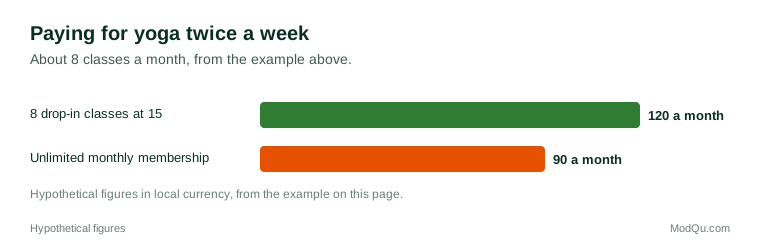
A person pays 15 in their local currency for a drop-in yoga class and goes twice a week, or about 8 classes a month, costing 120. A studio offers a monthly unlimited membership for 90. Switching would save 30 a month, or 360 a year, if they keep going twice a week.
What research suggests
Researchers have studied yoga and meditation in relation to stress, anxiety, depression, sleep, back pain, blood pressure and other outcomes. Many studies report some benefits, especially for stress and some kinds of pain, but the quality of studies varies, effects are often modest, and results differ between people. Health bodies in several countries describe yoga and meditation as generally safe for healthy people when practised carefully, while noting that they are not a replacement for medical care.
This page describes research in general terms and does not give health advice.
Safety and concerns
Points people raise include:
- Injuries, from pushing too hard or doing advanced postures without guidance.
- Heat in hot yoga, which may not suit everyone.
- Teacher training, which varies widely, as there is no single worldwide standard for yoga teachers.
- Difficult experiences in some people during intensive meditation, which researchers have also studied.
- Pressure from social media images of extreme poses.
Many teachers suggest that beginners start with gentle classes and tell teachers about injuries or health conditions.
Example
A man in his sixties with stiff hips is nervous about joining a yoga class. He tries a chair yoga class at a community centre, where the teacher shows adapted postures. After a few months he moves to a beginners' mat class.
Trends and debates
Current trends and debates include:
- Online and app-based practice, which grew sharply during the COVID-19 pandemic.
- Workplace mindfulness programs, with debate about whether they address the causes of stress.
- Cultural appropriation, with discussion of how yoga's origins and traditions are presented and respected.
- Commercialization, including expensive clothing and branded classes.
- Accessible yoga, for different bodies, ages and abilities.
- Hybrid classes, such as yoga combined with other fitness styles.
What people and businesses want to know
Questions businesses want answered include how many people practise yoga or meditation, how often, which styles, whether they use classes or apps, why they started, how much they spend, and what would help them keep practising.
Key terms
- AsanaA physical posture in yoga.
- VinyasaA style of yoga in which postures are linked by movement and breath.
- MindfulnessPaying attention to the present moment without judgement.
- MantraA word or phrase repeated in meditation.
- Body scanA meditation that moves attention slowly through the body.
- Guided meditationMeditation following a recorded or live voice.
- PropsItems such as blocks, straps and bolsters that support yoga postures.
- RetreatA period away, often several days, focused on practice.
Full glossary: wellness terms on EditingTests.com.
Yoga and meditation vocabulary test
How well do you know the language of this topic? Try 8 quick questions. Your score is shown straight away and is not saved.
What the yoga and meditation survey asks
This survey is part of ModQu's Leisure and Lifestyle survey. The yoga and meditation part takes about five minutes and covers:
- Whether you practise yoga, meditation or both, and how often.
- Which styles you practise.
- Whether you use classes, apps, videos or practise alone.
- Why you started, and what keeps you going or made you stop.
- How much you spend on classes, apps, equipment or retreats in a typical year.
- What changes you have noticed, if any, since starting.
After that you can choose to continue with other short parts of the Leisure and Lifestyle survey, such as gambling and lotteries or cannabis, or stop.
Ready to take part?
Your answers help show what people really think and do. Results are only ever reported as totals; no one can see your individual answers.
Start the surveyQuestions about this survey
Who can take part?
Adults.
Do I have to give my name?
No. You may be asked for your age group, region and similar details so results can be broken down, but not your name. ModQu never asks for passwords, card numbers or account numbers.
How are the results used?
Answers are combined into totals and percentages and published in ModQu reports. Individual answers are never shown.
Is the vocabulary test part of the survey?
No. It is optional and separate, and your score is not stored.
Do I need to be flexible to start yoga?
No. Many beginners' classes are designed for people with limited flexibility, and props are used to adapt postures.
How long should a meditation session be?
It varies. Many apps and teachers suggest that beginners start with a few minutes a day and increase the time gradually.
Is yoga a religion?
Yoga has roots in Indian spiritual traditions, and some people practise it as part of their faith. Many modern classes focus on physical postures and breathing and are not religious.