
Share your experience of smoking and vaping
Tell us whether you smoke or vape, whether you have tried to quit and what helped. Your answers are combined with other people's and reported only as totals.
Start the tobacco and vaping surveyAbout 5 minutes. No account needed. You can stop at any time.
What this topic covers
This topic covers products that deliver nicotine or are smoked or vaped for pleasure or habit:
- Cigarettes, including manufactured and roll-your-own.
- Cigars, cigarillos and pipes.
- Smokeless tobacco, such as chewing tobacco and snuff.
- Vaping products (e-cigarettes), which heat a liquid, usually containing nicotine, into an aerosol that is inhaled.
- Heated tobacco products, which heat tobacco rather than burning it.
- Nicotine pouches, small pouches placed between the lip and gum.
- Nicotine replacement therapies (NRT), such as patches, gum and lozenges, used to help people quit.
Cannabis is covered on a separate page.
How smoking has changed
Smoking rates in Canada are far lower than in the 1960s, when around half of adults smoked. Higher taxes, smoke-free laws in workplaces, restaurants and bars, graphic health warnings, bans on advertising, and decades of public health campaigns all played a part. Canada was the first country to require picture health warnings on cigarette packages, in 2001, and has had plain packaging since 2019. In 2023 Canada became the first country to require health warnings printed on individual cigarettes.
Even so, smoking remains a leading preventable cause of disease and early death in Canada, according to Health Canada. Smoking rates are higher in some groups than others, for example by income, region and occupation.
Vaping
Vaping devices range from small disposable vapes to refillable pod systems and larger tanks. Most vaping liquids contain nicotine, propylene glycol, glycerin and flavourings. Health Canada's position is that vaping is less harmful than smoking for people who smoke and switch completely, but that it is not harmless, and that young people and non-smokers should not vape.
Vaping among young people grew quickly in the late 2010s, which led to new rules:
- a federal cap on nicotine concentration in vaping products of 20 mg/mL, in force since 2021;
- restrictions on advertising that could appeal to young people;
- health warnings on vaping products;
- flavour restrictions in several provinces, with some allowing only tobacco flavour, and some limiting flavoured products to specialty adult-only stores;
- a federal excise tax on vaping products since 2022.
Example
A 16-year-old starts vaping at school with friends, using disposable vapes bought by an older acquaintance. A few months later they find they reach for the vape first thing in the morning and feel irritable without it. When a parent finds one, they talk to their family doctor, who explains what nicotine dependence is and what support is available for young people.
Laws on sale and use
The federal Tobacco and Vaping Products Act sets national rules on manufacturing, labelling, advertising and sales to young people. Provinces and territories set the minimum age to buy, which is 18, 19 or 21 depending on the province, and decide where smoking and vaping are allowed. Smoke-free rules commonly cover indoor workplaces, public places, restaurants and bars, cars carrying children, and many patios, parks and hospital grounds.
Nicotine and addiction
Nicotine is the substance in tobacco and most vaping products that causes dependence. When people stop, they can have withdrawal symptoms such as cravings, irritability, trouble concentrating and difficulty sleeping. These are usually strongest in the first days and weeks. Habits, such as smoking with coffee or after meals, also make quitting harder, separate from the nicotine itself.
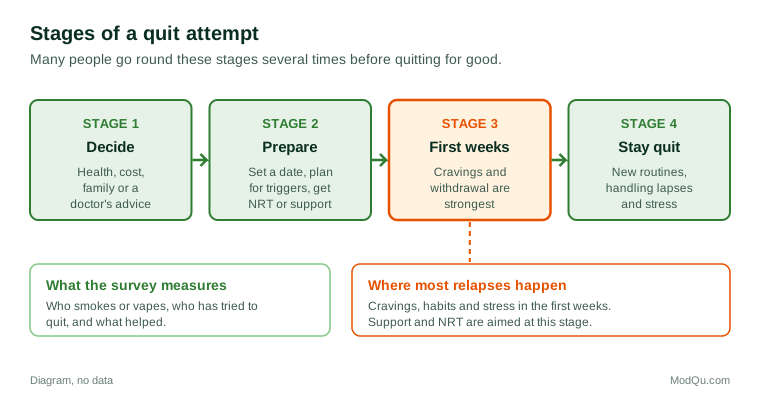
Quitting
Most people who smoke say they would like to quit, and many try several times before succeeding. Common methods include:
- Stopping all at once without help, often called cold turkey.
- Nicotine replacement therapy: patches, gum, lozenges, inhalers and mouth spray, available without a prescription.
- Prescription medicines that reduce cravings.
- Counselling and quitlines: free telephone, text and online support in every province and territory.
- Switching to vaping, which some people use to stop smoking.
- Apps and programs that track progress and money saved.
The pan-Canadian quitline number printed on tobacco packages connects people with free provincial and territorial quit services. Using more than one form of help, such as NRT with counselling, is often described by health bodies as more effective than willpower alone. This page describes quitting methods in general and is not medical advice; a pharmacist or doctor can help choose an approach.
Example (hypothetical figures)
A person smokes 15 cigarettes a day and pays $18 for a pack of 20. That is 0.75 packs a day, or $13.50 a day, which comes to $4,927.50 over 365 days. When they quit, they set up an automatic transfer of $13.50 a day into a savings account and use the money for a trip at the end of the year.
Example
After several attempts on their own, a woman in her fifties calls a quitline. A counsellor helps her plan for the moments she usually smokes: her morning coffee, her drive home and after dinner. She uses a nicotine patch and gum together for the first two months. She has a lapse at a wedding but does not go back to smoking every day.
Second-hand smoke and smoke-free homes
Second-hand smoke is the smoke breathed in by people near someone who is smoking. Health Canada states that there is no safe level of exposure. Smoke-free laws now protect people in most indoor public places, but homes and private cars are mostly a matter of choice, except where provinces ban smoking in cars carrying children.
Many households have their own rules: no smoking indoors, smoking only on a balcony, or no smoking anywhere on the property. In apartment buildings, smoke can travel between units through vents and gaps, and some landlords and condominium corporations have adopted smoke-free policies for new leases. Aerosol from vaping is also restricted in many of the same places as smoke.
What people disagree about
Debates in this area include whether vaping should be promoted to adult smokers as a way to quit or discouraged because of its appeal to young people, whether flavour bans help or push people back to cigarettes or to illegal products, how high taxes should be, whether nicotine pouches and other new products should be regulated like tobacco, and whether to follow the approach, proposed or adopted in some countries, of banning tobacco sales to anyone born after a set year. Questions that health agencies and others want answered include how many people smoke or vape, how many have tried to quit, and what helped.
Key terms
- NicotineThe substance in tobacco and most vapes that causes dependence.
- E-cigaretteA device that heats a liquid into an aerosol that is inhaled; also called a vape.
- Nicotine replacement therapyProducts such as patches, gum and lozenges that provide nicotine without smoke.
- WithdrawalSymptoms such as cravings and irritability that occur when someone stops using nicotine.
- QuitlineA free telephone, text or online service that helps people stop smoking or vaping.
- RelapseReturning to regular smoking or vaping after a period of quitting.
- Plain packagingRules requiring standard packages without brand colours or logos.
- Second-hand smokeSmoke breathed in by people near someone who is smoking.
Full glossary: public health terms on EditingTests.com.
Tobacco and vaping vocabulary test
How well do you know the language of this topic? Try 8 quick questions. Your score is shown straight away and is not saved.
What the tobacco and vaping survey asks
This survey is part of ModQu's Leisure and Lifestyle survey. The tobacco and vaping part takes about five minutes and covers:
- Whether you smoke, vape or use other nicotine products, and how often.
- Which products you use and where you buy them.
- Whether you have tried to quit in the last year, and how.
- What helped most, and what made it hard.
- How you feel about flavour rules, taxes and smoke-free places.
- Whether anyone in your household smokes or vapes.
After that you can choose to continue with other short parts of the Leisure and Lifestyle survey, such as gambling and lotteries or cannabis, or stop.
Ready to take part?
Your answers help show what people really think and do. Results are only ever reported as totals; no one can see your individual answers.
Start the surveyQuestions about this survey
Who can take part?
Adults.
Do I have to give my name?
No. You may be asked for your age group, region and similar details so results can be broken down, but not your name. ModQu never asks for passwords, card numbers or account numbers.
How are the results used?
Answers are combined into totals and percentages and published in ModQu reports. Individual answers are never shown.
Is the vocabulary test part of the survey?
No. It is optional and separate, and your score is not stored.