
Share your experience of going out
Tell us how often you go out, where you go and what you spend. Your answers are combined with other people's and reported only as totals.
Start the nightlife and bars surveyAbout 5 minutes. No account needed. You can stop at any time.
What nightlife covers
Nightlife means the places and activities people go to in the evening and late at night for entertainment and socializing. The main kinds of venue are:
- Pubs and neighbourhood bars, often with food, sports on TV and a regular crowd.
- Cocktail bars and wine bars, focused on drinks, often in a quieter setting.
- Brewpubs and taprooms attached to craft breweries.
- Nightclubs and dance clubs, open late with DJs and dancing.
- Live music venues and comedy clubs.
- Karaoke bars, pool halls, arcade bars and other activity bars.
- Late-night restaurants and lounges.
Nightlife also includes events such as festivals, concerts, theatre and late openings at museums, and the late-night food, transit and taxis that support them.
Rules on alcohol and venues
In Canada, alcohol is regulated by the provinces and territories. They set the legal drinking age, which is 18 in Alberta, Manitoba and Quebec and 19 elsewhere, and issue liquor licences to bars and restaurants. Licences set hours of service, capacity, and conditions such as serving food. Last call varies by province and city: in many places alcohol service ends at 2 a.m., while some cities allow later hours for special events. Bars can be held responsible for serving visibly intoxicated customers, and staff in most provinces must complete responsible beverage service training.
In the United States, the drinking age is 21 in every state.
How often people go out and why
Some people go out several times a week; others go out a few times a year or never. How often depends on age, income, where people live, whether they have children, work hours and health. People go out to see friends, to meet new people, to celebrate, to watch a game, to hear music, to dance, or to unwind after work.
Example
A couple in their late twenties used to go out most Fridays and Saturdays. After their first child is born, they go out about once a month, usually to a quiet pub near home for an early dinner and a drink, while a grandparent babysits. They say they enjoy it more than their old nights out, but spend about the same each time.
Questions that businesses want answered include how often people go out, what kinds of places they choose, how far they travel, and what would make them go out more.
What a night out costs
The cost of a night out can include cover charges, drinks, food, tips, transport and sometimes a babysitter. Spending varies widely by city, venue and how many rounds people buy.
Example (hypothetical figures)
Four friends go to a bar. Each has three drinks at $9 and they share two plates of food at $18 each. Drinks come to 4 × 3 × $9 = $108, food to $36, so $144 before tax and tip. With 13% tax ($18.72) and an 18% tip on the pre-tax amount ($25.92), the bill is $188.64, or $47.16 each. Two of them take a rideshare home for $24 split between them.
Many people say rising prices have made them go out less, or change how they go out: eating before they go, having a drink at home first, or choosing happy hour over late nights.
Drinking guidance and low- and no-alcohol options
In 2023, the Canadian Centre on Substance Use and Addiction published Canada's Guidance on Alcohol and Health. It describes risk as rising with the amount people drink per week and states that drinking less is better for health. Provincial health bodies publish similar advice. This page describes the guidance in general; it is not medical advice.
Low- and no-alcohol drinks have become much more common in bars, including alcohol-free beer, wine and spirits, and mocktails with the same care as cocktails. People choose them for many reasons: driving, health, pregnancy, religion, recovery, training for a sport, or simply preferring not to drink. "Sober curious" is a term used for people who are rethinking how much they drink.
Safety
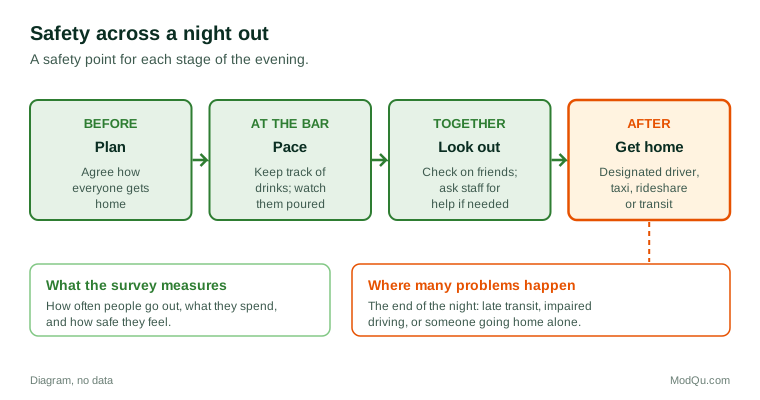
Safety is a concern for many people who go out, especially women and LGBTQ+ people. Concerns include harassment, drink spiking, fights, crowding, and getting home late at night. Bars and cities respond in several ways: staff training to recognize and respond to harassment, programs where a customer can ask staff for discreet help, security staff, better lighting, late-night transit and safe ride programs.
Impaired driving is a criminal offence in Canada, and police can demand breath samples at roadside. Planning a ride home before going out, by designated driver, taxi, rideshare or transit, is a common message in public campaigns.
Example
A group of friends going to a club agree before they leave that nobody goes home alone. One of them keeps the address of the club and the rideshare app open on their phone. When one friend feels unwell after a drink they did not watch being poured, the others tell the security staff, who call for help, and they all leave together.
How habits are changing
Several changes have affected nightlife. Younger adults in many countries drink less on average than earlier generations did at the same age. The pandemic closed venues for long periods and changed some habits, with some people going out less afterwards and others making up for lost time. Higher costs have hit both venues and customers. Many cities have lost live music venues and nightclubs, while activity bars and earlier events have grown. Some cities have appointed night mayors or nighttime economy offices to support venues and manage noise and safety.
What people disagree about
Debates about nightlife include how late bars should be allowed to stay open, how to balance venues with neighbours' complaints about noise, whether drinking ages should change, how much bars should be responsible for customers' safety and behaviour, whether the decline in drinking among young people is good news for health or bad news for venues, and how cities can keep affordable spaces for live music.
Key terms
- Cover chargeA fee to enter a bar or club, often when there is live music or a DJ.
- Last callThe final chance to order alcohol before service ends for the night.
- Liquor licenceA provincial permit allowing a business to sell or serve alcohol.
- Designated driverA person who stays sober to drive others home.
- Drink spikingAdding alcohol or a drug to someone's drink without their knowledge.
- Happy hourA set time when a bar sells drinks or food at lower prices.
- MocktailA mixed drink without alcohol.
- Responsible beverage serviceTraining for staff on serving alcohol safely and within the law.
Full glossary: restaurant chains terms on EditingTests.com.
Nightlife and bars vocabulary test
How well do you know the language of this topic? Try 8 quick questions. Your score is shown straight away and is not saved.
What the nightlife and bars survey asks
This survey is part of ModQu's Leisure and Lifestyle survey. The nightlife and bars part takes about five minutes and covers:
- How often you go out to a bar, pub, club or live music venue.
- Which kinds of places you go to most.
- How much you spend on a typical night out, including food and transport.
- Whether you go out more or less than a few years ago, and why.
- Whether you choose low- or no-alcohol drinks, and how often.
- How safe you feel on a night out, and what would make it safer.
After that you can choose to continue with other short parts of the Leisure and Lifestyle survey, such as gambling and lotteries or cannabis, or stop.
Ready to take part?
Your answers help show what people really think and do. Results are only ever reported as totals; no one can see your individual answers.
Start the surveyQuestions about this survey
Who can take part?
Adults of legal drinking age.
Do I have to give my name?
No. You may be asked for your age group, region and similar details so results can be broken down, but not your name. ModQu never asks for passwords, card numbers or account numbers.
How are the results used?
Answers are combined into totals and percentages and published in ModQu reports. Individual answers are never shown.
Is the vocabulary test part of the survey?
No. It is optional and separate, and your score is not stored.